


Gallbladder removal surgery, or cholecystectomy, is a procedure to remove the gallbladder, a pear-shaped organ located beneath the liver in the upper right side of the abdomen. The gallbladder stores and holds bile produced by the liver, which helps with digestion. This surgery is most commonly performed to treat gallstones and their complications.
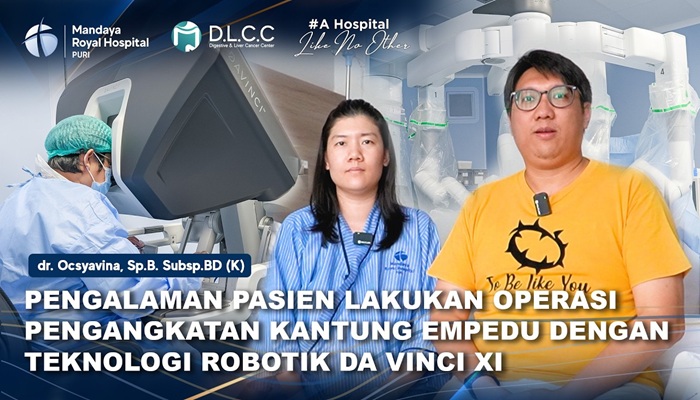
One of the patients who underwent gallbladder removal surgery due to gallstones was Monica Silvia, a 32-year-old woman from Lampung. Monica underwent the procedure with the assistance of the Da Vinci Xi surgical robot at Mandaya Royal Hospital Puri, together with dr. Ocsyavina, Sp.B. Subsp.BD (K), a digestive surgery subspecialist. After the surgery, the patient shared her recovery experience on the third day following the procedure.
“It’s the third day after the surgery, and I’m feeling better. Although there is still some pain, overall, I’m doing okay. There haven’t really been any major problems. I just need to take pain medication. Other than that, everything else is fine. I was already able to walk from the first day after the surgery, and I could walk around,” the patient said, accompanied by her husband.

Contents
Gallstones grew larger and symptoms became more frequent
Before undergoing surgery at Mandaya Royal Hospital Puri, the patient had already known that she had gallstones since 2023. At that time, an ultrasound examination in Lampung showed a stone in her gallbladder. Although the stone was still relatively small, it had already caused significant symptoms, including yellowing of the patient’s body.
The examination at the time also showed an infection in the neck of the gallbladder, which is located along the pathway leading toward the liver. However, because she was still afraid of undergoing surgery, Monica decided to postpone the procedure and tried to manage her condition with herbal treatment instead. Her symptoms subsequently subsided for a while and only appeared occasionally over the next few years.
The symptoms experienced by the patient usually included pain in the abdominal area that could radiate to the back. The pain also frequently occurred at night. By early 2026, the symptoms had become more frequent, sometimes occurring almost every night or at least several times a week.
The patient and her husband then decided to undergo another examination. The latest examination showed that the gallstone, which had previously been small, had grown to approximately 1.5 cm. The condition was also accompanied by inflammation, so a digestive surgeon in Lampung recommended removing the gallbladder. After receiving recommendations from family members, friends, and doctors, they chose Mandaya Royal Hospital Puri as the place to undergo the procedure.
Before the procedure, Monica was also given an explanation of the available surgical options, including conventional laparoscopic surgery and robotic-assisted laparoscopy. After discussing the options with her doctor, the procedure was performed using the Da Vinci Xi surgical robot together with dr. Ocsyavina.
The decision to undergo surgery was not easy for the patient. As it was her first surgical experience, she initially felt afraid, especially because she had been worried about surgery since first discovering her gallstones in 2023. However, as her symptoms became more frequent and the gallstone grew larger, Monica eventually felt ready to undergo the procedure.
Read also: Kolesistektomi (Operasi Batu Empedu): Prosedur dan Efek Samping
On the third day after surgery, the patient was already able to move around
After undergoing gallbladder removal surgery with the assistance of the Da Vinci Xi surgical robot, Monica entered her third day of recovery with her condition continuing to improve. She still experienced some pain, but overall, it no longer caused significant discomfort and could be managed with pain medication.
One of the things she noticed was that she was already able to walk starting from the first day after surgery. She could even get out of bed and walk around. The abdominal pain that previously often radiated toward her back was also no longer present after the procedure.
See also: Operasi Pengangkatan Kantung Empedu Dengan Teknologi Robotik Da Vinci XI | RS Mandaya
During her recovery, Monica also began adjusting her diet. For the time being, she reduced her intake of fatty foods as part of the adjustment process after surgery. Aside from this dietary adjustment, she did not experience any particular restrictions that interfered with her daily activities.
Her experience receiving care at Mandaya Royal Hospital Puri also became an important part of the impression Monica and her husband had after the surgery. They felt that communication with the doctor and medical team was clear, while the nurses were responsive in assisting with the patient’s needs. The hospital facilities were also one of the factors that contributed to their comfort during treatment.
For Monica and her husband, the decision to undergo surgery after postponing it for several years ultimately resulted in a relatively smooth recovery experience. The gallstone condition that she had previously been worried about could eventually be treated with the support of robotic technology and the medical team at Mandaya Royal Hospital Puri.
Read also: Batu Empedu, Harus Ke Dokter Spesialis Apa di RS Mandaya Puri?
Be aware of the symptoms of gallstones
Gallstones generally do not cause symptoms if they do not block the bile ducts. However, when a blockage occurs, several symptoms may develop, including:
- Pain in the upper abdomen, which may come and go or persist continuously.
- Nausea, which may occur along with abdominal pain.
- Sweating.
- Fever.
- A faster heart rate.
- A swollen and tender abdomen.
- Yellowing of the skin and the whites of the eyes.
- Dark-colored urine.
- Pale-colored stools.
If these symptoms occur repeatedly or become more severe, you should see a doctor to determine the underlying cause and receive appropriate treatment.
Why may gallbladder removal surgery be necessary for gallstones?
In some cases, gallstones are not only discovered during an examination but have already caused symptoms or complications. If gallstones cause severe or recurring abdominal pain, a doctor may consider gallbladder removal surgery, or cholecystectomy, as one of the treatment options.
Surgery may also be necessary when gallstones block the bile ducts, which are small ducts connecting the gallbladder to the liver. This blockage can cause bile to build up and may lead to several conditions, such as:
- Yellowing of the skin and whites of the eyes (jaundice).
- Inflammation of the gallbladder.
- Abdominal pain that becomes more frequent or severe.
Therefore, when gallstones have caused symptoms or complications, a doctor needs to evaluate the condition to determine the most appropriate treatment, including whether gallbladder removal surgery should be considered.
Can you live normally after gallbladder removal?
Although the gallbladder plays a role in digestion, a person can still live a normal and healthy life without a gallbladder. The body will adapt after the gallbladder is removed, while bile can still help with digestion, allowing most types of food to be consumed.
However, adjustments to diet and lifestyle, along with appropriate care after surgery, are still important to help maintain overall health and support recovery following cholecystectomy.
Consult dr. Ocsyavina at Mandaya Royal Hospital Puri about your gallstone condition
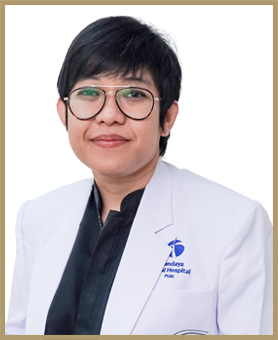
dr. Ocsyavina, Sp.B. Subsp.BD (K) is a general surgeon with a subspecialization in digestive surgery. She completed her medical education at Universitas Padjadjaran Bandung before continuing her General Surgery and Digestive Surgery subspecialty training at Universitas Indonesia.
In her practice, dr. Ocsyavina, Sp.B. Subsp.BD (K) provides a range of digestive surgery services and procedures, including digestive surgery consultations, endoscopy, gastroscopy, colonoscopy, laparoscopic and open gallbladder removal surgery, gastric bypass surgery, hemorrhoid surgery, hernia surgery, colorectal cancer surgery, stomach surgery, intestinal adhesions, intestinal polyps, hernia treatment, and laparoscopic appendectomy.
dr. Ocsyavina, Sp.B. Subsp.BD (K) is available for consultation at Mandaya Royal Hospital Puri on:
- Monday: 16.00 – 18.00 WIB
- Tuesday: 16.00 – 18.00 WIB
- Wednesday: 16.00 – 18.00 WIB
- Thursday: 16.00 – 18.00 WIB
- Friday: 16.00 – 18.00 WIB
- Saturday: 10.00 – 12.00 WIB.
To make your visit to Mandaya Royal Hospital Puri more convenient, you can use the Chat via WhatsApp, Book Appointment, or the Care Dokter app, which can be downloaded from Google Play and the App Store. The app can help you manage your visit, check your queue number, and access other information.
*The information provided on this page is intended for educational purposes and provides a general overview. It does not represent the full range of medical services that may be performed by each doctor. To determine the appropriate treatment for your specific health condition, consultation with the relevant doctor is recommended.
If you have any questions, suggestions, or require further information, please contact our call center at 0811-1900-2000.

References:
- Mayo Clinic. Cholecystectomy (gallbladder removal). (https://www.mayoclinic.org/tests-procedures/cholecystectomy/about/pac-20384818). Accessed September 30, 2026.
- Cleveland Clinic. Gallstones. (https://my.clevelandclinic.org/health/diseases/7313-gallstones). Accessed September 30, 2026.
- NHS. Why it’s done – Gallbladder removal. (https://www.nhs.uk/tests-and-treatments/gallbladder-removal/why-its-done/). Accessed September 30, 2026.
- Gallbladder Singapore. Living Without a Gallbladder. (https://www.gallbladder.sg/blog/living-without-a-gallbladder/). Accessed September 30, 2026.