


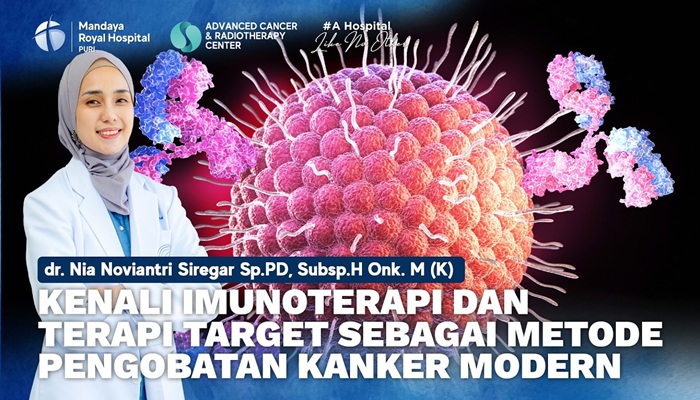
Cancer treatment continues to evolve over time. While chemotherapy was once the most commonly used systemic therapy for various types of cancer, there are now more specific treatment options available, such as targeted therapy and immunotherapy. The emergence of these therapies has opened the door to more personalized cancer treatment based on each patient’s condition and the characteristics of their cancer.
According to dr. Nia Noviantri Siregar, Sp.PD, Subsp.H Onk. M(K), a hematology-oncology medical consultant at Mandaya Royal Hospital Puri, chemotherapy is still widely used today because it remains effective for many types of cancer. However, chemotherapy is also known for causing significant side effects because it attacks rapidly growing cells, including some healthy cells in the body.
For this reason, researchers continue to develop more specific cancer therapies to minimize side effects. This led to the development of targeted therapy and immunotherapy, which are now increasingly used in modern cancer treatment.

Contents
What Are Targeted Therapy and Immunotherapy?
Below is dr. Nia’s explanation regarding targeted therapy and immunotherapy:
-
Targeted Therapy
According to dr. Nia, targeted therapy is a cancer treatment designed to work specifically against certain signals or mechanisms found in cancer cells.
Unlike chemotherapy, which attacks cells broadly, targeted therapy is designed to recognize specific targets on cancer cells, such as hormone receptors or certain genetic mutations. Because it is more specific, this therapy generally works in a more focused manner compared to conventional chemotherapy.
For example, in breast cancer, if examination results show that the cancer is dominated by hormone receptors or HER-2, patients may receive hormone therapy or anti-HER-2 therapy as a form of targeted therapy.
Additionally, in lung cancer with positive EGFR mutations, the primary treatment usually involves anti-EGFR medication. In such conditions, chemotherapy may still be used, but it is no longer considered the first-line treatment.
According to dr. Nia, if doctors already understand the signaling mechanisms underlying cancer growth and an appropriate medication is available, targeted therapy becomes a treatment option worth considering. In some cases, targeted therapy may also be combined with chemotherapy to improve treatment outcomes.
-
Immunotherapy
In addition to targeted therapy, immunotherapy is another treatment approach that is rapidly advancing in cancer care.
While targeted therapy and chemotherapy use medications that directly attack cancer cells, immunotherapy works differently. According to dr. Nia, immunotherapy aims to reactivate the patient’s immune system so it can recognize and fight cancer cells.
Cancer cells are known to have the ability to “trick” the body’s immune system. Naturally, the immune system should recognize cancer as a foreign threat and destroy it. However, cancer cells can interfere with the immune response, causing the immune system to fail to recognize their presence and preventing the body from mounting an effective defense.
“Cancer cells are very smart. Not only can they spread throughout the body, but they can also make the patient’s immune system fail to recognize them as foreign objects. Cancer is supposed to be seen as a foreign object, so our immune system should destroy it. But because cancer has many receptors, it affects our immune system and causes it to stay silent,” explained dr. Nia.
“The purpose of immunotherapy is to reactivate the immune system so it can recognize cancer as an enemy and a foreign object. That way, the immune system can attack and destroy cancer cells,” she added.
Although promising, immunotherapy cannot be given to all cancer patients. According to dr. Nia, there are specific requirements that must be evaluated before a patient can undergo immunotherapy.
Doctors usually check whether there are certain receptors that can become targets for immunotherapy, such as PD-1 or PD-L1. This examination is important to determine whether immunotherapy is likely to provide benefits for the patient.
If the test results show that these receptors are negative, immunotherapy may not provide optimal results. Therefore, cancer treatment selection must be personalized according to the patient’s condition and the characteristics of their cancer cells.
Read also: Understanding Chemotherapy from the Perspective of KHOM Specialist dr. Nia Sp.PD, Subsp.H Onk. M(K) at Mandaya Royal Hospital Puri
The Importance of Choosing the Right Cancer Treatment
Cancer treatment cannot be standardized for every patient. The type of cancer, disease stage, genetic mutations, specific receptors, and the patient’s overall condition are all important factors in determining the most suitable treatment.
For this reason, cancer patients usually require detailed examinations before treatment begins. These examinations help doctors understand the specific characteristics of the cancer so the chosen therapy can work more effectively.
With a more personalized approach, cancer treatment is expected not only to improve treatment effectiveness but also to help maintain the patient’s quality of life throughout therapy.
dr. Nia’s Profile, Expertise, and Practice Schedule at Mandaya Royal Hospital Puri

dr. Nia Noviantri Siregar, Sp.PD, Subsp.H Onk. M(K) is an internal medicine specialist with a subspecialty in hematology and medical oncology at Mandaya Royal Hospital Puri. She has extensive experience in treating various types of cancer through systemic therapies, including chemotherapy, targeted therapy, and immunotherapy.
A graduate of the Internal Medicine Specialist Program at the University of Indonesia, dr. Nia is also an active member of the Indonesian Medical Association (IDI) and the Indonesian Society of Internal Medicine (PAPDI).
For those who wish to consult regarding cancer treatment, including chemotherapy and other systemic therapies, dr. Nia is available for consultation at Mandaya Royal Hospital Puri.
dr. Nia Noviantri Siregar, Sp.PD, Subsp.H Onk. M(K) practices at Mandaya Royal Hospital Puri on:
- Tuesday: 3:00 PM – 6:00 PM WIB
- Friday: 5:00 PM – 8:00 PM WIB
To make your visit to Mandaya Royal Hospital Puri easier, use the WhatsApp Chat feature, Book Appointment service, or the Care Dokter application available on Google Play and the App Store to simplify your visit, check queue numbers, and access other complete information.
The information provided on this page is intended for educational and general informational purposes only and does not represent the full range of medical services that may be provided by each doctor. To ensure treatment that is appropriate for your condition, direct consultation with the relevant doctor is recommended.
If you have questions, suggestions, or need further information, please contact our call center at 0811-1900-2000.