



Thalassemia is a group of inherited blood disorders passed from parents to their children. The condition affects the body’s ability to produce hemoglobin, the protein in red blood cells responsible for carrying oxygen throughout the body. As a result, individuals with thalassemia may develop anemia of varying severity, ranging from mild to severe, and may be at risk of developing complications if not treated appropriately.
Because thalassemia is a complex condition that can affect a child’s growth and development, it should be managed by a physician with expertise in pediatric blood disorders. A pediatric hematology-oncology specialist has the expertise to diagnose, monitor, and treat children with thalassemia, including determining the most appropriate treatment based on the type and severity of the disease.
One recommended pediatric thalassemia specialist is dr. Ludi Dhyani Rahmartani, Sp.A, Subsp. H.Onk (K), who practices at Mandaya Royal Hospital Puri. As a pediatric hematology-oncology consultant, dr. Ludi has extensive experience in treating various blood disorders in children, including thalassemia, providing comprehensive care tailored to each patient’s condition.

Contents
Recommended Pediatric Thalassemia Specialist at Mandaya Royal Hospital Puri
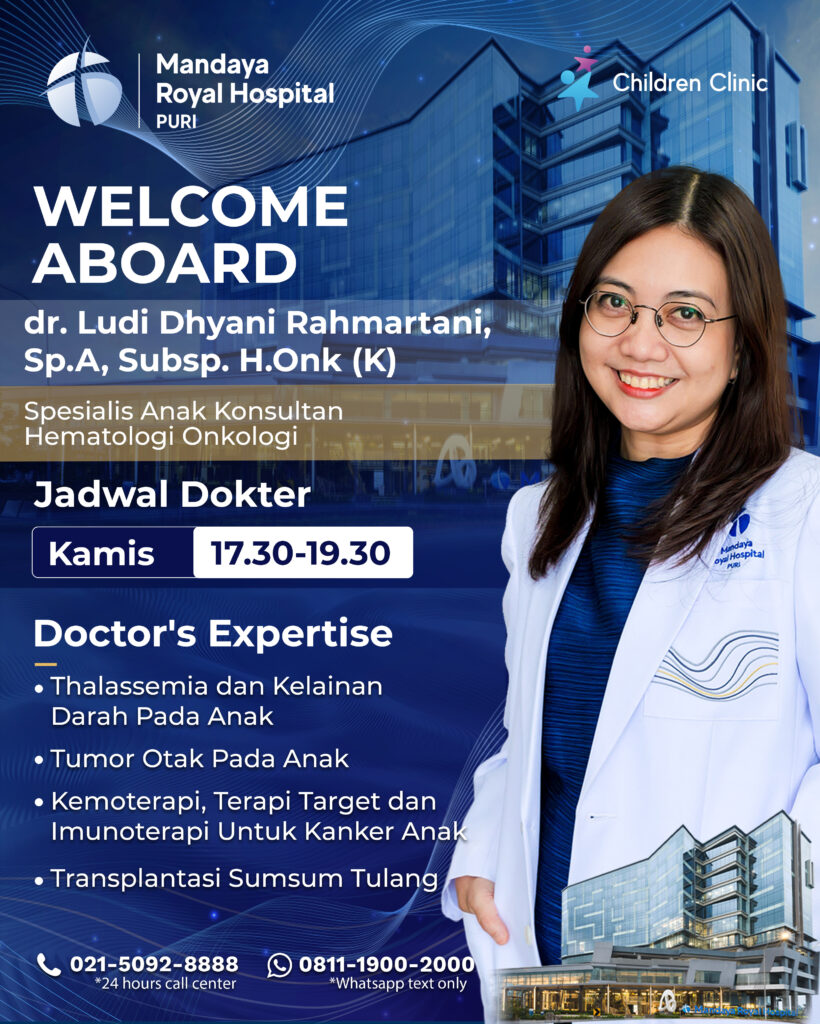
If you are looking for a pediatric thalassemia specialist, dr. Ludi Dhyani Rahmartani, Sp.A, Subsp. H.Onk (K) is one of the recommended physicians at Mandaya Royal Hospital Puri. She is a pediatric hematology-oncology consultant with expertise in diagnosing and managing a wide range of pediatric blood disorders, including thalassemia. In addition to establishing the diagnosis and recommending appropriate treatment, dr. Ludi also provides long-term follow-up care to help minimize the risk of complications.
dr. Ludi earned her medical degree from the University of Indonesia in 2002. She later completed her Pediatric Residency at the University of Indonesia in 2015. To further specialize in pediatric blood disorders and childhood cancers, she pursued a Pediatric Hematology-Oncology Fellowship at the same university, graduating in 2021.
In addition to treating thalassemia, dr. Ludi has expertise in managing various pediatric hematology and oncology conditions, including:
- Thalassemia and other pediatric blood disorders.
- Pediatric brain tumors.
- Chemotherapy, targeted therapy, and immunotherapy for childhood cancers.
- Bone marrow transplantation.
Pediatric Thalassemia Specialist Schedule at Mandaya Royal Hospital Puri
dr. Ludi Dhyani Rahmartani, Sp.A, Subsp. H.Onk (K) practices at Mandaya Royal Hospital Puri with the following schedule:
- Thursday: 5:30 PM – 7:30 PM
Understanding the Types of Thalassemia
Before determining the appropriate treatment, the doctor will first identify the type of thalassemia affecting the patient. This is important because each type has different levels of severity and treatment requirements.
1. Alpha Thalassemia
Alpha thalassemia occurs when there are abnormalities in the genes responsible for producing alpha-globin chains. Every individual has four alpha-globin genes, so symptoms depend on how many genes are affected.
- One abnormal or missing gene: Usually causes no symptoms, so affected individuals are often unaware they carry the condition. This is known as alpha thalassemia minima.
- Two abnormal or missing genes: Patients typically experience mild symptoms or may remain asymptomatic. This is called alpha thalassemia minor.
- Three abnormal or missing genes: This type can cause moderate to severe anemia and is known as Hemoglobin H disease.
- Four abnormal or missing genes: This is the most severe form of alpha thalassemia. It often results in fetal death before or shortly after birth. If the infant survives, lifelong regular blood transfusions are generally required. This condition is known as Hydrops Fetalis with Hemoglobin Barts.
2. Beta Thalassemia
Beta thalassemia is caused by mutations in the genes responsible for producing beta-globin chains. Since there are only two beta-globin genes, disease severity depends on the number of affected genes and the characteristics of the mutation.
- One abnormal or missing gene: Most patients have mild symptoms or no symptoms at all. This condition is known as beta thalassemia trait or beta thalassemia minor.
- Two abnormal or missing genes: Patients generally experience moderate to severe anemia. Based on transfusion requirements, this condition is classified into:
- Transfusion-dependent thalassemia (TDT): Requires regular blood transfusions.
- Non-transfusion-dependent thalassemia (NTDT): Does not require regular transfusions but may need them under certain circumstances.
It is important to note that transfusion requirements may change over time. Patients who initially do not require regular transfusions may eventually need them if their clinical condition worsens.
Thalassemia Treatment Options Recommended by Doctors
Treatment for thalassemia depends on the type of the disease, its severity, the patient’s age, and overall health condition. Some of the treatment options include:
1. Blood Transfusions
Blood transfusions are the primary treatment for patients with severe thalassemia, particularly those with transfusion-dependent thalassemia (TDT) and certain severe cases of alpha thalassemia. Patients with Hemoglobin H disease or NTDT generally require transfusions only under specific circumstances, such as during infections or when hemoglobin levels drop significantly.
2. Iron Chelation Therapy
Patients receiving regular blood transfusions are at risk of iron overload. If left untreated, excess iron can damage vital organs such as the heart and liver. Doctors may prescribe iron chelation therapy to remove excess iron from the body.
3. Folic Acid Supplements
Folic acid plays an important role in red blood cell production. In some patients with thalassemia, doctors may recommend folic acid supplementation to support healthy red blood cell formation.
4. Medications to Treat Anemia
In addition to blood transfusions, certain medications may help manage anemia in selected patients with thalassemia. Examples include luspatercept and mitapivat, which are approved for specific indications in adult patients. Luspatercept has also been shown to reduce transfusion requirements in some patients.
5. Splenectomy (Surgical Removal of the Spleen)
In certain cases, doctors may recommend a splenectomy. This procedure can help reduce symptoms and decrease the frequency of blood transfusions in appropriately selected patients.
6. Stem Cell Transplantation
Stem cell transplantation is currently the only treatment with the potential to cure thalassemia. The procedure replaces abnormal blood-forming stem cells with healthy stem cells from a compatible donor. However, because stem cell transplantation carries significant risks, it is only recommended for carefully selected patients after thorough medical evaluation.
Recognizing the Signs and Symptoms of Thalassemia in Children
Children with mild thalassemia may not experience any symptoms. However, children with more severe forms may develop the following signs and symptoms:
- Very pale skin (pallor) or yellowing of the skin and whites of the eyes (jaundice).
- Enlarged abdomen due to an enlarged spleen and/or liver.
- Prominent facial bones, particularly the cheekbones and forehead.
- Growth delay, causing height and weight to fall below expected levels for age.
- Fatigue or reduced tolerance for physical activities, including playing and exercising.
- Heart murmur, an abnormal heart sound caused by anemia.
To make your visit to Mandaya Royal Hospital Puri more convenient, you can use the Chat via WhatsApp feature, Book Appointment, or download the Care Dokter app from Google Play or the App Store to schedule appointments, monitor your queue number, and access other useful information.
The information provided on this page is intended for educational and general informational purposes only. It does not represent the full scope of medical services provided by each physician. To receive the most appropriate treatment based on your health condition, please consult the respective doctor directly.
If you have any questions, suggestions, or require further information, please contact our call center at 0811-1900-2000.

References
- Ministry of Health of the Republic of Indonesia. Thalassemia. (https://ayosehat.kemkes.go.id/topik-penyakit/ptm-lainnya/thalassemia). Accessed July 29, 2026.
- LIV Hospital. What Doctors Deal with Thalassemia? (https://int.livhospital.com/what-doctors-deal-with-thalassemia/). Accessed July 29, 2026.
- Cleveland Clinic. Thalassemias. (https://my.clevelandclinic.org/health/diseases/14508-thalassemias). Last updated March 12, 2024. Accessed July 29, 2026.
- Children’s Health. Thalassemia. (https://www.childrens.com/specialties-services/conditions/thalassemia). Accessed July 29, 2026.