



Uterine fibroids are among the most common gynecological conditions affecting women. They can cause a variety of symptoms, including heavy menstrual bleeding, pelvic pain, frequent urination, and even difficulty conceiving. For many years, surgery was considered one of the primary treatment options for fibroids. However, advances in medical technology have introduced a less invasive alternative known as High-Intensity Focused Ultrasound (HIFU).
Many fibroid patients have shared positive outcomes after undergoing HIFU treatment at Mandaya Royal Hospital Puri. Thanks to this technology, numerous patients have successfully reduced the size of their fibroids without surgery, preserved their uterus, and returned to their daily activities with a shorter recovery period. Some patients who previously struggled with fertility issues are now able to focus on achieving pregnancy after receiving appropriate treatment.

Contents
What Is HIFU?
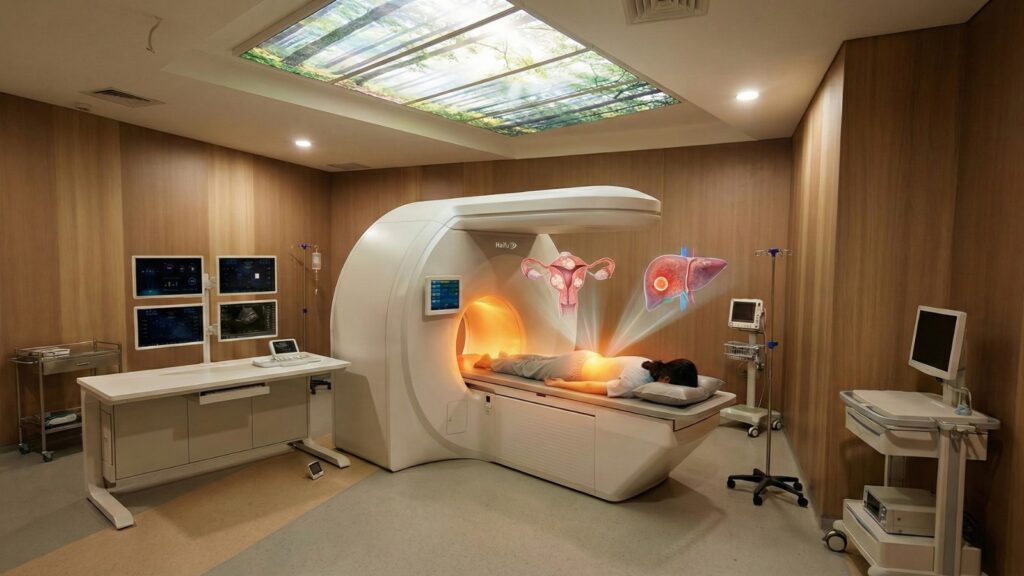
High-Intensity Focused Ultrasound (HIFU) is a non-surgical medical technology used to treat uterine fibroids without the need for incisions or surgery. The procedure utilizes high-intensity ultrasound waves that are precisely directed from outside the body toward fibroid tissue inside the uterus. This focused energy generates heat at the targeted area, destroying fibroid cells while preserving the surrounding healthy tissue.
HIFU works by concentrating ultrasound energy on a specific fibroid identified through imaging guidance. When the energy converges on the target area, the temperature rises and causes controlled tissue destruction (ablation). As a result, fibroid cells die and gradually shrink over time while the surrounding normal tissue remains intact.
Due to its high level of precision, HIFU has become an effective treatment option for benign uterine fibroids without surgery. In addition, the procedure offers a faster recovery period compared to conventional surgical approaches.
Patient Experiences with HIFU Treatment at Mandaya Royal Hospital Puri
Here are several stories from patients who have undergone HIFU treatment at Mandaya Royal Hospital Puri:
1. Choosing HIFU to Avoid Hysterectomy
Angela, a 40-year-old patient from Jakarta, visited Mandaya Royal Hospital Puri with complaints of prolonged menstrual bleeding lasting more than 20 days. After undergoing evaluation, she was diagnosed with uterine fibroids and adenomyosis, with the fibroid measuring approximately 6–7 cm.
In cases like this, hysterectomy is often considered one of the treatment options. However, for women who still wish to have children in the future, such a procedure requires careful consideration.
After assessing her condition, dr. Edward Tony Ngantung, Sp.OG, recommended HIFU as an alternative treatment. This technology destroys fibroid tissue using high-intensity ultrasound waves without surgery or incisions, allowing the uterus to be preserved.
“I decided to choose HIFU because I wanted to avoid having my uterus removed. I still plan to try for another pregnancy in the future, so I felt that HIFU was the best decision for me,” said the patient.
Post-treatment evaluation showed that approximately 80–90% of the fibroid tissue had been successfully ablated, demonstrating HIFU’s ability to significantly reduce fibroid size without surgery.
2. Avoiding Total Hysterectomy Through HIFU
A similar experience was shared by Mrs. Elli from Klaten, who chose to undergo non-surgical fibroid treatment using HIFU at Mandaya Royal Hospital Puri under the care of dr. Gracia Merryane R.G. Rauw, Sp.OG.
Prior to discovering HIFU, Mrs. Elli had been advised to undergo a hysterectomy. After exploring alternative treatment options, she found a less invasive solution through HIFU.
According to Mrs. Elli, choosing HIFU was the best decision she could make. By preserving her uterus, she could continue experiencing menopause naturally rather than having it induced by hysterectomy.
“This was the best decision for me because I want to go through menopause naturally. I don’t want that right to be taken away from me,” she said.
One of the greatest benefits she experienced was the ease of recovery. Since there were no surgical wounds, she was able to resume her daily activities without having to care for post-operative incisions.
“The best part after the procedure is that I was free to return to my daily activities right away because I didn’t have any external surgical wounds that needed care,” she added.
3. After Recurrent Miscarriages Caused by Fibroids, She Can Now Pursue Pregnancy Again
Fibroids can affect fertility and increase the risk of recurrent miscarriage. This was the case for one patient who experienced multiple pregnancy losses before discovering that the underlying cause was a fibroid located in a particularly difficult area to access through conventional surgery.
The fibroid was located at the back of the uterus (posterior wall) and had adhered to the intestine. This complex location made surgery highly risky. Approaching the fibroid from above could potentially damage the uterine wall, while approaching it from behind carried the risk of injuring the attached intestine.
“Because of the location of the fibroid, it was actually difficult to remove through laparoscopy. The fibroid was located at the back of the uterus and had already adhered to the intestine. Approaching it from the top could potentially damage the uterine wall, while approaching it from behind carried the risk of injuring the intestine. At first, I felt devastated and wondered whether it could even be treated. Then I found out about HIFU, and it truly helped me. Everything went smoothly, and I believe it was God’s way of making this possible,” said the patient.
Thanks to HIFU, the patient was able to undergo treatment without surgery. Remarkably, she was able to get out of bed, walk normally, and return home the day after the procedure.
According to dr. Edward, if recovery continues as expected, the patient may begin a fertility program approximately 3–6 months after treatment.
4. After 10 Years of Infertility Due to Adenomyosis, the Patient Underwent HIFU
In addition to fibroid treatment, HIFU at Mandaya Royal Hospital Puri can also be used to treat adenomyosis, a condition in which the tissue that normally lines the uterus grows into the muscular wall of the uterus.
One patient treated by dr. Rahmadsyah, Sp.OG(K)FER, M.Kes, MARS, a fertility consultant OB-GYN at Mandaya Royal Hospital Puri, had adenomyosis measuring 6.2 cm that had affected her fertility for many years. She had struggled to conceive due to the condition.
Following HIFU treatment, evaluation showed that the adenomyosis had decreased in size to approximately 4.8 cm. In addition, the tissue demonstrated an 80–90% necrosis rate, indicating an excellent treatment response.
With her condition improving, the patient is now preparing to undergo a fertility program. She is expected to begin trying to conceive approximately 3–4 months after treatment under the guidance of dr. Rahmadsyah.
5. A 5 cm Adenomyosis Successfully Treated with HIFU, Patient Discharged the Next Day
Another positive experience comes from Mrs. Egha, a patient from Jakarta who suffered from severe menstrual pain that significantly affected her daily activities. Following examination, she was diagnosed with adenomyosis measuring approximately 5 cm.
To address her condition, Mrs. Egha chose to undergo HIFU treatment with dr. Gracia Merryane R.G. Rauw, Sp.OG at Mandaya Royal Hospital Puri. The procedure was performed without open surgery or incisions, allowing for a much quicker recovery.
As a result, her condition improved significantly, and she was discharged just one day after the procedure. Being able to return to normal activities in a short period was one of the most noticeable benefits she experienced.
“By the day after the procedure, I was already feeling much better and was even able to go home. I was admitted on Monday afternoon, had the procedure on Tuesday, and was discharged on Wednesday. I felt well enough to resume my normal activities, could shower by myself, and was able to walk just a few hours after the procedure,” said the patient.
How Does HIFU Work for Fibroids and Adenomyosis?
HIFU works through the following process:
1. Focused Ultrasound Targets the Treatment Area
High-intensity ultrasound energy is precisely directed toward fibroid or adenomyosis tissue identified through imaging guidance.
2. Heat Is Generated Within the Target Tissue
As the ultrasound energy reaches the target area, it is converted into heat, creating a highly concentrated high-temperature zone.
3. Destruction of Abnormal Cells
The generated heat causes coagulative necrosis, destroying fibroid and adenomyosis tissue without requiring surgery.
4. Healthy Tissue Remains Protected
Because the ultrasound energy is highly focused, healthy uterine tissue surrounding the target area remains unharmed.
5. The Body Naturally Absorbs the Treated Tissue
After treatment, the destroyed fibroid or adenomyosis tissue is gradually absorbed by the body. Over time, the lesion shrinks and symptoms improve.
Benefits of HIFU for Fibroid and Adenomyosis Treatment
HIFU has become an increasingly popular treatment option for fibroids and adenomyosis because it offers several advantages:
- No incisions or surgery required
- Lower risk of infection compared to conventional surgical procedures
- No radiation exposure, as the treatment uses focused ultrasound waves
- No need for general anesthesia; the procedure is typically performed under light sedation or pain management protocols
- Helps preserve the uterus, making it a suitable option for women who wish to maintain fertility or plan future pregnancies
- High precision through advanced imaging guidance
- Faster recovery, allowing most patients to return to normal activities sooner
- Minimal pain and bleeding because no surgical incision or tissue removal is involved
To make your visit to Mandaya Royal Hospital Puri more convenient, you can use the WhatsApp Chat feature, Book Appointment service, or the Care Dokter application available on Google Play and the App Store. These services allow you to schedule appointments, view queue numbers, and access other useful information.