


A pinched nerve in the lower back can cause pain severe enough to disrupt daily activities. This condition occurs when a nerve experiences pressure from surrounding tissue, such as bone, ligaments, or muscle. As a result, sufferers may experience pain radiating to the buttocks or legs, tingling, numbness, and even weakness in the limbs.

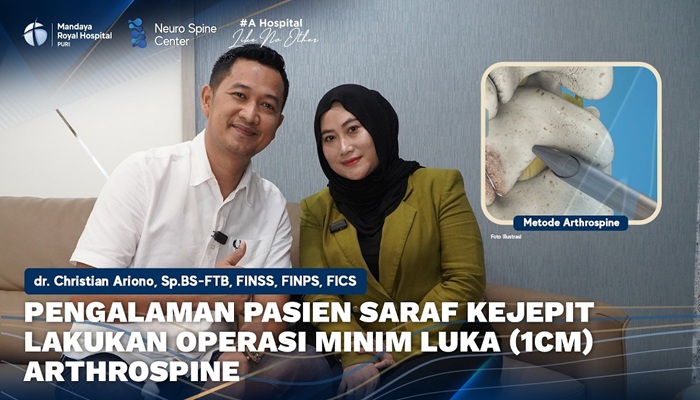
These were the complaints experienced by a 44-year-old patient from Karawaci, Tangerang City, after sustaining an injury from a fall. To treat her pinched nerve, the patient underwent an arthrospine procedure with dr. Christian Ariono, Sp.BS-FTB, FINSS, FINPS, FICS, a neurosurgeon at RS Mandaya Royal Puri. As a result, shortly after the surgery her condition gradually improved, and she was already able to sit and walk again.
“Right after I came out of surgery, the pain was gone immediately. The numbness was gone too — basically everything that hurt, right after coming out of surgery I felt fine right away, all the pain just disappeared,” said the patient. “As soon as she woke up (from general anesthesia after the surgery), she could sit and walk right away,” her husband added.

Contents
Back pain worsened, patient finally underwent arthrospine at RS Mandaya Puri
This patient sustained an injury after a fall. At first she did not feel any complaints, but about two months later, pain began to appear in her lower back. Over time, the pain grew worse, especially during the fasting month. The pain, which initially was only felt in the lower back, turned into a stabbing, electric-shock-like sensation, and even radiated to the point of making it difficult for her to move. Her condition continued to worsen until she had to be rushed to the hospital and underwent an MRI examination. The results showed a pinched nerve, and the doctor at the time recommended surgery.
Even so, the patient and her family did not immediately make a decision. They chose to undergo physiotherapy and conservative treatment for about a month. However, her condition actually got worse. The pain intensified, the right side of her body began to go numb from the lower back down to the leg, and she even had to crawl and search for the most comfortable position just to get up from bed. The family had considered taking the patient for treatment in Singapore because they were worried about the risks of neurosurgery.
Before leaving for treatment abroad, a colleague suggested that the patient consult with dr. Christian Ariono, Sp.BS-FTB, FINSS, FINPS, FICS at RS Mandaya Royal Puri. After undergoing another examination, the MRI results showed the same findings. However, dr. Christian’s explanation regarding the cause of her complaints, the treatment options, and the risks and benefits of surgery made the patient and her family feel more confident about undergoing treatment at Mandaya.
The patient then underwent the arthrospine procedure using an endoscopic technique. The results were felt immediately after the surgery. As soon as the effects of the anesthesia wore off, the patient was already able to learn to sit and walk. The severe pain she had previously felt disappeared right away, as did the numbness in her legs. During post-operative follow-ups, her condition continued to improve, so that she no longer needed to come to the hospital frequently and could simply consult with dr. Christian via WhatsApp if she had any complaints. Thanks to her experience, the patient said she would not hesitate to recommend RS Mandaya Royal Puri to relatives experiencing pinched nerve problems.
What is arthrospine and how does it work?
Arthrospine is a minimally invasive spinal surgery method used to treat pinched nerves (herniated nucleus pulposus/HNP) as well as various other spinal disorders.
This procedure is performed through a very small incision, about 1.5–2 cm, with the help of an endoscopic camera and specialized surgical instruments. Thanks to this technology, the doctor can perform the procedure more precisely, minimize damage to the tissue around the nerve, and help speed up the patient’s recovery process.
In the arthrospine procedure, the doctor carries out the following steps:
- Making a small incision of about 1.5–2 cm in the area to be treated.
- Inserting a special sleeve as a pathway for the endoscopic camera and specialized surgical instruments.
- Using an endoscopic camera that displays the condition inside the body in real time on a monitor screen.
- Releasing the pinched nerve or removing the protruding disc with a high level of precision, without needing to make a large incision.
Advantages of arthrospine in treating pinched nerves
Compared to conventional spinal surgery, arthrospine offers a number of advantages, including:
- A smaller incision, only about 1.5–2 cm, resulting in a more minimal surgical scar.
- Faster recovery, since damage to the muscles and tissue around the spine is much less.
- Lower risk of complications, including the risk of bleeding, infection, and post-operative pain.
- Higher precision thanks to the use of an endoscopic camera, which helps the doctor see the nerve area directly and perform the procedure more accurately.
When should you get a pinched nerve checked immediately?
A pinched nerve should not be treated as an ordinary complaint. Pain, tingling, or numbness that appears is a sign that a nerve is under pressure. If these symptoms do not improve after initial treatment or continue for several days, you should consult a doctor promptly so the cause can be identified and treated as early as possible.
The following conditions are also signs that a sufferer needs immediate medical attention, among others:
- Loss of bladder or bowel control due to a pinched nerve.
- Weakness in the hand making it difficult to grip objects or causing frequent dropping of items.
- The arm or leg suddenly losing strength, making it difficult to use for supporting the body or walking.
To determine the location and severity of the pinched nerve, a doctor may recommend a number of supporting examinations, such as an MRI, CT scan, or electromyography (EMG). Based on the results of these examinations, the doctor will determine the most appropriate therapy, ranging from medication, physiotherapy, and injections, to surgery if the condition is severe or does not improve with conservative therapy.
Consult about pinched nerve treatment with dr. Christian Ariono at RS Mandaya Royal Puri

dr. Christian Ariono, Sp.BS-FTB, FINSS, FINPS, FICS is a neurosurgeon at RS Mandaya Royal Puri, experienced in treating various conditions of the brain, spine, and peripheral nerves, including pinched nerves using minimally invasive surgical techniques. He completed his medical education at the Faculty of Medicine, Padjadjaran University, and then continued his neurosurgery specialist education at the same university.
To continue keeping up with developments in modern neurosurgery, dr. Christian actively participates in various training programs and scientific forums, including the Aesculap Academy & Padjadjaran University Skullbase Cadaver Dissection Resident Course & Cerebrovascular Microanastomosis Course, the Trigeminal Neuralgia International Awareness Day Symposium, and the Annual Scientific Meeting of the Indonesian Society of Neurological Surgeons held together with the World Federation of Neurosurgical Societies (WFNS). This experience supports his competency in applying modern, precise, and evidence-based neurosurgical techniques.
For those who wish to consult with dr. Christian Ariono, Sp.BS-FTB, FINSS, FINPS, FICS, he practices at RS Mandaya Royal Puri with the following schedule:
- Monday: 08:00–16:00 WIB
- Tuesday: 08:00–12:00 WIB
- Wednesday: 08:00–16:00 WIB
- Thursday: 08:00–16:00 WIB
- Friday: 08:00–16:00 WIB
- Saturday: 08:00–16:00 WIB
To make your visit to Mandaya Royal Hospital Puri easier, use the WhatsApp Chat feature, Book Appointment, or the Care Dokter app, which can be downloaded on Google Play and the App Store, to make visits easier, check queue numbers, and get other complete information.
The information available on this page is compiled for educational purposes and general illustration, and therefore does not reflect the full range of medical services that each doctor can provide. To ensure treatment appropriate to your health condition, it is recommended that you consult directly with the relevant doctor.
If you have any questions, suggestions, or need further information, please contact our call center at 0811-1900-2000.

References
- University of Utah Health. What to Do for a Pinched Nerve in Your Back. Published November 24, 2023. Accessed July 17, 2026.
- Cleveland Clinic. Pinched Nerve: What It Is, Causes, Symptoms & Treatment. Last revised June 25, 2024. Accessed July 17, 2026.
- Medical News Today. Pinched Nerve: Symptoms, Causes, and Treatment. Last revised January 24, 2024. Accessed July 17, 2026.