


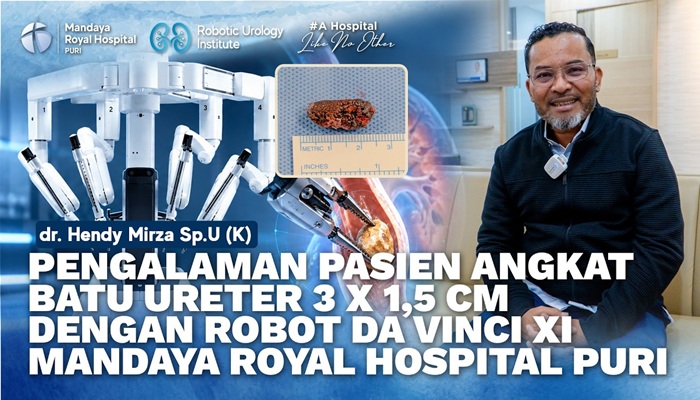
Ureteral stones are formed when crystals, minerals, and salts in the urine accumulate and become lodged in the ureter, the tube that connects the kidney to the bladder. If the stone is large enough, it can obstruct urine flow and cause severe pain. This condition requires appropriate medical treatment to relieve the obstruction and help prevent further complications.

One patient who underwent treatment for a ureteral stone was Jimmy Carter, a patient from Biak Numfor, Papua, who had a ureteral stone measuring 3 x 1.5 cm. He underwent robotic ureteral stone removal using the Da Vinci Xi system at Mandaya Royal Puri Hospital. The procedure was performed by urology consultant dr. Hendy Mirza, Sp.U(K).
“I can assure people that medical treatment in Indonesia is just as good as treatment at hospitals overseas. After the surgery, I experienced very significant improvement and progress. It has been a little over two weeks since the operation. Previously, I felt as though there was a pouch or something heavy on the right side of my back. After the surgery, I feel much lighter,” the patient said.

Contents
From a Medical Check-Up to the Discovery of a Nearly 3 cm Ureteral Stone
Jimmy Carter, a patient from Biak Numfor Regency, Papua, explained that he began paying closer attention to his kidney health in 2024 after being advised to undergo further examinations. At the time, he experienced an unusual sensation in his back, particularly around the right side of his waist. After undergoing a medical check-up, Jimmy discovered that a stone was obstructing his right ureter.
The ureteral stone measured approximately 3 x 1.5 cm. According to a doctor he had previously consulted, the stone was relatively hard. Given its large size compared with the diameter of the ureter, the condition required further treatment. Jimmy then searched for information about hospitals and doctors who could help manage his condition before deciding to consult dr. Hendy at Mandaya Royal Puri Hospital.
During the consultation, Jimmy and dr. Hendy discussed the available treatment options, including laser lithotripsy to break up the stone and surgery using a laparoscopic approach. After considering the doctor’s explanation and reviewing the information he had gathered, Jimmy decided to undergo surgery to remove the ureteral stone.
His decision to seek treatment at Mandaya Royal Puri Hospital was also influenced by information he found on social media and the comfortable consultation experience with dr. Hendy. According to Jimmy, good communication and the doctor’s approach to patients were important parts of the treatment process. He felt more confident about proceeding after discussing the procedure with the doctor and talking through his options with his family.
Read also: Mandaya Royal Puri Hospital Uses the Da Vinci Xi Robot for Heart, Uterine, Prostate, Kidney, Liver, and Intestinal Surgery
Undergoing Da Vinci Xi Robotic Surgery and Experiencing Improvements After the Procedure
To treat the large ureteral stone, Jimmy underwent surgery using the Da Vinci Xi robotic system at Mandaya Royal Puri Hospital. This technology helps surgeons perform procedures with detailed visualization and precise instrument control.
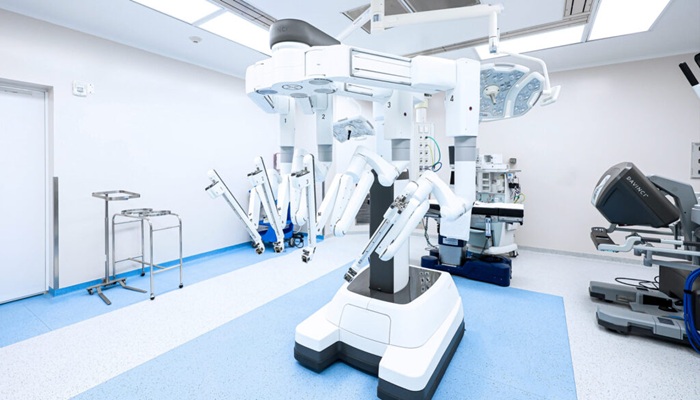
Jimmy explained that the surgery went well and left him with only small incisions. He said this was different from his expectations of conventional surgery, which he had imagined might leave larger scars. He also felt that the procedure was relatively brief.
More than two weeks after the operation, Jimmy noticed significant changes in how he felt. Before the procedure, he had felt as though there were a heavy pouch or object on the right side of his back. After surgery, this sensation had decreased, and he felt much lighter. Jimmy also reported that his urine appeared clear after the procedure.
Following postoperative observation, Jimmy was allowed to resume eating and drinking according to the medical team’s instructions. He also began paying closer attention to his daily habits, including drinking more mineral water and limiting his coffee intake as part of his efforts to maintain kidney health.
Be Aware of Ureteral Stone Symptoms That Can Disrupt Daily Activities
The symptoms of ureteral stones can vary depending on the size of the stone and whether it obstructs urine flow. One of the most common symptoms is severe pain in the back or side of the waist, just below the ribs. The pain may come and go and radiate toward the lower abdomen. This condition can interfere with daily activities, especially when the pain occurs suddenly.
In addition to pain, ureteral stones may cause several other symptoms, including:
- Pain or a burning sensation when urinating.
- Nausea and vomiting.
- Pink, red, or brownish urine due to the presence of blood.
- Cloudy urine.
- A more frequent urge to urinate.
- Passing only small amounts of urine each time.
If a ureteral stone is accompanied by a urinary tract infection, the patient may also experience fever, chills, or a general feeling of being unwell. These symptoms should not be ignored because a urinary tract obstruction accompanied by an infection may require urgent medical treatment.
If you experience symptoms that may indicate a ureteral stone, consult a doctor promptly for an appropriate examination and treatment. The doctor can determine the stone’s location and size, as well as the severity of the obstruction, to select the most suitable treatment method.
Are Ureteral Stones Dangerous if Left Untreated?
Yes, ureteral stones can be dangerous if left untreated, particularly when they grow larger or obstruct urine flow. This obstruction can cause urine to accumulate in the kidney, leading to swelling known as hydronephrosis. If the condition persists without treatment, it can damage kidney function.
Untreated ureteral stones can also increase the risk of urinary tract infections. When an obstruction occurs alongside an infection, the condition can develop into a serious complication that requires urgent medical attention. Therefore, it is important to consult a doctor to determine the stone’s size and location so that appropriate treatment can be provided as soon as possible.
Consult dr. Hendy at Mandaya Royal Puri Hospital for Ureteral Stones and Other Urinary Tract Conditions

If you experience symptoms that may indicate ureteral stones or other urinary tract conditions, consulting a urologist can help establish a diagnosis and determine the appropriate treatment. One of the specialists you can consult is dr. Hendy Mirza, Sp.U(K), at Mandaya Royal Puri Hospital.
dr. Hendy completed his medical education at the Faculty of Medicine, Universitas Sumatera Utara, before pursuing his urology specialization at Universitas Indonesia. He also further developed his expertise in pediatric urological reconstruction and laparoscopy through a fellowship program and obtained certification as a Pediatric Urology Consultant.
At Mandaya Royal Puri Hospital, dr. Hendy performs various urological procedures, ranging from urinary tract surgery and prostate biopsy to PCNL (Percutaneous Nephrolithotomy), a procedure used to remove kidney stones, and TURP (Transurethral Resection of the Prostate), a procedure for treating benign prostatic enlargement when medically indicated.
You can consult dr. Hendy Mirza, Sp.U(K), at Mandaya Royal Puri Hospital according to the following schedule:
- Monday: 4:00 PM–7:00 PM WIB
- Wednesday: 4:00 PM–7:00 PM WIB
- Friday: 4:00 PM–7:00 PM WIB
Facilities for Out-of-Town and International Patients at Mandaya Royal Puri Hospital


Mandaya Royal Puri Hospital provides a range of additional facilities to support the comfort of patients traveling from other cities or overseas.
- VIP Transportation: A pickup service from Soekarno-Hatta International Airport, train stations, or seaports to the hospital using comfortable vehicles, accompanied by a Patient Experience Officer (PEO).
- Medical Ambulance Pickup: A dedicated pickup service for patients with specific medical needs from arrival points, including airports, train stations, and seaports. The service includes medical equipment and assistance from professional healthcare personnel.
- Accommodation (Sleep Hub and Apartments): Comfortable accommodation for families accompanying patients, including facilities located on the eighth floor of the Mandaya Royal Puri building and nearby apartment options.
- International Patient Relations: Dedicated assistance for international patients with medical coordination, interpreter services, and administrative arrangements. For information and assistance from International Patient Relations, contact 021 5092 8888 or email [email protected].
To make your visit to Mandaya Royal Puri Hospital more convenient, use the WhatsApp Chat feature, Book Appointment, or the Care Dokter application, which is available for download on Google Play and the App Store. These services allow you to arrange appointments, check your queue number, and access other useful information.
The information provided on this page is intended for educational purposes and offers a general overview. It does not cover every type of medical service that each doctor may provide. To determine the most appropriate treatment for your health condition, you are advised to consult the relevant doctor directly.
If you have any questions, suggestions, or need further information, please contact our call center at 0811-1900-2000.