


A brain aneurysm is a condition in which a bulge develops in a weakened area of a blood vessel in or around the brain. Some aneurysms are small and do not cause symptoms. However, if an aneurysm ruptures, it can become life-threatening. One of the symptoms that may occur is a sudden, severe headache that feels very different from usual.

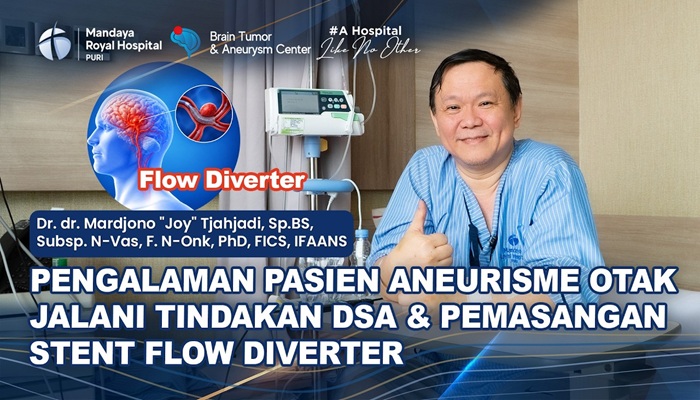
This was also experienced by Lo Meng Kong, a patient who developed a brain aneurysm that caused symptoms including neck pain and a severe headache. To receive further treatment, he underwent digital subtraction angiography (DSA) and flow diversion with Dr. dr. Mardjono Joy Tjahjadi, Sp.BS, Subsp. N-Vas, F. N-Onk, PhD, FICS, IFAANS, also known as Dr. Joy, at Mandaya Royal Puri. Following the procedure, Mr. Lo’s condition is now stable, and he feels much better.
“I’m feeling better now, although I still feel a little dizzy. Maybe it’s because of the blood-thinning medication and the stent. Perhaps my blood flow is still adjusting. I’ve adapted to it. Dr. Joy is very good. He also explains things to the family in a way that is easy to understand. Dr. Joy always visits me and checks my response after the procedure. The service here is also very good, from the cleaning service and nutrition team to the nurses. They have been very helpful,” said Mr. Lo Meng Kong.

Contents
It started with neck pain followed by a severe headache
Mr. Lo Meng Kong’s experience with brain aneurysm began after he finished his morning walk and took a shower. At that time, he suddenly felt pain and discomfort in his neck. The symptoms then became more severe and were accompanied by an intense headache that felt like pressure at the top of his head. The pain was so severe that Mr. Lo had difficulty opening his eyes.
He remained conscious when he was taken to the hospital by ambulance. During the initial examination, doctors found an enlarged blood vessel. Mr. Lo’s blood pressure was also reported to be quite high at approximately 215/100 mmHg. He was then treated to stabilize his condition before undergoing further examinations.
A DSA examination was then performed to provide a clearer view of the brain’s blood vessels. The examination revealed an enlarged blood vessel. Based on further evaluation, doctors suspected that the aneurysm originated from a blood vessel around the brainstem.
Read also: Key Signs of a Brain Aneurysm You Should Be Aware Of
Complex aneurysm treated with flow diversion
To assess the condition of his blood vessels in greater detail, Mr. Lo then underwent CT angiography. The examination revealed a complex aneurysm, specifically a dissecting aneurysm in the left vertebral artery. This condition occurs when a tear develops in the inner layer of a blood vessel wall. The tear allows blood to flow between the layers of the vessel wall, causing the layers to separate.
The fusiform shape of the aneurysm meant that the condition could not be treated using methods such as clipping or coiling. Therefore, doctors selected flow diversion to treat the aneurysm while helping maintain blood flow through nearby branches of the blood vessel.
In this procedure, a specialized stent is placed inside the blood vessel to redirect blood flow away from the aneurysm. Over time, this approach is expected to support the reconstruction and healing of the blood vessel wall while reducing the amount of blood flowing into the aneurysm.
After undergoing the procedure, Mr. Lo’s condition gradually improved. He still experienced some dizziness, which he believed might be related to the adjustment process following the use of blood-thinning medication and placement of the stent. During his recovery, he was also monitored by Dr. Joy, who regularly visited him and checked his response following the procedure.
Mr. Lo felt that the explanations provided to his family were easy to understand and that he received helpful support from the team at Mandaya Royal Puri throughout his treatment.
Read also: Headache Behind the Eye? Be Aware of Brain Aneurysms and Learn About Their Treatment
Understanding flow diversion for brain aneurysms
Flow diversion is one of the minimally invasive treatment options for brain aneurysms. During this procedure, doctors place a device called a neurovascular stent in the main blood vessel where the aneurysm is located. The device helps redirect blood flow so that it does not directly enter the aneurysm sac.
In simple terms, the way flow diversion works can be understood through several stages:
- Redirecting blood flow: The stent placed in the blood vessel helps direct blood flow away from the aneurysm.
- Reducing blood flow into the aneurysm: Over time, the amount of blood flowing into the aneurysm may gradually decrease until blood no longer enters the aneurysm.
- Supporting blood vessel healing: At the same time, the body naturally begins the healing process in the blood vessel wall.
- Helping the aneurysm shrink: As blood flow into the aneurysm decreases and the healing process takes place, the aneurysm may shrink.
Advantages of flow diversion for brain aneurysms
The potential benefits of flow diversion include:
- No need to enter the aneurysm directly: With flow diversion, doctors do not need to place the device inside the aneurysm sac. This may reduce risks associated with directly treating the aneurysm, which can be one of the higher-risk aspects of certain endovascular procedures.
- May support a shorter recovery: Compared with some surgical procedures that require a longer recovery period, flow diversion allows some patients to undergo treatment with a relatively short hospital stay. In certain cases, patients may be discharged the following day and return to their activities within approximately one week.
- May reduce the risk of aneurysm recurrence: This method may also help reduce the possibility of an aneurysm recurring after treatment, although outcomes can vary from one patient to another.
- Lower radiation exposure: During a flow diversion procedure, the radiation exposure received by the patient may be lower compared with some other endovascular techniques.
Dr. Joy’s practice schedule at Mandaya Royal Hospital Puri
Dr. dr. Mardjono Joy Tjahjadi, Sp.BS, Subsp. N-Vas, F. N-Onk, PhD, FICS, IFAANS is available for consultation at Mandaya Royal Hospital Puri on:
- Monday: On appointment
- Tuesday: 14:00–17:00 WIB
- Wednesday: On appointment
- Thursday: 08:00–12:00 WIB
- Friday: 14:00–17:00 WIB
- Saturday: 08:00–12:00 WIB
To make your visit to Mandaya Royal Hospital Puri easier, use Chat via WhatsApp, Book an Appointment, or the Care Dokter app, which can be downloaded from Google Play and the App Store. The app makes it easier to schedule visits, check your queue number, and access other information.
*The information provided on this page is intended for educational purposes and general information only and does not represent all types of medical services that may be performed by each doctor. To ensure appropriate treatment based on your health condition, consultation with the relevant doctor is recommended.
If you have any questions, suggestions, or need further information, please contact our call center at 0811-1900-2000.

References:
- Cleveland Clinic. Brain Aneurysm. (https://my.clevelandclinic.org/health/diseases/16800-brain-aneurysm). Accessed October 2, 2026.
- Elsevier. Dissecting Aneurysm. (https://www.sciencedirect.com/topics/nursing-and-health-professions/dissecting-aneurysm). Accessed October 2, 2026.
- Medtronic. Aneurysm Flow Diversion – About the Therapy. (https://www.medtronic.com/en-us/l/patients/treatments-therapies/aneurysm-flow-diversion/about.html). Accessed October 2, 2026.
- Johns Hopkins Medicine. Flow Diversion with Stents for Brain Aneurysms. (https://www.hopkinsmedicine.org/health/treatment-tests-and-therapies/flow-diversion-with-stents-for-brain-aneurysms). Accessed October 2, 2026.