


Coronary artery disease (CAD) is a condition in which the coronary arteries, which supply oxygen-rich blood to the heart muscle, become narrowed or blocked. This condition generally occurs due to the buildup of plaque, including cholesterol, inside the blood vessels, restricting blood flow to the heart.
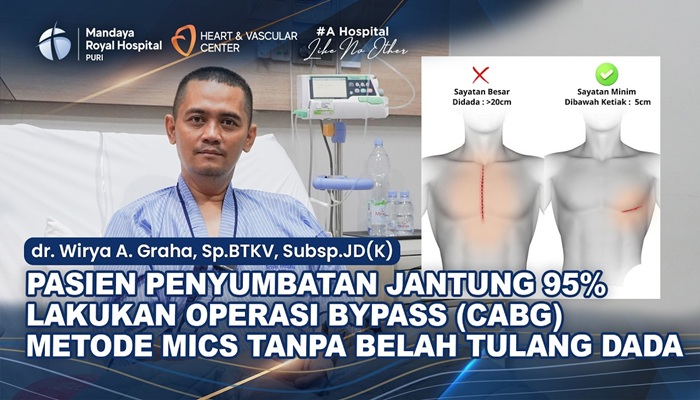
Coronary artery blockages can vary in severity. In one patient at Mandaya Royal Hospital Puri, the blockage was severe, reaching approximately 95%. The condition required the patient to undergo coronary artery bypass surgery to help restore blood flow to the heart muscle. The procedure was performed using a minimally invasive approach, or Minimally Invasive Cardiac Surgery (MICS), without opening the breastbone, together with dr. Wirya Ayu Graha, Sp. BTKV, Subsp. JD (K).
Three days after surgery, the patient’s condition had improved, and he was already able to walk independently without assistance. “(Three days after the surgery), thank God, I’m feeling better, and we may be able to go home this afternoon. So far, there have been no problems, just some soreness, probably from the incision wound,” the patient said.

Contents
The symptoms started with chest tightness, warmth, and cold sweats
The patient was Lulus Widodo, 47, from Cipondoh Makmur. Before undergoing coronary artery bypass surgery, the patient experienced symptoms including chest tightness and a feeling of warmth in the chest, accompanied by cold sweats. These symptoms had actually started toward the end of January, but initially, they were not given much attention. Over time, the symptoms became more frequent and severe, prompting the patient to seek medical attention from dr. Wirya at Mandaya Royal Hospital Puri.
Based on the examination and evaluation, the patient was found to have coronary artery blockage of approximately 95%. With this condition, the patient was advised to undergo coronary artery bypass surgery. The decision to undergo the procedure was made relatively soon after the patient received an explanation about his condition and discussed it with the doctor and medical team at Mandaya Royal Hospital Puri.
One of the factors the patient considered was the choice of surgical method. The patient received an explanation about the differences between conventional coronary artery bypass surgery and the minimally invasive MICS approach. Unlike conventional bypass surgery, which requires an incision in the middle of the chest, MICS is performed through a smaller incision below the chest, measuring approximately 5–6 cm.
Before undergoing the procedure, the patient also looked for more information about MICS because he had previously thought that the technique was only available overseas. After learning that the method was already available in Indonesia, he became more confident in considering it as an option together with his doctor.
The patient admitted that he was initially surprised to learn that he needed bypass surgery, especially since he was only 47 years old and exercised regularly. However, based on the doctor’s explanation, several factors can contribute to this condition, including genetic factors and an unbalanced diet. The patient also had a family history of heart disease.
Recovery after coronary artery bypass surgery with the MICS method
Three days after undergoing coronary artery bypass surgery using the MICS method, the patient showed good progress. He was already able to walk independently without assistance and had started doing light activities in the hospital hallway. Some soreness remained around the incision, but overall, there were no significant complaints.
Recovery still required time and was carried out gradually, including through physiotherapy. The patient also experienced coughing and some shortness of breath during the early recovery period. According to the doctor, the recovery process could take at least around two weeks, so the patient still needed to follow medical advice and undergo rehabilitation gradually.
The smaller incision was one of the aspects the patient experienced during recovery. With MICS, access to the heart is achieved through a smaller incision compared with conventional coronary artery bypass surgery, which uses an incision in the middle of the chest. This makes the MICS procedure one of the minimally invasive approaches that may be considered for patients who meet the criteria for the procedure.
In addition to the medical treatment itself, the patient’s experience at Mandaya Royal Hospital Puri also included the services provided by the medical and nursing teams. The patient felt that the doctor explained the procedure clearly and in detail, allowing him to understand the information before the surgery. The nursing team was also responsive, while the variety of food options during treatment was another aspect he appreciated.
Understanding MICS coronary artery bypass surgery and its advantages
MICS coronary artery bypass surgery is a minimally invasive coronary artery bypass procedure that creates a new route for blood flow around narrowed or blocked coronary arteries.
Unlike conventional coronary artery bypass surgery, which requires opening the breastbone, MICS CABG uses specialized instruments through a small incision measuring approximately 7–10 cm in the rib area or beneath the left breast. Through this incision, the doctor creates an alternative blood vessel pathway so that blood can bypass the blocked section of the coronary artery.
During the procedure, the heart continues to beat, unlike conventional bypass surgery, which may require the heart to be temporarily stopped. The doctor uses a specialized device to stabilize the part of the heart being treated, allowing the blood vessels to be connected precisely without significantly interfering with the heart’s function.
Because it is performed through a smaller incision, MICS CABG can reduce trauma to tissues and blood vessels and may help support a faster recovery.
Some of the advantages of MICS CABG include:
- No need to split the breastbone, unlike conventional coronary artery bypass surgery.
- A smaller incision, approximately 7–10 cm, located beneath the left breast, making it less visible.
- Less trauma to tissues and blood vessels.
- Less blood loss during the procedure.
- Postoperative pain may be less severe.
- May help reduce the risk of certain complications, particularly in patients with underlying conditions such as diabetes or in older patients.
- Faster recovery with a relatively shorter hospital stay. Patients may generally return to light work approximately 3–4 weeks after surgery, depending on their condition and medical evaluation.
Do not underestimate it: complications of coronary artery disease to watch out for
Coronary artery disease that becomes more severe can lead to several complications, including:
- Chest pain (angina): occurs when blood flow to the heart muscle is insufficient due to narrowed blood vessels.
- Heart attack: can occur when a blood clot blocks a blood vessel and prevents blood from reaching the heart.
- Heart failure: long-term narrowing of the blood vessels or high blood pressure can cause the heart to become weak or stiff, making it harder to pump blood.
- Abnormal heart rhythm (arrhythmia): insufficient blood flow to the heart can interfere with the heart’s electrical system and cause an irregular heartbeat.
Signs of coronary artery blockage that should be checked by a doctor promptly
Chest pain or discomfort is one of the most common symptoms of coronary artery disease. It can occur when plaque buildup causes the coronary arteries to narrow, reducing blood flow to the heart muscle.
For some people, the first sign of coronary artery disease may occur during a heart attack. Some of the symptoms include:
- Chest pain or discomfort.
- Weakness, dizziness, nausea, or cold sweats.
- Pain or discomfort in the arm or shoulder.
- Shortness of breath.
Over time, coronary artery disease can also weaken the heart muscle and increase the risk of heart failure, a condition in which the heart is unable to pump blood effectively. Seek medical attention promptly if you experience any of these symptoms.
Read also: Ini Ciri-ciri Penyempitan Pembuluh Darah Jantung yang Wajib Diwaspadai
Profile and practice schedule of dr. Wirya at Mandaya Royal Hospital Puri

dr. Wirya A. Graha, Sp.BTKV, Subsp. JD (K) is a thoracic, cardiac, and vascular surgeon with a subspecialization in adult cardiac surgery. He has experience performing various cardiac and vascular surgical procedures. He completed his Thoracic and Cardiovascular Surgery Specialist training at the Faculty of Medicine, Universitas Indonesia. In addition to conventional cardiac surgery techniques, dr. Wirya also has expertise in minimally invasive cardiac surgery.
In his practice, dr. Wirya performs MICS, a cardiac surgery technique carried out through a small incision without fully opening the breastbone. This approach can reduce trauma to the body and support the patient’s recovery process. To further expand his experience and knowledge in cardiac and vascular surgery, dr. Wirya has also participated in various international training programs and conferences, including:
- 2017: 25th Annual Meeting of the Asian Society for Cardiovascular and Thoracic Surgery, Seoul, South Korea.
- 2018: 28th Annual Meeting of the Association of Thoracic and Cardiovascular Surgeons of Asia.
- 2019: 1st Joint Biennial South East Asian Regional Congress on Cardiovascular and Thoracic Surgery and the 20th MATCVS Annual Scientific Meeting, Malacca.
- 2021: 25th European Vascular Course and 5th European Cardiovascular Course.
dr. Wirya A. Graha, Sp.BTKV, Subsp. JD (K) is available for consultation at Mandaya Royal Hospital Puri on the following schedule:
- Tuesday: 16.30–20.00 WIB.
- Thursday: 16.30–20.00 WIB.
- Saturday: 10.00–13.00 WIB.
To make your visit to Mandaya Royal Hospital Puri more convenient, use the Chat via WhatsApp, Book Appointment, or the Care Dokter app, which can be downloaded from Google Play and the App Store to help you manage your visit, check your queue number, and access other information.
*The information provided on this page is intended for educational purposes and provides a general overview. It does not represent the full range of medical services that may be performed by each doctor. To determine the appropriate treatment for your specific health condition, consultation with the relevant doctor is recommended.
If you have any questions, suggestions, or require further information, please contact our call center at 0811-1900-2000.

References:
- Cleveland Clinic. Coronary Artery Disease. (https://my.clevelandclinic.org/health/diseases/16898-coronary-artery-disease). Accessed September 30, 2026.
- Bangkok Hospital. MICS CABG. (https://www.bangkokhospital.com/en/bangkok-heart/content/mics-cabg). Accessed September 30, 2026.
- Mayo Clinic. Coronary artery disease – Symptoms and causes. (https://www.mayoclinic.org/diseases-conditions/coronary-artery-disease/symptoms-causes/syc-20350613). Accessed September 30, 2026.
- Centers for Disease Control and Prevention (CDC). About Coronary Artery Disease. (https://www.cdc.gov/heart-disease/about/coronary-artery-disease.html). Accessed September 30, 2026.