


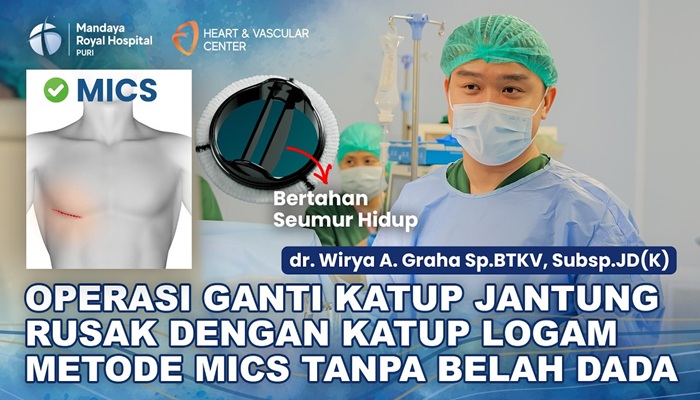
Heart valve replacement surgery is one of the treatment options for advanced heart valve disease. The procedure is generally performed when a heart valve becomes narrowed (stenosis) or leaky (regurgitation), causing the heart to work harder to pump blood throughout the body. Replacing the damaged valve with an artificial heart valve can restore normal blood flow, relieve symptoms, and reduce the risk of complications associated with heart valve disease.

Recently, dr. Wirya A. Graha, Sp.BTKV, Subsp. JD(K), a thoracic, cardiac, and vascular surgeon with subspecialty training in adult cardiac surgery at Mandaya Royal Hospital Puri, performed a heart valve replacement procedure using a mechanical heart valve. The operation was carried out using the Minimally Invasive Cardiac Surgery (MICS) technique, which involves a small 5–6 cm incision between the ribs without splitting the breastbone, allowing for a faster recovery.

Contents
Dr. Wirya Explains the Patient’s Condition and Treatment
The patient, who came from Papua, sought medical attention after experiencing shortness of breath and having a history of stroke. Following an echocardiography (cardiac ultrasound) examination, the medical team found severe narrowing (stenosis) of one of the heart valves accompanied by significant calcification.
The narrowed valve disrupted normal blood flow through the heart, increasing the risk of blood clot formation. One of these blood clots eventually traveled to the brain, resulting in the patient’s stroke.
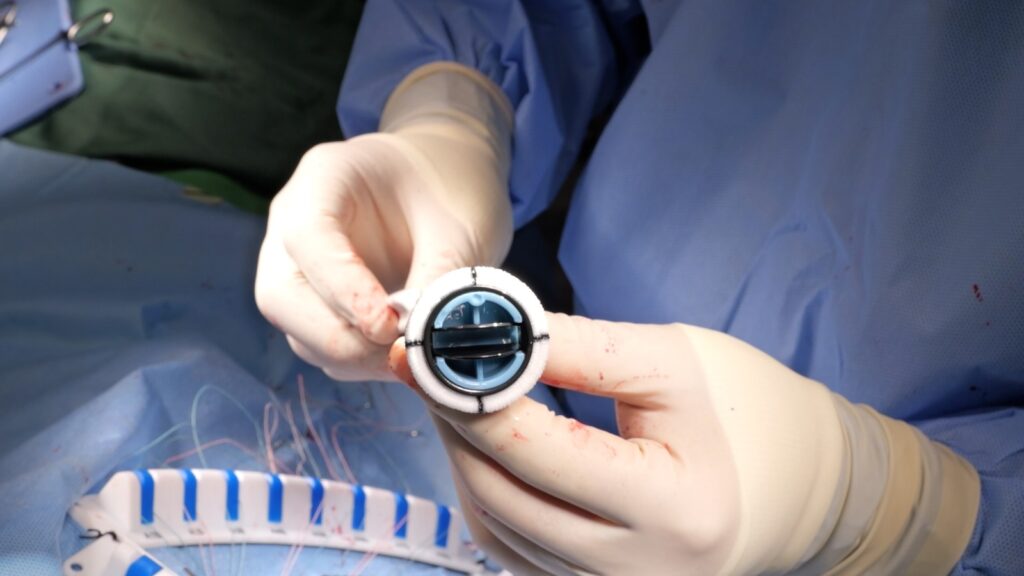
To treat the condition, Dr. Wirya and the cardiac surgery team at Mandaya Royal Hospital Puri performed minimally invasive heart valve replacement surgery (MICS). The procedure was completed through a small 5–6 cm incision on the right side of the chest, eliminating the need to split the breastbone. During surgery, the diseased valve, including the calcified tissue, was completely removed and replaced with an artificial heart valve.
The replacement valve used was a mechanical heart valve, which is highly durable and designed to last a lifetime. This significantly reduces the likelihood of needing another valve replacement surgery in the future. However, patients with mechanical valves must take blood-thinning medication for life to prevent blood clots from interfering with the valve’s movement.
Following surgery, the patient was reported to be in stable condition and admitted to the Intensive Care Unit (ICU). If recovery progresses as expected, the patient is anticipated to stay in the ICU for approximately two days before being transferred to a regular hospital room.
Understanding Heart Valve Replacement Surgery and Its Purpose
Heart valve replacement surgery is a procedure performed to replace a damaged heart valve with an artificial (prosthetic) valve. Depending on the patient’s condition, the procedure may be performed through conventional open-heart surgery or a minimally invasive approach. The goal is to restore normal valve function and improve blood flow throughout the body.
This procedure is commonly recommended for patients with severe heart valve disease, such as valve stenosis or valve regurgitation. If left untreated, these conditions can force the heart to work harder, leading to symptoms such as shortness of breath, chest pain, fatigue, and fainting. Replacing the damaged valve helps improve blood circulation, relieve symptoms, and reduce the risk of serious complications.
The heart valves that can be replaced include:
- Aortic valve
- Mitral valve
- Tricuspid valve
- Pulmonary valve
Types of Artificial Heart Valves: Understanding the Advantages and Disadvantages
There are two main types of artificial heart valves used in valve replacement surgery:
- Biological (tissue) valves, which are made from animal tissue (such as cow or pig tissue) or donated human tissue. These valves generally do not require lifelong blood-thinning medication but typically last between 10 and 20 years, meaning another replacement procedure may eventually be necessary.
- Mechanical heart valves, which are made from metal or carbon. These valves are extremely durable and can last a lifetime, significantly reducing the need for repeat surgery. However, patients must take lifelong blood-thinning medication to prevent blood clots from forming on the valve.
The choice of valve depends on several factors, including the patient’s age, overall health, the risks associated with long-term blood-thinning medication, the likelihood of future surgeries, and the patient’s personal preferences after discussion with the treating physician.
Advantages of MICS Compared with Conventional Open-Heart Surgery
Compared with conventional open-heart surgery, which requires splitting the breastbone, Minimally Invasive Cardiac Surgery (MICS) offers several benefits. Because the procedure is performed through a much smaller incision, patients generally experience a more comfortable recovery.
Some of the advantages of MICS include:
- Faster recovery, with many patients able to return to normal activities within approximately 2–4 weeks.
- Less postoperative pain due to the smaller incision.
- Smaller surgical scars with improved cosmetic results.
- Reduced physical and psychological trauma associated with surgery.
- Shorter hospital stays, typically around 3–4 days if recovery is uncomplicated.
- Better early postoperative lung function.
- Lower risk of bleeding and infection compared with conventional open-heart surgery.
Although MICS offers many advantages, it is not suitable for every patient. The decision between MICS and conventional open-heart surgery depends on a comprehensive evaluation by the cardiac surgeon, including the type and severity of the heart condition, the patient’s heart anatomy, medical history, and other clinical considerations. The most appropriate surgical approach is selected to ensure the safest procedure and the best possible outcome for each patient.
Consult Dr. Wirya for Heart Valve Disease at Mandaya Royal Hospital Puri

dr. Wirya A. Graha, Sp.BTKV, Subsp. JD(K) is a thoracic, cardiac, and vascular surgeon with subspecialty expertise in adult cardiac surgery. He has extensive experience in performing a wide range of heart and vascular surgical procedures and completed his specialist training in Thoracic and Cardiovascular Surgery at the Faculty of Medicine, University of Indonesia. He has also pursued advanced training in modern cardiac surgical techniques, including minimally invasive procedures.
In his clinical practice, Dr. Wirya is well known for his expertise in Minimally Invasive Cardiac Surgery (MICS), a surgical technique that uses a small incision without splitting the breastbone. This approach minimizes surgical trauma and offers patients several benefits, including less postoperative pain, a lower risk of complications, and a faster recovery compared with conventional open-heart surgery.
Some of the international conferences and training programs attended by Dr. Wirya include:
- 2017: 25th Annual Meeting of the Asian Society for Cardiovascular and Thoracic Surgery, Seoul, South Korea
- 2018: 28th Annual Meeting of the Association of Thoracic and Cardiovascular Surgeons of Asia
- 2019: 1st Joint Biennial South East Asian Regional Congress on Cardiovascular and Thoracic Surgery with the 20th MATCVS Annual Scientific Meeting, Malacca, Malaysia
- 2021: 25th European Vascular Course and 5th European Cardiovascular Course
Dr. Wirya is available for consultation at Mandaya Royal Hospital Puri on:
- Tuesday: 4:30 PM – 8:00 PM
- Thursday: 4:30 PM – 8:00 PM
- Saturday: 10:00 AM – 1:00 PM
To make your visit to Mandaya Royal Hospital Puri more convenient, you can contact us via WhatsApp, book an appointment online, or download the Care Dokter application from Google Play or the App Store to schedule appointments, monitor queue numbers, and access additional hospital information.
The information provided on this page is intended for educational purposes and general information only. It does not represent the complete range of medical services that may be provided by each physician. To receive treatment tailored to your specific condition, please consult the appropriate doctor directly.
If you have any questions, suggestions, or require additional information, please contact our call center at 0811-1900-2000.

References
- American Heart Association. Options for Heart Valve Replacement. https://www.heart.org/en/health-topics/heart-valve-problems-and-disease/understanding-your-heart-valve-treatment-options/options-for-heart-valve-replacement
- Cleveland Clinic. Heart Valve Replacement. https://my.clevelandclinic.org/health/treatments/23966-heart-valve-replacement