


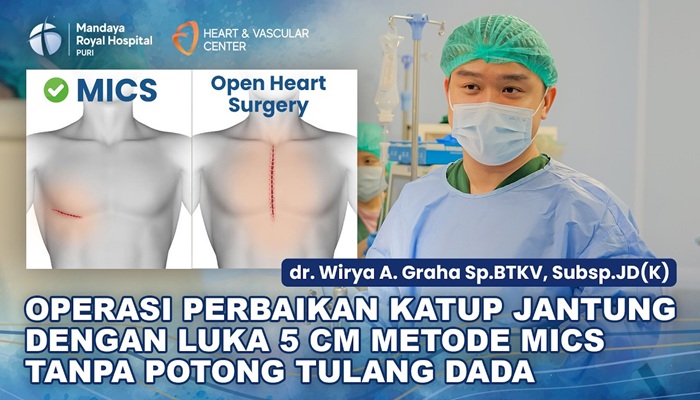
Heart valve disease is a condition in which the heart valves cannot open or close properly, disrupting normal blood flow within the heart. This condition may cause various symptoms, such as shortness of breath during activity, fatigue, chest discomfort, difficulty lying flat while sleeping, swollen legs, and abnormal heart rhythms (arrhythmias) in more severe cases. Traditionally, conventional heart valve surgery requires splitting the breastbone to access the heart. However, Minimally Invasive Cardiac Surgery (MICS) is now available as a less invasive alternative, allowing heart valve repair to be performed through a small incision of around 5 cm without opening the breastbone.
At Mandaya Royal Puri Hospital, MICS heart valve surgery is performed by dr. Wirya A. Graha, Sp.BTKV, Subsp.JD(K), a consultant thoracic, cardiac, and vascular surgeon with a subspecialty in adult cardiac surgery who has extensive experience in minimally invasive heart surgery procedures. Using this technique, patients can undergo heart surgery through a small incision between the ribs on the right side of the chest, resulting in less postoperative pain and faster recovery.

Contents
dr. Wirya Explains the MICS Heart Valve Surgery Technique
According to dr. Wirya, heart valve surgery no longer always requires splitting the breastbone as in conventional procedures. With the MICS technique, surgery can be performed through a small incision of approximately 4–5 cm on the right side of the chest, specifically between the ribs.
Through this small opening, surgeons can perform the entire procedure without cutting the breastbone. This technique also avoids the use of large retractors to widely spread the chest cavity, helping minimize pain, muscle damage, and the risk of bone fractures.
Advantages of MICS Heart Valve Surgery
Some advantages of the MICS heart valve surgery technique include:
- Smaller surgical incision, approximately 4–5 cm
- No need to split the breastbone
- Reduced postoperative pain
- Lower risk of muscle and bone damage
- Faster recovery compared to conventional open-heart surgery
During heart valve surgery, dr. Wirya also prioritizes repairing the patient’s native valve whenever possible rather than immediately replacing it with an artificial valve. According to him, preserving the body’s natural structure is preferable if the damaged valve can still be repaired.
“So whenever there is damage to the heart valve, we try to repair it instead of immediately replacing it, because it is a natural structure given by God, so we aim to preserve the body’s original structure,” said dr. Wirya.
In some cases, loose or leaking heart valves can still be repaired so they can close properly again when the heart pumps blood. This allows the valve to function optimally without the need for replacement.
Supported by Cardiac Anesthesia Consultants and TEE Technology
To ensure greater precision during surgery, the MICS procedure is supported by Transesophageal Echocardiography (TEE), an ultrasound examination performed through the esophagus to provide a more detailed view of the heart valves.
Using TEE technology, dr. Wirya can evaluate:
- The location of heart valve leakage
- Which valve leaflets are loose
- The severity of valve damage more clearly
- More accurate and well-prepared surgical planning

This surgery is also supported by dr. Yudi Hadinata, Sp.AN-KAKV, a consultant anesthesiologist specializing in cardiac and vascular surgery anesthesia. Not all hospitals have anesthesiologists with expertise in cardiac surgery, making this multidisciplinary team an important factor in supporting the success of MICS procedures at Mandaya Royal Puri Hospital.
Signs of Heart Valve Disease That Should Be Evaluated by a Doctor
Heart valve disease can cause symptoms that often develop gradually. In the early stages, symptoms may seem mild and are frequently mistaken for ordinary fatigue. However, if left untreated, the condition can eventually affect overall heart function.
According to dr. Wirya, patients with heart valve disease commonly experience symptoms such as:
“So what are the common complaints of patients with heart valve damage? Shortness of breath, especially when walking or doing activities. Sometimes they also feel bloated or uncomfortable in the chest and cannot sleep with just one pillow. They need to sleep half-sitting because if they lie flat, they start coughing and feel uncomfortable. In more severe cases, the legs may swell or the heartbeat may become irregular (arrhythmia).”
In addition to those symptoms, heart valve disease may also cause:
- Fatigue or getting tired easily during activities
- Heart palpitations or abnormal heartbeats
- Weakness or dizziness
- Rapid weight gain due to fluid retention
- Chest pain, especially during physical activity
If you experience one or more of these symptoms, you should consult a cardiologist for further evaluation and appropriate treatment.
What Are the Complications of Untreated Heart Valve Disease?
If left untreated, heart valve disease can lead to serious complications, including:
- Heart failure
- Arrhythmias
- Blood clots
- Pulmonary hypertension
- Stroke
- Cardiac arrest
Consultation with dr. Wirya at Mandaya Royal Puri Hospital
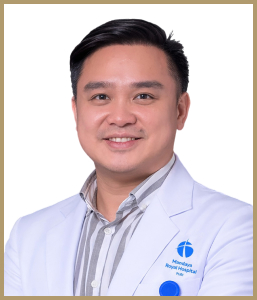
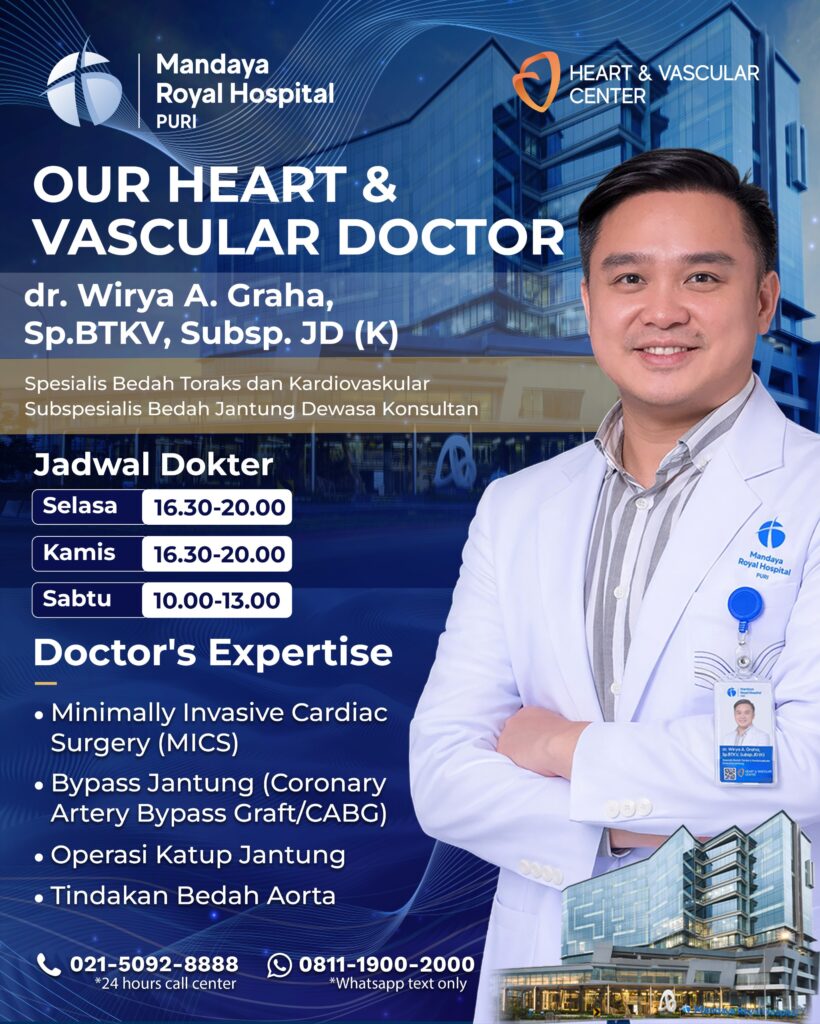
dr. Wirya A. Graha, Sp.BTKV, Subsp.JD(K) is a thoracic, cardiac, and vascular surgeon with a consultant subspecialty in adult cardiac surgery. He completed his Thoracic and Cardiovascular Surgery specialist training at the Faculty of Medicine, University of Indonesia, and has extensive experience in various heart and vascular surgical procedures.
In his clinical practice, dr. Wirya is known for his extensive experience in cardiac surgery, performing more than 600 operations annually. More than 300 of these procedures are minimally invasive cardiac surgeries using the MICS technique, including over 200 minimally invasive heart bypass surgeries and more than 100 minimally invasive heart valve surgeries.
His expertise in MICS allows procedures to be performed without fully opening the breastbone. This approach offers several advantages for patients, including reduced postoperative pain, lower complication risks, and faster recovery compared to conventional heart surgery techniques.
In addition to minimally invasive procedures, dr. Wirya also performs heart bypass surgery, heart valve surgery, and aortic surgery. He is a member of the Indonesian Medical Association (IDI) and is committed to providing safe, professional, and patient-centered thoracic and cardiovascular surgical care.
dr. Wirya A. Graha, Sp.BTKV, Subsp.JD(K) practices at Mandaya Royal Puri Hospital on:
- Tuesday: 04.30 PM – 08.00 PM
- Thursday: 04.30 PM – 08.00 PM
- Saturday: 10.00 AM – 01.00 PM
To make your visit to Mandaya Royal Hospital Puri more convenient, you can use the WhatsApp Chat feature, Book Appointment service, or the Care Dokter application available on Google Play and the App Store to manage appointments, check queue numbers, and access additional information.
The information provided on this page is intended for educational and general informational purposes only and may not represent the full range of medical services performed by each doctor. To ensure treatment that is appropriate for your condition, direct consultation with the relevant doctor is recommended.
If you have any questions, suggestions, or require further information, please contact our call center at 0811-1900-2000.