


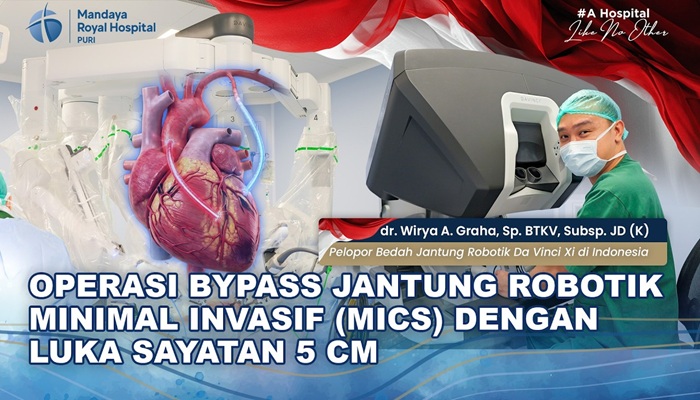
Coronary artery bypass grafting (CABG) is a surgical procedure that creates a new pathway for blood flow to bypass coronary arteries that have become narrowed or blocked due to coronary artery disease. During the procedure, the doctor uses healthy blood vessels from another part of the body as bypass grafts, allowing blood flow to the heart muscle to be restored more effectively.
One approach that can be used is minimally invasive cardiac surgery coronary artery bypass grafting (MICS CABG). Unlike conventional bypass surgery, which requires opening the breastbone, MICS CABG is performed through smaller incisions between the ribs or below the left breast. Using specialized techniques and instruments, doctors can create bypass grafts without splitting the breastbone, allowing the procedure to be performed using a minimally invasive approach.
Robotic technology can now also be used to support minimally invasive coronary bypass procedures. At Mandaya Royal Puri Hospital, dr. Wirya Ayu Graha, Sp. BTKV, Subsp. JD (K), a thoracic, cardiac, and vascular surgeon specializing in adult cardiac surgery, performed MICS CABG with the assistance of the Da Vinci Xi robotic system. In this procedure, the incision was approximately 5 cm, and the patient was awake approximately two hours after surgery and able to communicate well.

Contents
Patient’s condition before undergoing robotic-assisted coronary bypass surgery
The patient who underwent this procedure was a 63-year-old man from Surabaya. Before coming to Mandaya Royal Puri Hospital, he had experienced chest pain and had previously undergone an examination in Penang, Malaysia. The results of his cardiac catheterization showed blockages in three coronary arteries, with two arteries completely blocked and another narrowed by approximately 95%.
In such cases, severe coronary artery blockages can increase the risk of serious heart problems. Therefore, the doctor planned coronary bypass surgery to create a new pathway for blood flow to the heart muscle.
In this patient’s case, the procedure was performed using a robotic-assisted MICS CABG approach with the Da Vinci Xi robotic system. The doctor performed four bypass grafts according to the predetermined surgical plan.
Coronary bypass surgery with an incision of only about 5 cm
One of the notable aspects of this procedure was the size of the surgical incision. With robotic assistance, the doctor was able to perform the procedure through a smaller access point compared with conventional coronary bypass surgery.
Some of the potential advantages of the minimally invasive, robot-assisted approach in this case include:
- Smaller incision: The surgical wound created during this procedure was approximately 5 cm.
- Reduced trauma to the breastbone: MICS CABG is performed without opening the breastbone as required in conventional bypass surgery.
- Robotic-assisted precision: The robotic system helps the doctor perform highly precise surgical movements while providing a detailed view of the surgical area.
- Preserving the quality of blood vessels: The doctor aims to avoid injury to the blood vessels in the chest wall that will be used as bypass grafts so that they can maintain good quality.
- Potentially more comfortable recovery: Smaller incisions may be associated with less postoperative bleeding and pain and may support the patient’s recovery process.
In this procedure, the bypass surgery was performed with robotic assistance, and four bypass grafts were successfully created according to the surgical plan. The use of robotic technology is not only intended to create smaller incisions but also to help the doctor work with greater precision in areas that require a high degree of accuracy.
Patient became awake approximately 1–2 hours after surgery
A minimally invasive, robot-assisted approach may also support the recovery process after surgery. After the procedure was completed, the patient was planned to be awakened and monitored in the ICU. In this case, the patient was able to start eating, drinking, and communicating with his family approximately two hours after arriving in the ICU, provided that his clinical condition allowed it.
Recovery can vary from one patient to another depending on the condition of the heart, the type of procedure performed, and the body’s response after surgery. However, approaches such as robotic-assisted MICS CABG provide an opportunity for selected patients to undergo coronary bypass surgery through smaller incisions, potentially allowing for a more comfortable recovery process.
For patients with coronary artery disease and coronary artery blockages requiring bypass surgery, the choice of surgical technique should be determined based on each individual’s condition. Doctors will conduct a comprehensive evaluation to determine whether a minimally invasive approach and robotic assistance are suitable for the patient.
Read also: Treatment for Coronary Artery Disease: From Stent Placement to Coronary Bypass Surgery
Understanding coronary artery disease that can trigger a heart attack
The case of the 63-year-old patient who underwent robotic-assisted coronary bypass surgery using the Da Vinci Xi system at Mandaya Royal Puri Hospital began with severe blockages in his coronary arteries. Cardiac catheterization showed that two major coronary arteries were completely blocked, while another artery was narrowed by approximately 95%. This is one of the manifestations of coronary artery disease (CAD), which can increase the risk of a heart attack.
Coronary artery disease occurs when the coronary arteries, which supply oxygen-rich blood to the heart muscle, become narrowed or blocked. The condition is commonly associated with the buildup of plaque, including cholesterol, inside the walls of the arteries. As plaque buildup increases, the amount of blood that can reach the heart muscle becomes increasingly restricted.
Coronary artery disease can also develop over many years without causing obvious symptoms. Serious problems can occur when plaque ruptures and triggers the formation of a blood clot that then obstructs blood flow to the heart. When blood flow is interrupted, the heart muscle does not receive enough oxygen, potentially resulting in a heart attack.
A heart attack is one of the major complications of coronary artery disease and requires immediate medical treatment. In addition, long-term coronary artery disease can lead to other complications, such as:
- Heart rhythm disorders (arrhythmia), a condition in which the heartbeat becomes abnormal.
- Cardiac arrest, when the heart suddenly stops pumping blood.
- Cardiogenic shock, a condition in which the heart is unable to pump enough blood to meet the body’s needs.
- Heart failure, when the heart’s ability to pump blood gradually decreases.
Because coronary artery disease can develop without typical symptoms, cardiac examinations and evaluations are important, particularly when a person begins experiencing symptoms such as chest pain or has risk factors for heart disease.
Consult dr. Wirya at Mandaya Royal Puri Hospital about your coronary bypass surgery needs
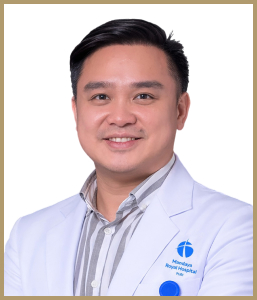
dr. Wirya Ayu Graha, Sp. BTKV, Subsp. JD (K) is a thoracic, cardiac, and vascular surgeon specializing in adult cardiac surgery. His clinical focus includes the application of minimally invasive cardiac surgery (MICS) techniques, including coronary bypass procedures using a minimally invasive approach without splitting the breastbone.
dr. Wirya is recognized as one of the pioneers in the use of Da Vinci Xi robotic technology for coronary bypass procedures in Indonesia. The technology is used to support minimally invasive coronary bypass surgery through smaller incisions.
To support his expertise in performing these procedures, dr. Wirya also holds a license to use the Da Vinci Xi robotic system for robotic-assisted coronary bypass surgery. This expertise and technology enable the application of minimally invasive, robot-assisted coronary bypass approaches for patients who meet the appropriate medical indications.
dr. Wirya Ayu Graha, Sp. BTKV, Subsp. JD (K) is available at Mandaya Royal Puri Hospital on:
- Tuesday: 16:30–20:00 WIB
- Thursday: 16:30–20:00 WIB
- Saturday: 10:00–13:00 WIB
Facilities for out-of-town and international patients at Mandaya Royal Puri Hospital
Mandaya Royal Puri Hospital provides various supporting facilities to offer additional convenience for patients traveling from other cities or countries:
- VIP transport: A pick-up service from Soekarno-Hatta International Airport, train stations, or ports to the hospital using a comfortable vehicle accompanied by the Patient Experience Officer (PEO) team.
- Medical ambulance pick-up: A dedicated pick-up service for patients with certain medical conditions from their arrival point (airport, train station, or port), equipped with medical equipment and accompanied by professional healthcare personnel.
- Accommodation (Sleep Hub & apartments): Comfortable accommodation facilities for patients’ families and companions, located on the 8th floor of the Mandaya Royal Puri building, as well as nearby apartment options.
- International Patient Relation: Dedicated assistance for international patients, including medical coordination, interpretation, and administrative support. For information and assistance from International Patient Relation, you can contact 021 5092 8888 or email [email protected].
To make your visit to Mandaya Royal Puri Hospital easier, use the Chat via WhatsApp, Book an Appointment, or the Care Dokter app, which can be downloaded from Google Play and the App Store. The app can help you manage your visit, check your queue number, and access other information.
The information provided on this page is intended for educational purposes and general information only and does not represent the full range of medical services that may be provided by each doctor. To determine the most appropriate treatment for your medical condition, consultation with the relevant doctor is recommended.
If you have any questions, suggestions, or require further information, please contact our call center at 0811-1900-2000.
\
References:
- Mayo Clinic. Coronary Bypass Surgery. https://www.mayoclinic.org/tests-procedures/coronary-bypass-surgery/about/pac-20384589. Accessed October 7, 2026.
- Bangkok Hospital. MICS CABG. https://www.bangkokhospital.com/en/bangkok-heart/content/mics-cabg. Accessed October 7, 2026.
- Cleveland Clinic. Coronary Artery Disease. https://my.clevelandclinic.org/health/diseases/16898-coronary-artery-disease. Accessed October 7, 2026.