


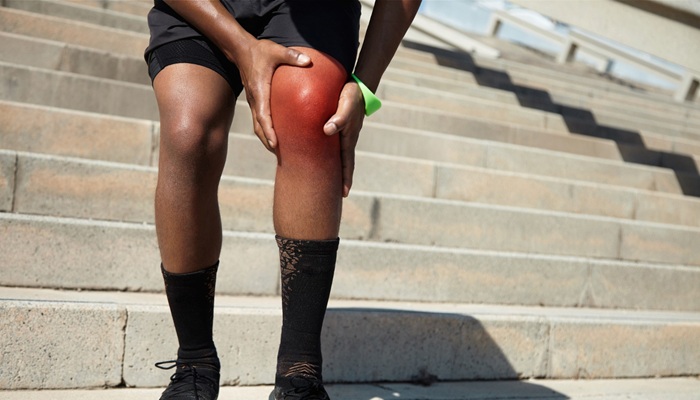
Does your knee feel fine when walking on flat surfaces but start hurting when you climb stairs? This is a fairly common problem because activities such as climbing stairs involve different muscle movements and require the knee to bend while supporting your body weight against gravity. When climbing stairs, the knee joint can even experience pressure equivalent to three to six times your body weight.
This additional pressure does not always cause pain. However, if you climb stairs frequently, have certain health conditions, or use improper movement techniques, your knees may start hurting during physical activities. Occasional discomfort or brief pain does not necessarily indicate a serious problem, so you can generally continue moving within your body’s limits.
Even so, knee pain should not be ignored because it may indicate a problem with the joint or surrounding muscles. Strengthening the muscles that support the knee can help improve joint stability and reduce stress during physical activities. Therefore, it is important to understand the causes of knee pain when climbing stairs or performing other everyday movements.

Contents
Causes of Knee Pain When Climbing Stairs or Standing Up from a Sitting Position
Here are some possible causes of knee pain when climbing stairs or standing up from a sitting position:
1. Patellofemoral Pain Syndrome
Patellofemoral pain syndrome is a condition that causes pain at the front of the knee, around or behind the kneecap (patella). It is also known as runner’s knee because it commonly affects runners and people who participate in sports involving frequent running and jumping.
The pain usually becomes more noticeable when running, climbing or descending stairs, squatting, or sitting for long periods with the knees bent. Symptoms may develop gradually and affect one or both knees. In some cases, rest and ice packs can help relieve the pain, although certain conditions may require physical therapy.
Symptoms of patellofemoral pain syndrome include:
- Dull pain or aching at the front of the knee.
- Knee pain when climbing or descending stairs.
- Pain when running, jumping, squatting, or kneeling.
- Knee pain after sitting for a long time with the knees bent.
- A grinding, popping, or crackling sensation in the knee.
2. Meniscus Tear
A meniscus tear is one of the most common types of cartilage injuries affecting the knee. The meniscus is a piece of cartilage located between the bones that form the knee joint. It helps protect the bones and absorb pressure as the knee moves.
A meniscus tear usually occurs when the knee suddenly twists, such as during sports activities. However, this injury can also result from relatively minor movements, such as twisting the knee while standing or changing body position.
Symptoms of a meniscus tear may include:
- Pain or tenderness when touching the knee.
- Knee stiffness or swelling. Swelling may not appear until several hours or even days after the injury.
- Difficulty bending, straightening, or moving the knee.
- A feeling that the knee is unstable or may give way when standing.
- A grinding or clicking sensation when moving the knee.
Symptoms of a meniscus tear may sometimes resemble those of a knee sprain. Therefore, a medical examination is necessary to confirm the underlying cause.
3. Knee Osteoarthritis
Knee osteoarthritis is a condition in which the cartilage that cushions the knee joint gradually changes and deteriorates. Over time, the cartilage may become thinner, reducing the space between the bones. As a result, the bones may rub against each other when the knee moves, triggering joint irritation and inflammation.
Symptoms of knee osteoarthritis may include:
- Knee stiffness that makes it difficult to bend or straighten the joint.
- Grinding or crackling sounds when moving the knee.
- Knee pain that becomes worse after physical activity.
- Weakness or a feeling that the knee may give way when standing.
- Knee pain that worsens with changes in the weather.
4. Knee Ligament Injuries
Ligaments are strong tissues that connect the bones in the knee joint and help maintain its stability. Sudden twisting movements or changes in direction during sports can cause ligaments to stretch excessively, become sprained, or even tear. These injuries can affect any of the four main knee ligaments, including the ACL, MCL, LCL, and PCL.
Symptoms of knee ligament injuries include:
- Sharp knee pain immediately after the injury.
- A popping sound or sensation when the injury occurs.
- Swelling that develops within the first few hours.
- Limited knee range of motion.
- Difficulty walking or bearing weight on the injured knee.
- A feeling of instability in the knee.
- A sensation that the knee may give way or buckle.
- Knee pain or aching.
5. Muscle Imbalances
Muscle imbalances can affect how the knee supports your body during movement, including when climbing stairs. In everyday activities, many people rely more on their quadriceps (front thigh muscles) than their gluteal muscles (buttock muscles) and hamstrings (back thigh muscles). However, the glutes and hamstrings also play an important role in supporting body movements. If these muscle groups are weak or underactive, pressure on the front of the knee may increase and trigger pain.
Strengthening the gluteal muscles and hamstrings can help your body activate these muscle groups more effectively when climbing stairs. This can help reduce the load on the front of the knee.
Symptoms of muscle imbalances associated with knee pain include:
- Knee pain when climbing stairs.
- Tightness or stiffness in the quadriceps.
- Tightness or stiffness in the hamstrings.
When Should You See a Doctor for Knee Pain When Climbing Stairs or Standing Up from a Sitting Position?
Not all knee pain when climbing stairs requires emergency medical treatment. However, if the symptoms persist or continue to worsen, you should not delay seeking medical evaluation to determine the cause.
Consult a doctor promptly if you experience any of the following symptoms:
- Knee pain that lasts for more than 2–3 weeks.
- Knee swelling after physical activity.
- Persistent knee pain every time you walk downstairs.
- A feeling that the knee is unstable, weak, or may give way.
- The knee feels locked, is difficult to move, or cannot be fully straightened.
- Difficulty standing or walking because the knee cannot support your body weight.
- Knee pain that interferes with sleep quality.
Mandaya Orthopedic Center: Expert Hip and Knee Specialists Supported by Robotic Technology
Knee pain that occurs when climbing stairs, walking, or standing up from a sitting position should not be ignored. To help identify the underlying cause, the Mandaya Royal Hospital Puri Orthopedic Center is supported by a team of orthopedic specialists and hip and knee consultants experienced in treating various knee joint conditions, ranging from osteoarthritis and ligament injuries to cartilage damage.
Patients can also undergo examinations and receive treatment recommendations tailored to their individual conditions, ranging from conservative therapies to surgical procedures when necessary. Mandaya is also equipped with CORI robotic technology to support knee replacement procedures through more precise and carefully planned surgical techniques.
The orthopedic specialists and hip and knee consultants at Mandaya include:
- dr. Paulus Ronald Hibono, Sp.OT (K), Hip & Knee
- dr. Ardi Setiawan, Sp.OT (K), Hip & Knee
- dr. Rahendra Pratama, Sp.OT (K), Hip & Knee
- dr. William Chandra, Sp.OT (K), Hip & Knee
One of the key advantages of the Mandaya Orthopedic Center is the availability of orthopedic specialists and hip and knee consultants who see patients every day. This gives patients the flexibility to schedule consultations throughout the week to have their knee problems evaluated.
Facilities for Out-of-Town and International Patients at Mandaya Royal Hospital Puri


Mandaya Royal Hospital Puri provides various support facilities to ensure greater comfort for patients traveling from other cities or countries:
- VIP Transport: A pickup service from Soekarno-Hatta International Airport, train stations, or seaports to the hospital in a comfortable vehicle, accompanied by a Patient Experience Officer (PEO).
- Medical Ambulance Pickup: A dedicated pickup service for patients with specific medical needs from arrival points, including airports, train stations, and seaports. The service is equipped with medical equipment and supported by professional healthcare personnel.
- Accommodation (Sleep Hub and Apartments): Comfortable accommodation facilities for patients’ families and companions, located on the 8th floor of the Mandaya Royal Puri building, with additional nearby apartment options.
- International Patient Relation: Dedicated assistance for international patients with medical coordination, interpretation, and administrative arrangements. For information and assistance from the International Patient Relation team, you can call 021 5092 8888 or email [email protected].
To make your visit to Mandaya Royal Hospital Puri easier, you can use the WhatsApp chat feature, Book Appointment service, or the Care Dokter app, available for download on Google Play and the App Store. These services can help you arrange appointments, check queue numbers, and access other important information.
The information on this page is provided for educational purposes and as a general overview. It does not reflect every type of medical service that may be performed by each doctor. To ensure that you receive care appropriate to your health condition, we recommend consulting directly with the relevant doctor.
If you have any questions, suggestions, or need further information, please contact our call center at 0811-1900-2000.

References:
- Hinge Health. Why Does My Knee Hurt When Climbing Stairs? (https://www.hingehealth.com/resources/articles/pain-in-knee-when-climbing-stairs/). Accessed on November 4, 2026.
- Mayo Clinic. Patellofemoral Pain Syndrome: Symptoms and Causes. (https://www.mayoclinic.org/diseases-conditions/patellofemoral-pain-syndrome/symptoms-causes/syc-20350792). Accessed on November 4, 2026.
- NHS. Meniscus Tear. (https://www.nhs.uk/conditions/meniscus-tear/). Accessed on November 4, 2026.
- Performance Orthopaedics. Why Does My Knee Hurt When Going Up and Down Stairs? (https://www.performanceortho.com/why-does-my-knee-hurt-when-going-up-and-down-stairs/). Accessed on November 4, 2026.