


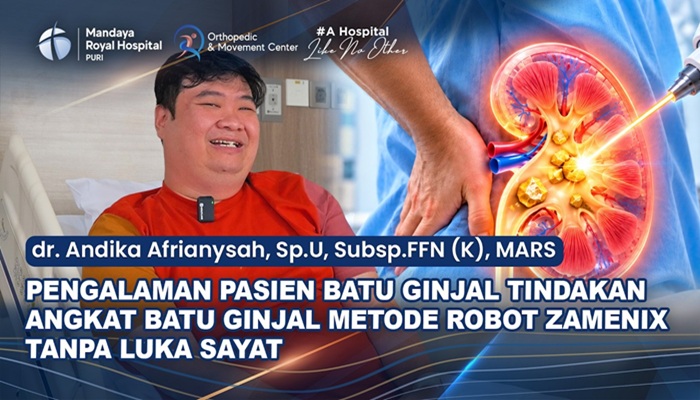
Kidney stones are a condition in which minerals and salts form hard deposits inside the kidneys. If left untreated, kidney stones can obstruct the urinary tract, trigger infections, cause severe pain, and even impair kidney function. Therefore, early examination and treatment are important, especially if symptoms occur during urination.
Today, kidney stone treatment is also supported by advances in medical technology, one of which is the use of the Zamenix robotic system. This technology is used in the Robotic Retrograde Intrarenal Surgery (RIRS) procedure, which involves breaking down kidney stones through the urinary tract without making any skin incisions. The Zamenix robotic system helps doctors control instruments with greater stability and precision throughout the procedure.

One patient who underwent this procedure was Robin, a man diagnosed with a 1.5 cm kidney stone in his left kidney. At Mandaya Royal Hospital Puri, Robin underwent surgery using the Zamenix robotic system with dr. Andika Afriansyah, Sp.U, Subsp. FFN (K), MARS, a urologist specializing in functional, female, and neuro-urology.
“My urine volume has returned to normal, and urination is flowing smoothly again. That’s the most noticeable improvement I’ve experienced. I had an X-ray yesterday, and everything has been checked. My right kidney is now clear. The stones are gone; everything has been cleared,” said the patient after undergoing Zamenix-assisted kidney stone surgery.

Contents
The Patient’s Condition Before Undergoing Kidney Stone Surgery with Zamenix
Before undergoing surgery, Robin experienced several symptoms indicating urinary tract problems. He had a fever, pain in his left flank, occasional urinary urgency, and sometimes blood in his urine.
In addition, Robin also noticed changes in the amount of urine he passed. However, because these changes were not always accompanied by pain, he initially considered them normal changes associated with aging.
After further examination using a CT scan, doctors identified a kidney stone measuring approximately 1.5 cm in his left kidney. The condition was subsequently treated through an RIRS procedure using the Zamenix robotic system.
Interestingly, the procedure on Robin’s left kidney was his second kidney stone surgery. Approximately three weeks earlier, he had undergone a procedure to treat a stone in his right kidney, which included stent placement and stone removal.
Based on Robin’s experience, there was a difference in the duration of the two procedures. The first surgery on his right kidney took approximately 3–4 hours, while the procedure on his left kidney with the assistance of the Zamenix robot was estimated to take around 1.5–2 hours.
After the procedure, Robin noticed that his urine volume had returned to normal and that urination had become smoother. An X-ray examination also showed that the stones in his right kidney had been successfully cleared.
This experience made Robin realize the importance of seeking medical attention whenever unusual changes occur during urination.
Read also: 8 Signs of Kidney Stones and Their Treatment at Mandaya Royal Hospital Puri
Dr. Andika Afriansyah, Sp.U, Subsp. FFN (K), MARS Explains the Zamenix Robotic System
According to dr. Andika, using the Zamenix robotic system in RIRS procedures offers several advantages over conventional techniques. One of these is helping doctors perform procedures with greater stability and precision, particularly when treating relatively large kidney stones.
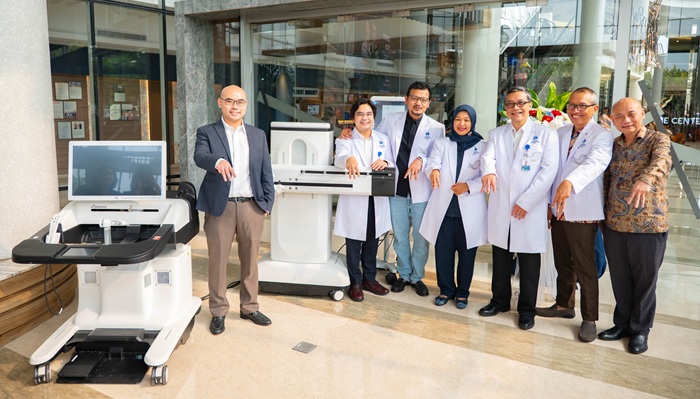
In conventional RIRS procedures, doctors need to manually hold and control the scope or endoscopic instrument for extended periods. When surgery lasts several hours, operator fatigue can affect the stability of instrument movements.
The Zamenix robotic system is designed to help overcome these challenges. According to dr. Andika, this technology offers three main advantages:
1. Reduces Operator Fatigue
During surgery for large kidney stones, doctors need to control the scope for extended periods to reach and break down the stones. The robotic arm helps maintain instrument stability, so doctors do not have to continuously control the scope manually.
2. Equipped with AI Tracking That Follows Breathing Movements
The Zamenix robotic system features AI tracking technology that synchronizes instrument movements with the patient’s breathing patterns. This allows the position of the scope and laser to adjust to kidney movements as the patient breathes.
This feature helps reduce the risk of the instrument or laser accidentally hitting the kidney wall.
3. Features Stone Position Storage and Autopilot Functions
One of Zamenix’s notable features is its ability to store the positions of kidney stones previously identified by the doctor.
When doctors need to return to the location of a stone, the system can help guide the instrument based on the previously saved position. This feature works similarly to an autopilot system, allowing doctors to avoid repeating the entire process of locating the stone from the beginning.
This technology helps simplify navigation during surgery while supporting greater procedural accuracy and efficiency.
According to dr. Andika, the combination of these three features can improve doctors’ control during RIRS procedures, while also reducing potential operator fatigue and shortening procedure time when clinically appropriate.
Read also: Are Kidney Stones Dangerous? Learn About Their Potential Complications
Getting to Know the Zamenix Robotic System for Kidney Stone Surgery at Mandaya Royal Puri
The Zamenix robotic system is a robotic technology designed to assist doctors in treating kidney stones through RIRS procedures. This technology combines a robotic arm, small-sized endoscopic instruments, and laser technology to break down kidney stones.
At Mandaya Royal Hospital Puri, this technology is part of the Mandaya Institute of Robotic and Precision Urology services.
Here are some of the key advantages of the Zamenix robotic system:
- No skin incisions: The procedure is performed through the urinary tract using endoscopic instruments, eliminating the need for incisions in the abdominal or flank area.
- Stable robotic arm: Helps doctors control the scope more steadily when accessing different parts of the kidney.
- Thulium laser technology: The laser is used to break kidney stones into smaller fragments so they can be removed or cleared during the procedure.
- Supports treatment of large kidney stones: This technology can be used to treat kidney stones of various sizes, including those larger than 2 cm.
- AI tracking system: Helps synchronize instrument movements with the patient’s breathing patterns to support procedural safety.
- Stone position storage feature: Helps doctors return to previously identified stone locations, making the navigation process more efficient.
With these features, the Zamenix robotic system offers another minimally invasive option for kidney stone treatment. However, the choice of surgical method must still be tailored to the size, location, and number of stones, as well as each patient’s overall health condition.
Meet dr. Andika, a Urologist Specializing in Functional, Female, and Neuro-Urology at Mandaya Royal Puri
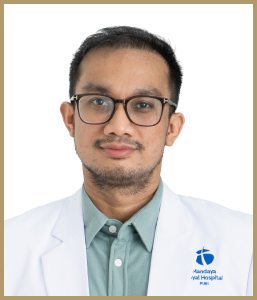
dr. Andika Afriansyah, Sp.U, Subsp. FFN (K), MARS is a urologist at Mandaya Royal Hospital Puri, specializing in functional, female, and neuro-urology.
He completed his general medical education at the University of Indonesia in 2008 before pursuing his urology specialist training at the same university, graduating in 2020.
To further develop his expertise, dr. Andika continued his training in Functional, Female, and Neuro-Urology through the Indonesian Urology College, which he completed in 2022.
In his clinical practice, dr. Andika treats various urinary tract and bladder function disorders, including:
- Urination disorders and difficulty passing urine.
- Urinary incontinence, a condition characterized by difficulty controlling urination.
- Overactive bladder.
- Urinary tract disorders in women.
- Bladder dysfunction caused by nerve disorders or neurological conditions.
In addition, dr. Andika is also part of the urology specialist team at the Mandaya Institute of Robotic and Precision Urology.
dr. Andika’s Consultation Schedule at Mandaya Royal Hospital Puri
dr. Andika Afriansyah, Sp.U, Subsp. FFN (K), MARS is available for consultations at Mandaya Royal Hospital Puri on the following days:
- Tuesday: 4:00 PM–8:00 PM
- Thursday: 4:00 PM–8:00 PM
- Saturday: 9:00 AM–4:00 PM
Facilities for Out-of-Town and International Patients at Mandaya Royal Hospital Puri


Mandaya Royal Hospital Puri provides various supporting facilities to ensure greater comfort for patients traveling from other cities or overseas:
- VIP Transport: A pick-up service from Soekarno-Hatta International Airport, train stations, or seaports to the hospital using comfortable vehicles, accompanied by a Patient Experience Officer (PEO).
- Medical Ambulance Pick-Up: A dedicated pick-up service for patients with specific medical conditions from arrival points (airports, train stations, or seaports), equipped with medical equipment and accompanied by professional healthcare personnel.
- Accommodation (Sleep Hub & Apartments): Comfortable accommodation facilities for patients’ families, located directly on the 8th floor of the Mandaya Royal Puri building, as well as nearby apartment options.
- International Patient Relation: Dedicated assistance for international patients, covering medical coordination, interpretation services, and administrative arrangements. For information and assistance from the International Patient Relation team, please contact 021 5092 8888 or email [email protected].
To make your visit to Mandaya Royal Hospital Puri more convenient, you can use the WhatsApp Chat feature, Book Appointment service, or the Care Dokter application, available for download on Google Play and the App Store. These services make it easier to arrange visits, check queue numbers, and access other important information.
The information provided on this page is intended for educational purposes and general reference only. It does not represent the full range of medical services that each doctor may perform. To ensure that you receive treatment appropriate to your health condition, we recommend consulting directly with the relevant doctor.
If you have any questions, suggestions, or require further information, please contact our call center at 0811-1900-2000.