


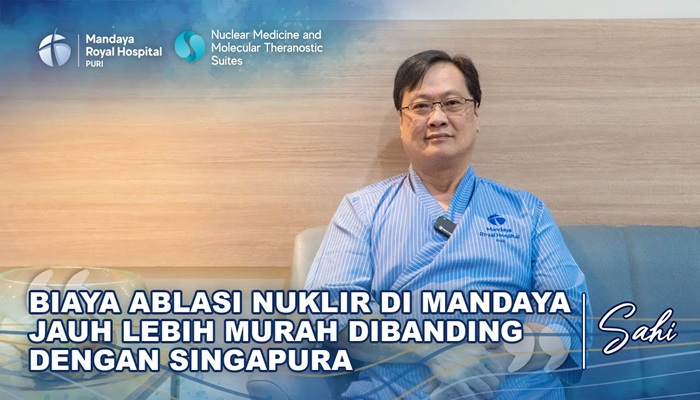
Thyroid cancer is one of the cancers that often does not cause symptoms in its early stages. Many patients only become aware of the condition after noticing a lump in the neck or during a routine health examination. Following thyroid gland removal surgery, some patients may still require additional treatment, such as nuclear ablation therapy, to help eliminate any remaining thyroid tissue or cancer cells.
This was the case for Mr. Sahi, a papillary thyroid cancer patient who initially planned to undergo nuclear ablation therapy in Singapore. However, after conducting further research, he discovered that the same treatment was available at Mandaya Royal Puri Hospital in Indonesia at a much more affordable cost.
“It was still too expensive. To be honest, receiving treatment there (in Singapore) could cost twice as much. I had asked around about the price, and if I’m not mistaken, it was around SGD 17,000. Besides the very high medical costs, we would also need to pay for accommodation, and language could also be a challenge. When I searched for ablation therapy in Indonesia, I found that Mandaya Royal Hospital Puri offers ablation treatment. I also learned that the medication used is the same as in Singapore, but it’s much more affordable here,” said Mr. Sahi.
Contents
It All Started with a Neck Lump That Caused No Symptoms
Mr. Sahi admitted that he initially did not experience any symptoms. He was able to carry out his daily activities as usual without pain or other health issues. However, one day, a friend noticed a lump on his neck while they were having a conversation.
After examining himself in the mirror, he realized there was indeed a noticeable lump in the neck area. Although it was painless, its presence concerned him, prompting him to seek medical evaluation.
Following a series of examinations, Mr. Sahi was diagnosed with papillary thyroid cancer. Since the diagnosis was made during the COVID-19 pandemic, he initially postponed surgery. Eventually, in 2023, he underwent a total thyroidectomy in Singapore.
After the surgery, his doctor recommended nuclear ablation therapy to eliminate any remaining cancerous tissue that might still be present in his body.
Canceling Nuclear Ablation Therapy Plans in Singapore Due to High Costs
During a follow-up consultation in Singapore, Mr. Sahi received information about the nuclear ablation therapy recommended by his doctor. However, after considering various factors, particularly the cost of treatment, he began exploring alternative options.
According to him, the expenses associated with undergoing nuclear ablation therapy in Singapore were extremely high. At the time, the estimated cost was approximately SGD 17,000, equivalent to around IDR 200 million. In addition to medical expenses, patients must also consider accommodation, transportation, and daily living costs while staying abroad.
While searching for similar services in Indonesia, he discovered that Mandaya Royal Puri Hospital provides nuclear ablation therapy for thyroid cancer patients. After consulting with dr. Eko Purnomo, Sp.KNTM (K) Onk, a nuclear medicine specialist at Mandaya, he learned that the treatment protocol and medication used were the same as those recommended in Singapore.
The more affordable cost, proximity to his home, and ease of communication were the main factors that convinced him to undergo treatment in Indonesia.
In addition, he was impressed by the facilities available at Mandaya Royal Puri Hospital. According to him, the hospital environment felt comfortable and did not resemble the typical hospital atmosphere.
Experience Undergoing Nuclear Ablation Therapy at Mandaya Royal Puri Hospital
Before undergoing nuclear ablation therapy, patients must complete several preparations prescribed by their doctor. For thyroid cancer cases, these preparations generally include temporarily stopping thyroid hormone medication and following a low-iodine diet for a specific period before treatment.
Once all preparations are completed, patients receive nuclear ablation therapy using radioactive iodine (I-131), administered in capsule form and taken orally. The procedure is generally straightforward and does not require additional surgery.
The Typical Steps of Nuclear Ablation Therapy for Thyroid Cancer
1. Taking a Radioiodine (I-131) Capsule
Radioiodine is administered orally and has no distinctive color, odor, or taste, making the process similar to taking a regular medication.
2. Staying in a Dedicated Isolation Room
After receiving radioiodine therapy, patients are required to stay in a specialized isolation room for approximately 3–5 days, depending on the prescribed dose. This isolation period helps prevent radiation exposure to others until the radiation level within the patient’s body decreases to a safe level.
During isolation at Mandaya Royal Puri Hospital, patients can remain comfortable thanks to various in-room facilities, including a 55-inch smart TV, coffee and tea maker, microwave, and refrigerator available throughout their stay.
Based on his experience, Mr. Sahi reported no significant discomfort during the treatment. He was even able to continue working from the isolation room throughout the treatment period.
He also praised the quality of service, noting that every step of the therapy had been explained thoroughly well in advance. The hospital team actively reminded him about schedules, preparation requirements, and procedures to follow during treatment.
Following the first treatment, evaluation results showed that his thyroglobulin level—one of the indicators used to monitor thyroid cancer—had decreased. To optimize the treatment outcome, he later underwent a second nuclear ablation therapy session as recommended by his doctor.
Through his experience, Mr. Sahi hopes that people will not delay medical evaluation if they discover a lump or any suspicious symptoms. According to him, the earlier cancer is detected, the greater the opportunity for effective treatment. He also believes that cancer treatment services in Indonesia have advanced significantly, including nuclear ablation therapy for thyroid cancer, which is available at Mandaya Royal Puri Hospital with facilities and technology comparable to those found overseas.
Profile and Practice Schedule of dr. Eko, Nuclear Medicine Specialist at Mandaya Royal Puri Hospital
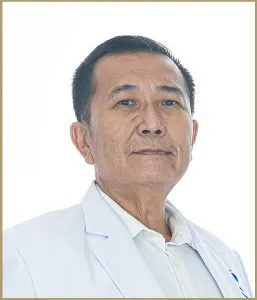
dr. Eko Purnomo, Sp.KNTM (K) Onk is a nuclear medicine and molecular therapy consultant oncologist with extensive experience in diagnosing and treating various diseases, particularly cancer and thyroid gland disorders.
In his clinical practice, he provides a wide range of nuclear medicine services, including:
- Thyroid ablation therapy
- Hyperthyroidism therapy
- Thyroid cancer treatment
- Prostate cancer therapy
- PET Scan examinations
- Whole Body Scan
- Bone Scan
- Renography
dr. Eko completed his medical degree at the Faculty of Medicine, Atma Jaya Catholic University of Indonesia, Jakarta. He then pursued his Nuclear Medicine specialty training at Hasan Sadikin Hospital, affiliated with the Faculty of Medicine, Padjadjaran University, Bandung.
With his educational background and experience in nuclear medicine, dr. Eko plays an important role in helping patients obtain accurate diagnoses and appropriate treatments tailored to their specific conditions.
Practice Schedule
dr. Eko Purnomo, Sp.KNTM (K) Onk is available at Mandaya Royal Puri Hospital on:
- Monday: 11:00 AM – 5:00 PM
- Tuesday: 11:00 AM – 5:00 PM
- Wednesday: 11:00 AM – 5:00 PM
- Thursday: 11:00 AM – 5:00 PM
- Friday: 1:00 PM – 5:00 PM
To make your visit to Mandaya Royal Hospital Puri more convenient, you can use the WhatsApp Chat feature, Book Appointment service, or the Care Dokter application, available on Google Play and the App Store, to schedule appointments, view queue numbers, and access other useful information.
The information provided on this page is intended for educational and general informational purposes only and does not represent the full scope of medical services that may be performed by each physician. To ensure treatment appropriate to your condition, a direct consultation with the relevant doctor is recommended.
If you have any questions, suggestions, or require further information, please contact our call center at 0811-1900-2000.