



Immune thrombocytopenia (ITP) is an autoimmune disorder that occurs when the immune system mistakenly identifies healthy platelets as foreign substances and destroys them. Platelets are blood components that play an important role in blood clotting to help stop bleeding.
When platelets are destroyed excessively, their number in the blood decreases. This makes it more difficult for the body to form blood clots, increasing the risk of bleeding in children.
According to data from Indonesia’s Ministry of Health, ITP affects approximately 50–150 people per million population each year. Around half of those affected are children.

Contents
Symptoms of ITP in Children
ITP sometimes causes no symptoms. However, when symptoms do occur, they may include:
- Easy bruising: Bruises may develop even after minor bumps or injuries.
- Small reddish-purple spots on the skin (petechiae): These tiny spots result from bleeding beneath the skin. They commonly appear on the lower legs and may resemble a rash.
- Larger areas of bleeding beneath the skin (purpura): These occur when blood leaks into the skin, creating patches larger than petechiae.
- Bleeding from the gums or nose: This may occur spontaneously or more easily when brushing the teeth.
- Blood in the urine or stool: This may indicate bleeding in the urinary or digestive tract.
- Heavy menstrual bleeding: This may occur in girls who have started menstruating.
When Should You See a Doctor?
Consult a doctor promptly if you or your child develops concerning symptoms, particularly unusual bruising, reddish-purple spots on the skin, or recurrent bleeding.
Bleeding that does not stop is a medical emergency. Seek immediate medical attention if bleeding cannot be controlled with first aid, such as applying direct pressure to the affected area. Do not delay treatment, especially when the bleeding occurs in a child.
Causes of ITP in Children
ITP occurs when the immune system mistakenly attacks platelets, the blood components responsible for clotting. In this condition, the immune system produces antibodies that incorrectly identify platelets as foreign substances or threats. These antibodies then trigger other immune cells to attack and destroy the platelets.
Normally, when a blood vessel is injured or damaged, platelets gather at the affected site and stick together to form a clot. This process helps stop bleeding. However, when platelets are destroyed excessively because of ITP, their number in the blood decreases, potentially disrupting the clotting process.
To date, experts do not fully understand what triggers the immune system to attack platelets in people with ITP. However, research suggests that several conditions may be associated with an increased risk of ITP, including:
- HIV infection: A viral infection that attacks the immune system.
- Helicobacter pylori (H. pylori) infection: An infection caused by bacteria that can affect the stomach.
- Hepatitis C: A viral infection that affects the liver.
Having any of these conditions does not necessarily mean that a person will develop ITP. ITP can also occur without a clearly identifiable cause or trigger.
Treatment for ITP in Children: From Monitoring to Medical Therapy
Treatment for ITP in children depends on the platelet count, the severity of symptoms, and the risk of bleeding. Children with mild symptoms may not need specific treatment and may only require regular monitoring by a doctor. However, in certain cases, doctors may prescribe therapies to increase the platelet count or reduce the immune system activity responsible for attacking platelets.
Treatment options for ITP include:
- Corticosteroids: These medications help suppress the immune response responsible for producing antibodies that destroy platelets. They may help increase the platelet count temporarily.
- Immunoglobulin and thrombopoietin receptor agonists: Immunoglobulin can help reduce platelet destruction, while thrombopoietin receptor agonists stimulate the bone marrow to produce more platelets.
- Immunosuppressants: These medications suppress immune system activity that attacks platelets. They may be used in certain circumstances based on the doctor’s assessment.
- Treatment of underlying infections: If a particular infection is contributing to the low platelet count, the doctor may prescribe treatment for that infection.
- Medication adjustments: A doctor may recommend stopping or changing certain medications, such as aspirin, that can increase the risk of bleeding. Do not stop any prescribed medication without consulting your doctor first.
- Platelet transfusions: In cases of serious bleeding, donor platelets may be given as part of emergency medical treatment.
- Surgical removal of the spleen (splenectomy): In selected cases, doctors may consider removing the spleen, an organ involved in platelet destruction. However, this procedure can increase the risk of infection and therefore requires careful consideration.
Children with ITP Can Recover: Parents Should Not Lose Hope
Learning that a child has been diagnosed with ITP can understandably make parents feel worried. However, the good news is that many children with ITP improve within several weeks to a few months, sometimes without requiring specific treatment. Nevertheless, each child’s course of the condition may differ depending on their health and the severity of the disease.
In some people, ITP may last longer or become chronic. When this happens, doctors may recommend medications or other therapies to help control symptoms and manage bleeding risks based on the platelet count and the patient’s overall condition.
Although there is no treatment that guarantees a cure for chronic ITP, the condition can still be managed. Many people with chronic ITP live for decades. Therefore, parents do not need to lose hope if their child is diagnosed with ITP. With regular medical monitoring, appropriate treatment, and family support, children can still have the opportunity to participate in daily activities and grow and develop well.
Consult a Pediatric Hematology-Oncology Consultant for Your Child’s ITP at Mandaya Royal Hospital Puri
If your child experiences symptoms that may indicate immune thrombocytopenia (ITP), such as easy bruising, red spots on the skin, or unusual bleeding, parents can consult a pediatric hematology-oncology specialist. The doctor can evaluate the child’s condition, determine which examinations are needed, and develop a treatment plan based on the platelet count and symptoms.
Mandaya Royal Hospital Puri has pediatric hematology-oncology specialists experienced in managing various blood disorders in children. The following doctors are available for consultation.
1. dr. Ludi Dhyani Rahmartani, Sp.A, Subsp. H.Onk (K)

dr. Ludi Dhyani Rahmartani, Sp.A, Subsp. H.Onk (K), is a pediatric hematology-oncology consultant at Mandaya Royal Hospital Puri who treats various blood disorders and cancers in children. Her areas of expertise include leukemia, thalassemia, brain tumors, and other childhood cancers. She also manages diagnostic evaluations, treatment planning, and monitoring throughout a child’s treatment.
dr. Ludi completed her medical degree at the University of Indonesia in 2002 and continued her pediatric specialist training at the same university, graduating in 2015. She subsequently pursued subspecialty training in pediatric hematology-oncology, which she completed in 2021.
Some of the conditions and medical procedures within dr. Ludi’s areas of expertise include:
- Treatment of childhood leukemia, including chemotherapy and therapies tailored to the type of leukemia.
- Management of thalassemia and various blood disorders in children.
- Treatment of brain tumors and other childhood cancers.
- Chemotherapy, targeted therapy, and immunotherapy for childhood cancer.
- Bone marrow transplantation.
Consultation schedule at Mandaya Royal Hospital Puri:
- Thursday: 5:30–7:30 PM WIB.
2. dr. Fatimah Saidah, Sp.A, Subsp. H.Onk. (K)
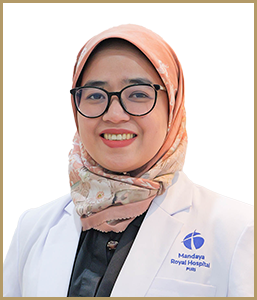
dr. Fatimah Saidah, Sp.A, Subsp. H.Onk. (K), is a pediatric hematology-oncology consultant at Mandaya Royal Hospital Puri with experience treating various blood disorders and cancers in children. The conditions she manages include anemia, thalassemia, blood cancers, and solid tumors, including brain tumors.
In treating childhood cancer, dr. Fatimah is experienced in providing systemic therapies, such as chemotherapy, as well as bone marrow transplantation when medically indicated. Treatment plans are tailored to the type of disease, the child’s health, and each patient’s individual needs.
Some of dr. Fatimah’s areas of expertise include:
- Management of blood disorders in children, including anemia, thalassemia, and blood cancers.
- Treatment of blood cancers using chemotherapy and bone marrow transplantation when medically indicated.
- Management of childhood cancers and solid tumors, including brain tumors.
Consultation schedule at Mandaya Royal Hospital Puri:
- Monday: 5:00–7:00 PM WIB.
- Wednesday: 5:00–7:00 PM WIB.
- Friday: 5:00–7:00 PM WIB.
Facilities for Out-of-Town and International Patients at Mandaya Royal Hospital Puri


Mandaya Royal Hospital Puri provides various support facilities to offer additional comfort for patients traveling from other cities or overseas.
- VIP transport: Pick-up services from Soekarno-Hatta International Airport, train stations, or seaports to the hospital in comfortable vehicles accompanied by a Patient Experience Officer (PEO).
- Medical ambulance pick-up: Dedicated pick-up services for patients with specific medical needs from arrival points, including airports, train stations, and seaports. The service is equipped with medical equipment and supported by professional healthcare personnel.
- Accommodation (Sleep Hub and apartments): Comfortable accommodation for families accompanying patients. The Sleep Hub is located on the eighth floor of the Mandaya Royal Hospital Puri building, with nearby apartments also available.
- International Patient Relations: Dedicated assistance for international patients with medical coordination, interpretation, and administrative arrangements. For information and assistance, contact International Patient Relations at 021 5092 8888 or email [email protected].
To make your visit to Mandaya Royal Hospital Puri easier, use the WhatsApp chat feature, Book Appointment, or the Care Dokter app, available for download on Google Play and the App Store. These options help you arrange visits, check queue numbers, and access other useful information.
The information provided on this page is intended for educational purposes and general reference. It does not represent the full range of medical services that each doctor may provide. To determine the most appropriate treatment for your health condition, we recommend consulting the relevant doctor directly.
If you have any questions, suggestions, or need further information, please contact our call center at 0811-1900-2000.

References
- Boston Children’s Hospital. Immune Thrombocytopenia (ITP). (https://www.childrenshospital.org/conditions-treatments/immune-thrombocytopenia-itp). Accessed October 28, 2026.
- Mayo Clinic. Immune Thrombocytopenia (ITP): Symptoms & Causes. (https://www.mayoclinic.org/diseases-conditions/idiopathic-thrombocytopenic-purpura/symptoms-causes/syc-20352325). Accessed October 28, 2026.
- Cleveland Clinic. Immune Thrombocytopenia (ITP). (https://my.clevelandclinic.org/health/diseases/5726-immune-thrombocytopenia). Accessed October 28, 2026.
- Ministry of Health of the Republic of Indonesia. Idiopatik. (https://keslan.kemkes.go.id/view_artikel/1463/idiopatik-). Accessed October 28, 2026.