
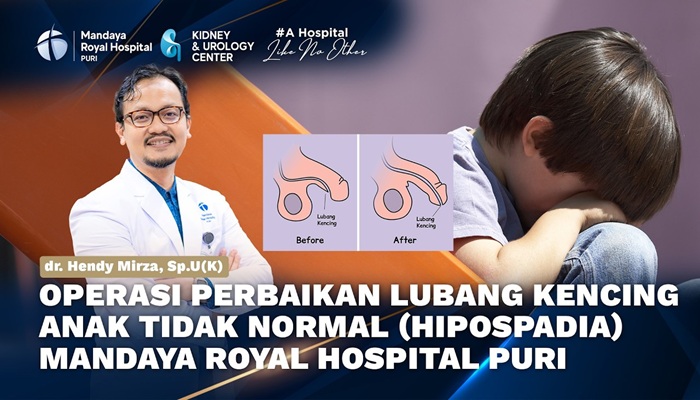
Hypospadias (Urethral Opening Not Located at the Tip of the Penis) Treated by dr. Hendy Mirza, Sp.U(K) at Mandaya Royal Hospital Puri

Lubang Kencing Tidak Terletak di Ujung Penis (Hipospadia) Ditangani oleh dr. Hendy Mirza Sp.U (K) di RS Mandaya Royal Puri

Hypospadias is a congenital condition in baby boys that develops while the baby is still in the womb. In this condition, the opening of the urethra is located on the underside of the penis instead of at the tip. The urethra is the tube that carries urine from the bladder out of the body. Hypospadias is a relatively common birth defect and is usually identified shortly after birth.

Most cases of hypospadias can be successfully treated with surgery. The goal of the procedure is to reposition the urethral opening so the child can urinate normally while also restoring the appearance and function of the penis. With appropriate treatment, most children with hypospadias grow up with normal urinary and reproductive function.

dr. Hendy Mirza, Sp.U (K)

Recently, dr. Hendy Mirza, Sp.U(K), a pediatric urology consultant at Mandaya Royal Hospital Puri, successfully treated a child with hypospadias. With extensive experience in managing pediatric urological disorders, dr. Hendy provides individualized treatment tailored to each patient’s condition to restore urinary function and support healthy reproductive development.

Understanding Hypospadias and Its Surgical Treatment with dr. Hendy Mirza, Sp.U(K)

According to dr. Hendy, hypospadias is a congenital abnormality of the penis that can affect urinary function and therefore requires treatment based on its severity.

One of the hallmark characteristics of hypospadias is that the urethral opening is not located at the tip of the penis. As a result, urine does not flow normally, which may interfere with the child’s daily activities.

“This patient was born with hypospadias, a congenital abnormality in which the urethral opening is not located at the tip of the penis but further down along the penile shaft. As a result, the patient is unable to urinate normally,” explained dr. Hendy.

In addition to an abnormally positioned urethral opening, some children with hypospadias also have narrowing of the urethra and a downward curvature of the penis (chordee). Therefore, the goal of surgery is not only to reposition the urethral opening but also to straighten the penis to restore normal function.

Dr. Hendy explained that one of the key principles of hypospadias repair (urethroplasty) is correcting the penile curvature before reconstructing the urethra.

“The first principle of hypospadias repair, or urethroplasty, is to straighten the curved penis because penile curvature is one of the abnormalities associated with hypospadias,” he added.

The surgical technique is selected according to each patient’s condition. After surgery, patients typically return for a follow-up visit about one week later to evaluate healing and ensure that urinary function has returned to normal.

Types of Hypospadias

Hypospadias is classified according to the location of the urethral opening. In general, the farther the opening is from the tip of the penis, the more severe the condition.

1. Glanular (Balanic) Hypospadias

Glanular hypospadias occurs when the urethral opening is located on the head of the penis but not exactly at the tip. This is the mildest and easiest type of hypospadias to treat.

2. Coronal Hypospadias

Coronal hypospadias is the most common type. In this condition, the urethral opening is located just below the head of the penis, at the junction between the glans and the shaft.

3. Midshaft Hypospadias

In midshaft hypospadias, the urethral opening is located along the middle portion of the penile shaft. Surgical correction is usually required to restore normal urinary function and anatomy.

4. Penoscrotal Hypospadias

Penoscrotal hypospadias occurs when the urethral opening is located where the penis meets the scrotum. This type is considered more severe than the previous forms.

5. Scrotal or Perineal Hypospadias

This is the most severe type of hypospadias. The urethral opening is located on the scrotum or even farther down in the perineum, the area between the scrotum and the anus. These cases are generally more complex and require reconstructive surgery by an experienced pediatric urologist.


What Are the Symptoms of Hypospadias in Children?

The primary sign of hypospadias is that the urethral opening is located on the underside of the penis rather than at the tip. In addition, children with hypospadias may experience the following symptoms:

  • An abnormal urine stream. Urine may spray to the side or downward, making it difficult for the child to urinate while standing. In some cases, the abnormal urine flow can also cause irritation of the surrounding skin.
  • An underdeveloped foreskin. The foreskin covers only part of the head of the penis, giving it an unusual appearance. Since the foreskin is often used as tissue during hypospadias repair surgery, children with this condition should not undergo circumcision before being evaluated by a pediatric urologist.
  • A downward-curved penis (chordee). The curvature may become more noticeable during an erection and, if left untreated, can affect penile function later in life.
  • Undescended testicles (cryptorchidism). In some children, one or both testicles have not descended into the scrotum at birth and require further medical evaluation.

If parents notice one or more of these signs in their baby or young boy, they should consult a pediatric urologist as soon as possible for proper evaluation and early treatment.

Causes and Prevention of Hypospadias

The exact cause of hypospadias remains unknown. However, experts believe that it results from a combination of genetic and environmental factors that affect the development of the baby’s reproductive organs during pregnancy.

Several factors are thought to increase the risk of hypospadias, including:

  • Family history. A child is more likely to develop hypospadias if the father or a brother was born with the same condition. Hypospadias may also be associated with certain genetic syndromes.
  • Fertility treatments. The use of hormone therapy or certain medications to assist pregnancy may increase the risk, although further research is still needed.
  • Maternal age and health. Babies born to mothers over the age of 35, those who are overweight or obese, or those with pre-existing diabetes may have a higher risk of hypospadias.
  • Exposure to cigarette smoke and pesticides during pregnancy. Certain chemicals may interfere with fetal development.
  • Premature birth. Babies born before full term are known to have a higher risk of developing hypospadias.

Although hypospadias cannot always be prevented, expectant mothers may reduce the risk by maintaining a healthy lifestyle during pregnancy, including:

  • Avoiding smoking and alcohol.
  • Maintaining a healthy weight before and during pregnancy.
  • Taking 400–800 micrograms (mcg) of folic acid daily, as recommended by a healthcare provider.
  • Attending regular prenatal check-ups to monitor the health of both mother and baby.

While these measures cannot guarantee that a baby will not develop hypospadias, they help support healthy fetal growth and development throughout pregnancy.

Consult dr. Hendy Mirza, Sp.U(K) at Mandaya Royal Hospital Puri

dr. Hendy Mirza, Sp.U(K) is a pediatric urology consultant at Mandaya Royal Hospital Puri with extensive experience treating a wide range of urinary tract conditions in both children and adults. His expertise includes hypospadias, congenital urinary tract abnormalities, urinary stones, enlarged prostate, and other urological disorders.

Dr. Hendy earned his medical degree from the Faculty of Medicine, Universitas Sumatera Utara, followed by specialist training in Urology at Universitas Indonesia. He later completed a Pediatric Reconstructive (Laparoscopic) Fellowship at Universitas Indonesia and obtained certification as a Pediatric Urology Consultant.

In addition to pediatric reconstructive urology, dr. Hendy performs various urological procedures, including kidney surgery, Percutaneous Nephrolithotomy (PCNL), Extracorporeal Shock Wave Lithotripsy (ESWL), ureterorenoscopy, prostate biopsy, Transurethral Resection of the Prostate (TURP), Transurethral Needle Ablation (TUNA), prostate examination and ultrasound, Retrograde Pyelography (RPG), lithoclast procedures, urinary tract surgery, and circumcision. With his extensive experience and expertise, he provides comprehensive, personalized care tailored to each patient’s condition.

Schedule a Consultation with dr. Hendy Mirza, Sp.U(K) at Mandaya Royal Hospital Puri

You can consult dr. Hendy Mirza, Sp.U(K) at Mandaya Royal Hospital Puri during the following clinic hours:

  • Monday: 4:00 PM – 7:00 PM (WIB)
  • Wednesday: 4:00 PM – 7:00 PM (WIB)
  • Friday: 4:00 PM – 7:00 PM (WIB)

To make your visit more convenient, you can use the WhatsApp Chat feature, Book Appointment, or the Care Dokter mobile application, available on Google Play and the App Store. The app allows you to schedule appointments, check queue numbers, and access additional hospital services and information.

The information provided on this page is intended for educational and general informational purposes only. It does not represent the full range of medical services that may be provided by each physician. To receive appropriate diagnosis and treatment based on your individual health condition, we recommend consulting directly with the relevant specialist.

If you have any questions, suggestions, or would like more information, please contact our call center at 0811-1900-2000.

References

  1. Mayo Clinic. Hypospadias.
    https://www.mayoclinic.org/diseases-conditions/hypospadias/symptoms-causes/syc-20355148
    Last updated: September 14, 2024. Accessed August 3, 2026.
  2. Cleveland Clinic. Hypospadias.
    https://my.clevelandclinic.org/health/diseases/15060-hypospadias
    Last updated: October 17, 2022. Accessed August 3, 2026.
  3. WebMD. What Is Hypospadias?
    https://www.webmd.com/parenting/baby/what-is-hypospadias
    Last updated: January 18, 2024. Accessed August 3, 2026.
Need Help? Chat with us!
Start a Conversation
Hi! Click one of our members below to chat on WhatsApp
We usually reply in a few minutes