



Difficulty speaking after a stroke, also known as aphasia, is a language disorder that affects a person’s ability to communicate. It most commonly occurs when a stroke damages the left side of the brain, the area responsible for speech and language functions.
People with aphasia may have difficulty speaking, understanding conversations, reading, or writing. As a result, everyday activities at home, in social settings, or at work can become more challenging. Many stroke survivors with aphasia also experience feelings of isolation due to their communication difficulties.
It is important to understand that aphasia does not affect intelligence. Stroke survivors with aphasia remain mentally alert and are often fully aware of their surroundings. However, they may struggle to express themselves or understand language, causing their speech to sound fragmented, unclear, or difficult to understand.

Contents
Recognizing the Symptoms of Aphasia After a Stroke
Common symptoms of aphasia in stroke patients include:
- Speaking in short or incomplete sentences.
- Producing sentences that are difficult to understand or lack meaning.
- Replacing one word with another or substituting incorrect sounds.
- Speaking words that are unrecognizable.
- Having difficulty finding the right words.
- Difficulty understanding conversations.
- Difficulty understanding written text.
- Writing sentences that do not make sense.
The symptoms of aphasia vary from person to person depending on the location and severity of brain damage caused by the stroke or other underlying conditions.
Why Can a Stroke Cause Speech Problems?
To understand why stroke can lead to speech impairment, it is important to first understand what a stroke is.
A stroke occurs when blood flow to the brain is reduced or completely blocked, preventing brain cells from receiving enough oxygen and nutrients. This results in damage to brain tissue. This type of stroke is known as an ischemic stroke, the most common form of stroke.
Stroke can also occur when a blood vessel in the brain ruptures, causing bleeding into the brain. This condition is called a hemorrhagic stroke, and it can also damage brain tissue and impair brain function.
Stroke is the leading cause of aphasia. In fact, approximately one in three stroke survivors develops aphasia.
The brain contains many blood vessels that supply different regions responsible for specific functions. Because of this, a stroke typically affects only certain parts of the brain, depending on where the blockage or bleeding occurs.
When a stroke damages the areas responsible for speech and language, aphasia may develop. Symptoms usually appear suddenly at the same time the stroke occurs and are generally most severe during the early stages after the stroke.
The brain’s language centers are primarily located in the left hemisphere, especially in Broca’s area, which controls speech production, and Wernicke’s area, which is responsible for language comprehension. Damage to one or both of these regions can significantly impair a person’s ability to speak, understand language, read, and write.
Why Is It Important to Treat Aphasia?
Aphasia can have a significant impact on the quality of life of stroke survivors because communication plays a vital role in daily living.
Communication difficulties caused by aphasia can affect many aspects of life, including:
- Employment and career.
- Relationships with family, friends, and partners.
- The ability to perform daily activities independently.
Difficulty expressing thoughts, emotions, and personal needs may also lead to embarrassment, frustration, social isolation, and even depression.
In addition to language impairment, stroke survivors with aphasia may experience other neurological problems, such as movement disorders, memory decline, and cognitive impairment. Therefore, comprehensive rehabilitation is essential to maximize recovery and improve long-term quality of life.
TMS Therapy for Speech Difficulties After Stroke at Mandaya Royal Hospital Puri
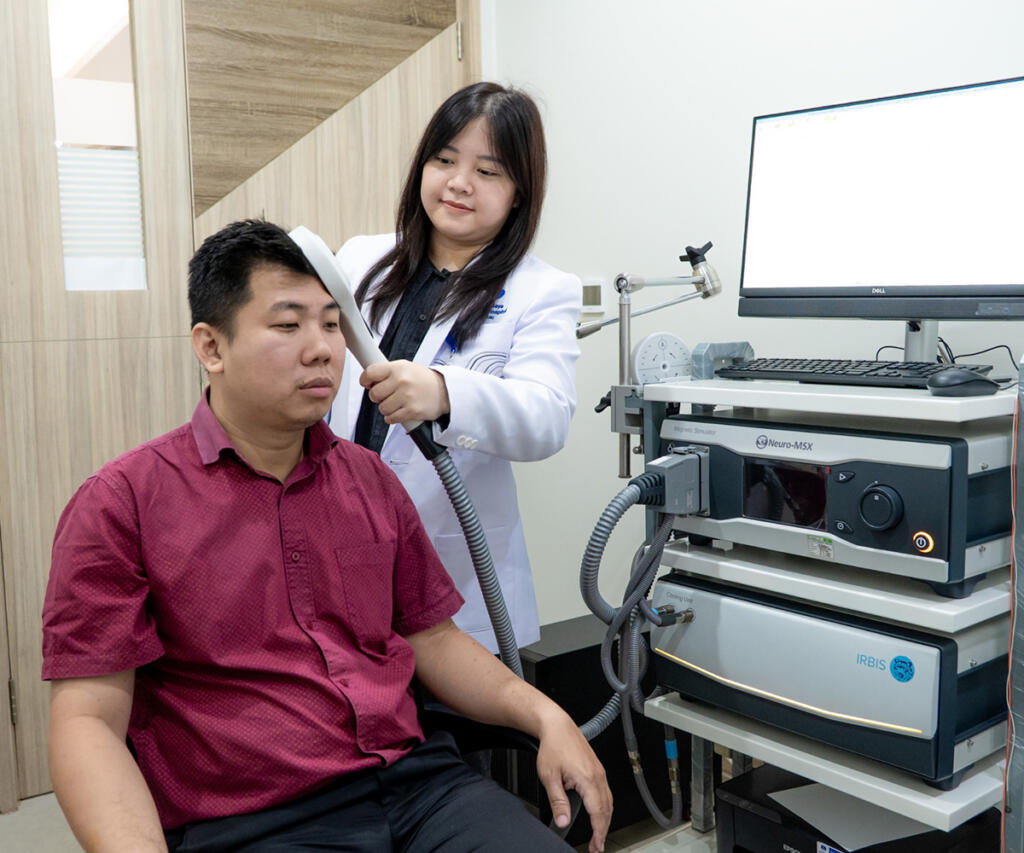
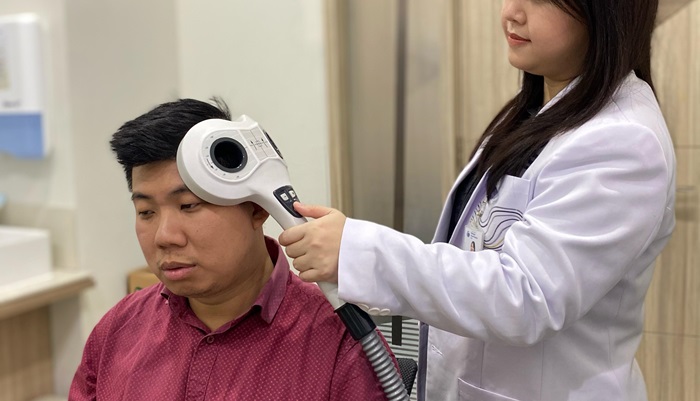
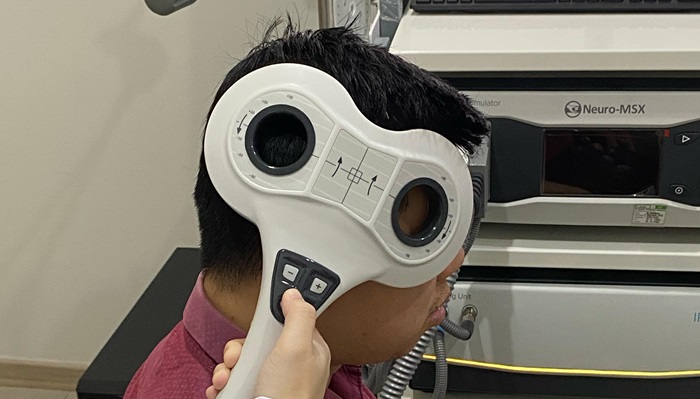
At Mandaya Royal Hospital Puri, stroke patients experiencing speech difficulties can undergo Transcranial Magnetic Stimulation (TMS), a non-invasive treatment that uses magnetic pulses to stimulate nerve cells in the brain. The procedure requires no surgery or incisions and is generally painless.
During the procedure, a small electromagnetic coil is placed over a specific area of the scalp corresponding to the targeted brain region. TMS works through the following process:
- The electromagnetic coil is positioned over the targeted area of the brain.
- The device generates magnetic pulses that safely pass through the skull without surgery.
- These magnetic pulses produce low-intensity electrical currents that stimulate nerve cells.
- The stimulation pattern is customized according to the patient’s condition, either to increase activity in underactive brain regions or reduce excessive activity.
- This stimulation is expected to improve neural function and support the recovery of brain function after stroke.
TMS Therapy Packages at Mandaya Royal Hospital Puri
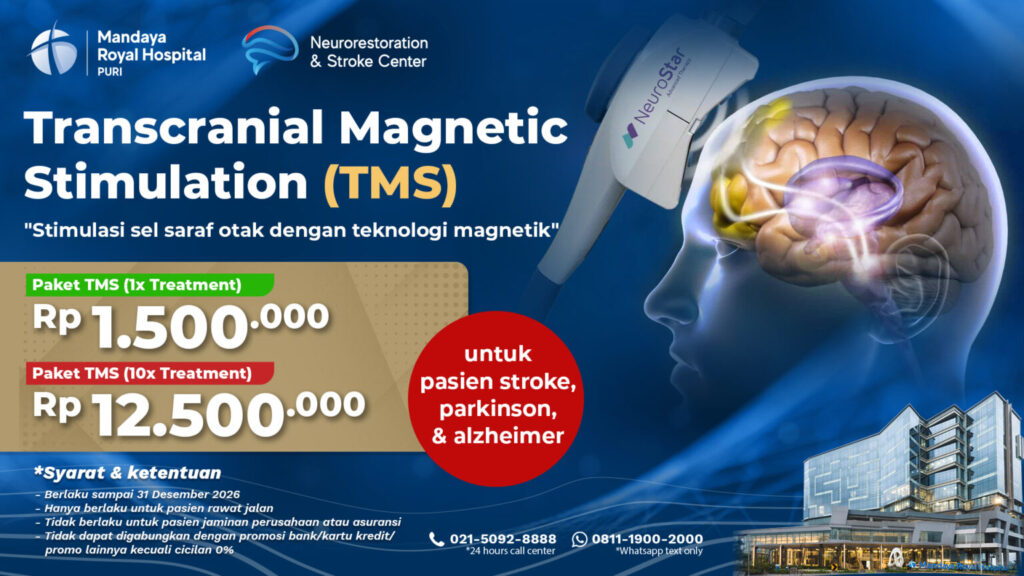
Mandaya Royal Hospital Puri offers TMS therapy packages starting from IDR 1,500,000 for a single session or IDR 12,500,000 for a package of ten sessions.
Each patient undergoes a comprehensive evaluation by experienced neurologists and rehabilitation specialists before an individualized treatment plan is developed.
Neurologist Specializing in Post-Stroke TMS Therapy at Mandaya Royal Hospital Puri
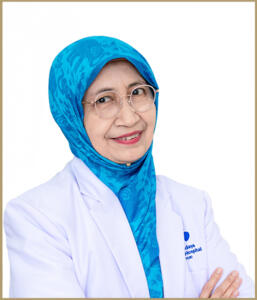
Patients seeking TMS therapy as part of post-stroke rehabilitation may consult Dr. dr. Yetty Ramli, Sp.N(K) at Mandaya Royal Hospital Puri.
Dr. Yetty is a neurologist specializing in neurorestoration, neurobehavior, and neurotrauma for both adult and pediatric patients. She has extensive experience treating a wide range of neurological disorders, including stroke, Parkinson’s disease, Alzheimer’s disease, and autism spectrum disorders.
In addition to TMS therapy, Dr. Yetty is experienced in various neuromodulation and neurorehabilitation techniques, including Transcranial Direct Current Stimulation (tDCS), Electroencephalography (EEG), and comprehensive neurorestoration approaches designed to optimize nervous system recovery.
She earned her medical degree from Andalas University, completed her neurology residency at the University of Indonesia, and obtained a Ph.D. in Veterinary Biomedical Sciences from Bogor Agricultural University (IPB University). She also completed multiple fellowship programs at Sydney Children’s Hospital, as well as fellowships in Neurobehavior, Neurorestoration, and Neurotrauma, providing her with extensive expertise in neurological rehabilitation.
Practice Schedule:
- Monday: 4:00 PM – 8:00 PM
- Wednesday: 4:00 PM – 8:00 PM
To make your visit to Mandaya Royal Hospital Puri more convenient, you can contact the hospital via WhatsApp Chat, use the Book Appointment feature, or download the Care Dokter mobile application from Google Play or the App Store to schedule appointments, check queue numbers, and access additional hospital services.
The information provided on this page is intended for educational purposes and general guidance only. It does not represent the full scope of medical services provided by each physician. For personalized diagnosis and treatment recommendations, please consult the appropriate medical specialist directly.
If you have any questions or require further information, please contact our call center at 0811-1900-2000.