



To answer the question, “Can breast cancer be cured?”, it is important to understand the difference between a cure and cancer remission. A cure means that the cancer has been eliminated from the body and is not expected to return. However, doctors generally cannot guarantee that cancer will never recur. Therefore, the term remission is more commonly used to describe how cancer responds to treatment.
Cancer remission is divided into two types: partial remission, in which the cancer has shrunk but has not disappeared completely, and complete remission, in which the signs and symptoms of cancer have disappeared and tests no longer detect evidence of the disease. According to the National Cancer Institute, cancer may be considered cured if it remains undetectable after five years of complete remission. Nevertheless, the likelihood of a cure and the risk of recurrence can vary from one breast cancer patient to another.

Contents
Can Breast Cancer Be Cured?
Breast cancer can achieve complete remission. This means that treatment has been effective and no signs of cancer are detectable. However, complete remission does not always guarantee that the cancer will never return.
A patient’s prognosis, or the expected course and outcome of the disease, depends on several factors, including:
- The type of breast cancer.
- The stage of breast cancer.
- The tumor grade.
- Estrogen receptor, progesterone receptor, and HER2 status, including whether these markers are positive or negative.
- The types of treatment available to the patient.
Breast cancer diagnosed at an early stage can often be treated effectively and generally has a very favorable prognosis.
According to the American Cancer Society (ACS), advanced-stage breast cancer is generally not curable in most cases. Nevertheless, treatment can often help to:
- Shrink the cancer.
- Slow cancer growth.
- Relieve symptoms.
- Extend the patient’s life expectancy.
Understanding the Stages of Breast Cancer
Determining the stage of breast cancer helps doctors plan treatment and estimate a patient’s prognosis, including the likelihood of successful treatment. One commonly used system is TNM, which considers the size and location of the tumor, as well as whether the cancer has spread to nearby lymph nodes or other organs. Breast cancer is classified into stages 0 through IV, with higher numbers indicating more advanced disease.
The stages of breast cancer are as follows:
- Stage 0: The cancer has not spread beyond the breast ducts. At this stage, the disease is almost always curable.
- Stage I: The tumor may measure less than 2 cm, with possible limited spread to lymph nodes in the armpit.
- Stage II: The tumor is generally 2–5 cm in size and may have spread to nearby lymph nodes.
- Stage III: The cancer has involved breast tissue and lymph nodes.
- Stage IV: The cancer has spread to other organs, such as the bones, liver, lungs, or brain. This is known as metastatic breast cancer and is more difficult to treat.
In addition to the cancer stage, doctors also consider the tumor grade, estrogen and progesterone hormone receptor status, and HER2 status. These factors help determine the cancer’s characteristics and guide the selection of appropriate treatment. For example, estrogen receptor-positive (ER-positive) breast cancer generally has a more favorable prognosis than some types of breast cancer that lack estrogen receptors.
Although the cancer stage is an important factor in determining prognosis, doctors need to consider the cancer’s overall characteristics and the patient’s health to provide a more accurate assessment of treatment outcomes.
What Are the Treatment Options for Breast Cancer?
Surgery is one of the main treatment methods for breast cancer. Its goal is to remove the tumor and minimize the risk of leaving cancer cells behind. Types of breast cancer surgery include:
- Mastectomy: Surgery to remove the entire breast.
- Lumpectomy: Surgery to remove the cancerous lump along with a margin of surrounding healthy tissue to help ensure that no microscopic cancer cells remain at the surgical margins.
- Breast reconstruction: Surgery to restore the shape of the breast after mastectomy.
Doctors may combine surgery with one or more of the following treatments:
- Radiotherapy: Uses high-energy X-rays to destroy cancer cells. It may be given before or after surgery, or serve as the primary treatment for patients who are not healthy enough to undergo surgery.
- Chemotherapy: Uses medication to destroy cancer cells throughout the body. It may be given before or after surgery and can also be used to treat cancer that has spread.
- Hormone therapy: Uses medication to block the effects of hormones that stimulate the growth of hormone receptor-positive cancer cells.
- Targeted therapy: Targets HER2 proteins that promote the growth of HER2-positive breast cancer or other specific vulnerabilities in cancer cells.
- Immunotherapy: Helps the immune system recognize and attack cancer cells. It is most commonly used for triple-negative breast cancer.
Doctors tailor treatment to each patient’s needs. Factors considered include the type and stage of cancer, as well as whether the patient is receiving treatment for the first time or experiencing a recurrence after previous treatment.
When Should You See a Doctor?
Consult a doctor promptly if you notice changes in your breast that do not go away after a few days. Most breast lumps are not cancerous, but some may be a sign of breast cancer. A medical examination and appropriate diagnostic tests are needed to determine the cause.
Mandaya Breast Cancer Center: Comprehensive Care From Detection to Treatment
Mandaya Royal Hospital Puri provides comprehensive breast cancer services, from early detection and diagnosis to treatment and breast reconstruction. Available services include:
- Breast cancer detection and diagnosis: Supported by 2D and 3D mammography, breast ultrasound, and Digital PET/CT scans to help evaluate the condition of the breast.
- Vacuum-Assisted Breast Biopsy (VABB): A procedure to collect breast tissue samples through a small incision. In selected cases, this method can also be used to remove small benign tumors with minimal incisions.
- Breast cancer surgery: Includes mastectomy to remove the entire breast and endoscopic lumpectomy to remove tumors through minimal incisions while preserving as much breast tissue as possible.
- Sentinel Lymph Node Biopsy (SLNB): A procedure to examine sentinel lymph nodes and assess the possibility of cancer spread. For eligible patients, this method can help doctors determine whether further lymph node removal is necessary while reducing the risk of lymphedema.
- Breast cancer therapy: Various treatment options are available, including radiotherapy, chemotherapy, immunotherapy, targeted therapy, and hormone therapy, tailored to each patient’s condition.
- Breast reconstruction: Services designed to help restore breast shape after surgery and support patients’ quality of life and self-confidence.
- High-Intensity Focused Ultrasound (HIFU): A technology that uses high-intensity sound waves to target and destroy certain benign tumor tissue without surgical incisions.
- Lymphedema Center: Specialized services for managing lymphedema, including swelling that may develop after breast cancer treatment. Care includes conservative therapies and microsurgical procedures, depending on the patient’s condition.
Facilities for Patients Traveling From Other Cities and Countries at Mandaya Royal Hospital Puri

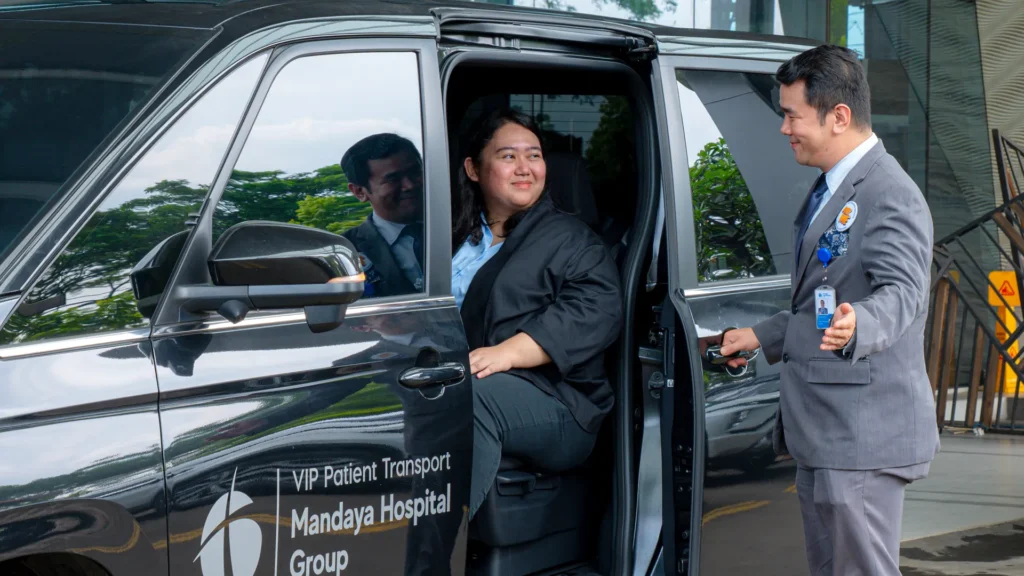
Mandaya Royal Hospital Puri provides a range of support services to offer additional convenience for patients traveling from other cities or abroad:
- VIP transportation: Pick-up services from Soekarno-Hatta International Airport, train stations, or seaports to the hospital in comfortable vehicles, accompanied by a Patient Experience Officer (PEO).
- Medical ambulance transportation: Specialized pick-up services for patients with specific medical needs from arrival points, including airports, train stations, and seaports. These services include medical equipment and assistance from professional healthcare personnel.
- Accommodation (Sleep Hub and apartments): Comfortable accommodation for families accompanying patients, available on the eighth floor of the Mandaya Royal Puri building, as well as nearby apartment options.
- International Patient Relations: Dedicated assistance for international patients with medical coordination, interpretation, and administrative arrangements. For information and assistance, contact 021 5092 8888 or email [email protected].
To make your visit to Mandaya Royal Hospital Puri easier, use Chat via WhatsApp, Book an Appointment, or the Care Dokter app, available for download on Google Play and the App Store. These options can help you arrange visits, check queue numbers, and access other information.
The information on this page is provided for educational purposes and as a general overview. It may not reflect the full range of medical services that each doctor can provide. To determine the most appropriate care for your medical condition, we recommend consulting the relevant doctor directly.
For questions, suggestions, or further information, please contact our call center at 0811-1900-2000.

References:
- Medical News Today. Is Breast Cancer Curable? https://www.medicalnewstoday.com/articles/is-breast-cancer-curable#is-it-possible. Accessed October 20, 2026.
- Cleveland Clinic. Breast Cancer. https://my.clevelandclinic.org/health/diseases/3986-breast-cancer. Accessed October 20, 2026.