


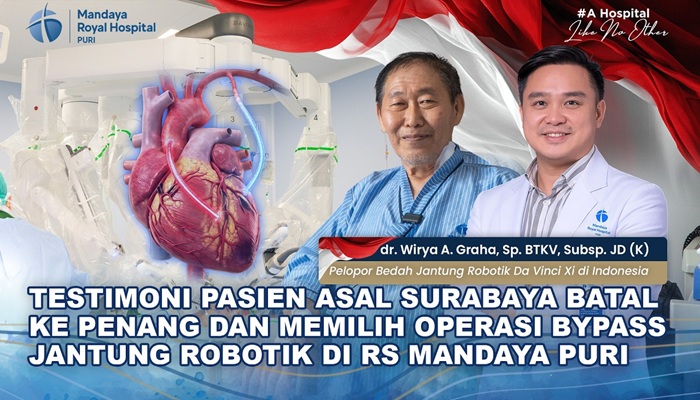
Coronary artery bypass surgery is one of the procedures used to treat blocked or narrowed heart blood vessels caused by coronary artery disease. During this procedure, doctors create a new pathway for blood flow using a healthy blood vessel from another part of the body as a bypass graft. This new pathway helps improve blood flow to the heart muscle that was previously affected by the blockage.
With advances in medical technology, heart bypass surgery does not always require a large incision. One option is minimally invasive cardiac surgery (MICS), which allows the procedure to be performed through smaller incisions. The procedure can also be assisted by the Da Vinci Xi surgical robot, which is designed to help doctors perform surgery with enhanced visualization and more precise instrument movements.
This was also the experience of Mr. Freddy, a patient from Surabaya who had initially planned to seek treatment in Penang, Malaysia, after receiving information that medical treatment there would be more affordable. However, he eventually chose to undergo robotic MICS heart bypass surgery with a Da Vinci Xi robot at Mandaya Royal Puri with dr. Wirya Ayu Graha, Sp. BTKV, Subsp. JD (K).
“Operasi (dengan dr. Wirya) hari Minggu malam. Hari ini (4 hari pascaoperasi) sudah bisa jalan. Sudah bisa muter-muter tadi. Terus bisa ke toilet sendiri. Luar biasa,” kata Pak Freddy.

Contents
Initially planned to seek treatment in Penang because it was rumored to be cheaper
Before discovering the blockage in his heart blood vessels, Mr. Freddy experienced symptoms that mainly appeared when his body started to feel tired. He felt discomfort in his chest, which sometimes made him need to stop for a while to recover.
He initially told his children about these symptoms. His family then advised him not to ignore them and to have his heart checked as soon as possible. He underwent several examinations, including an ECG and a treadmill test. The results showed blockages in his heart blood vessels that required further treatment.
Before undergoing the procedure at Mandaya Royal Puri, Mr. Freddy had considered seeking treatment in Penang. He had heard that the cost of heart treatment there would be more affordable.
“Kalau (operasi) jantung, lebih baik ke Penang dan di sana murah. Itu rumor yang ada. Tapi kenyataannya saya ke sana tidak murah juga (harganya),” ucap pasien.
After his examination showed blockages in several heart blood vessels, Mr. Freddy initially also considered having a ring or stent inserted.
However, after receiving further information about his condition, heart bypass surgery was considered more suitable for treating his blockages. Based on the examination results he brought with him, there were blockages in the left-side heart blood vessels, with blockage levels of approximately 90%, 80%, and 70%.
Mr. Freddy then looked for more information about the available treatment options. During his consultation in Penang, he was informed about a minimally invasive procedure that could be performed through the side of the chest. However, the explanation about the procedure actually made him feel concerned. As a layperson, he admitted that he still had many questions about the surgical process and what would happen to his heart during the procedure.
Because he was still uncertain, Mr. Freddy eventually decided to return to Indonesia and look for another treatment option. From Surabaya, he flew to Jakarta and visited Mandaya Royal Puri to consult with dr. Wirya.
At Mandaya Royal Puri, Mr. Freddy received an explanation about minimally invasive heart bypass surgery, or MICS, assisted by the Da Vinci Xi surgical robot. According to the explanation he received, the procedure could be performed through smaller incisions of approximately 5–6 cm, making it different from conventional heart bypass surgery, which generally requires a longer incision in the chest.
The explanation made Mr. Freddy more confident about undergoing the procedure in Indonesia. He also received information about dr. Wirya’s experience performing robotic MICS procedures, including treating patients with complex heart conditions.
Read also: The Difference Between Conventional and MICS (Minimally Invasive) Heart Bypass Surgery
Four days after surgery, Mr. Freddy was already able to walk
The decision to undergo robotic MICS heart bypass surgery with the Da Vinci Xi was ultimately made after Mr. Freddy received an explanation about the procedure and expected recovery. The surgery was performed by dr. Wirya on Sunday evening.
After undergoing robotic MICS heart bypass surgery with the Da Vinci Xi robot, Mr. Freddy’s condition gradually improved. Just four days after surgery, he was already able to walk, move around the hospital, and go to the toilet independently.
This experience became part of Mr. Freddy’s journey in choosing treatment for his heart condition without continuing his plans to seek treatment overseas. Based on his experience, advances in medical technology and the expertise of doctors in Indonesia give patients the option of receiving modern cardiac procedures domestically.
Read also: Treatment for Coronary Artery Disease: From Heart Stents to Bypass Surgery
Be aware of heart blood vessel blockages and their symptoms
Blockages in the heart blood vessels are commonly associated with coronary artery disease, a condition in which the blood vessels that carry blood and oxygen to the heart muscle become narrowed or blocked. This condition usually occurs due to plaque buildup in the walls of the blood vessels over many years.
In its early stages, coronary artery disease may not cause obvious symptoms. However, as the blood vessels become increasingly narrowed, the flow of blood and oxygen to the heart muscle may decrease, particularly when the heart requires more oxygen during physical activity.
Some symptoms that may occur include:
- Chest pain or discomfort (stable angina), especially during physical activity or periods of stress. Symptoms usually improve after resting.
- Shortness of breath, which may occur during physical activity, even during relatively light activities.
- Fatigue or reduced ability to perform physical activities.
In some people, coronary artery disease may only be discovered when a heart attack occurs. Therefore, symptoms such as chest pain or discomfort, particularly when they occur during physical activity, should not be ignored and should be evaluated to determine the underlying cause.
The advantages of robotic heart bypass surgery with Da Vinci Xi, explained by the specialist
The use of the Da Vinci Xi robot in heart bypass surgery offers several advantages, particularly in helping doctors perform procedures with a high degree of precision. According to dr. Wirya, some of these advantages include:
1. Clearer visualization of the surgical area
The Da Vinci Xi robotic system is equipped with a camera with high magnification capabilities. This technology allows doctors to see the surgical area in greater detail, including very small blood vessels.
With the magnified view, doctors can perform procedures more precisely in areas that require a high level of accuracy.
“Ketika kita menggunakan robot, kita menggunakan kamera dan zoom-nya itu besar. View-nya jadi lebih jelas, makanya sangat-sangat presisi. Bahkan 1 milimeter atau 2 milimeter itu sangat kelihatan di robot,” kata dr. Wirya.
2. Allows surgery through smaller incisions
The Da Vinci Xi robot helps doctors perform procedures through several small access points, eliminating the need for a large incision like the one used in conventional heart bypass surgery.
Smaller incisions may help reduce tissue trauma, including the risk of pain and bleeding, while supporting the recovery process after surgery.
3. Helps harvest blood vessels for the graft with greater precision
During heart bypass surgery, doctors need a healthy blood vessel from another part of the body to be used as a graft. The blood vessel is then used to create a new pathway so that blood can flow around the blocked section of the heart blood vessel.
One of the blood vessels that can be used is the left internal mammary artery (LIMA), a blood vessel located in the chest wall. With robotic assistance, this blood vessel can be harvested through smaller access points while helping doctors work with a high degree of precision.
“Fungsinya robot adalah mengambil pembuluh darah yang di dinding dada, yang nanti kita mau bypass ke jantung,” lanjut dr. Wirya.
LIMA has characteristics that make it suitable for use as a graft in heart bypass surgery. This blood vessel is particularly often used to create a bypass to the coronary artery at the front of the heart and is known for its durability, which may support the long-term results of bypass surgery.
Profile and practice schedule of dr. Wirya at Mandaya Royal Puri
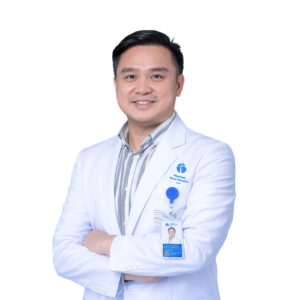
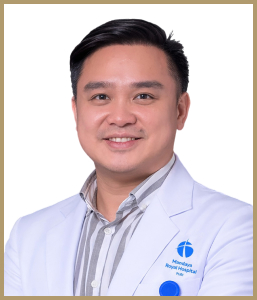
dr. Wirya A. Graha, Sp.BTKV, Subsp. JD (K) is a specialist in Thoracic, Cardiac, and Vascular Surgery (BTKV), with a subspecialty focus on adult cardiac surgery. Within two years, he has performed more than 400 MICS cases.
This experience also supports his role in developing and introducing MICS techniques in Indonesia, including for heart bypass surgery and heart valve replacement. With this approach, procedures can be performed through smaller incisions, generally around 6–8 cm, without fully opening the breastbone.
After completing his Thoracic and Cardiovascular Surgery specialist training at the Faculty of Medicine, Universitas Indonesia, dr. Wirya has expertise in performing various cardiac surgical procedures using minimally invasive approaches. MICS is one of his areas of focus, involving cardiac surgery through smaller incisions without fully opening the breastbone.
For patients who meet the appropriate criteria, the MICS approach may help reduce surgical trauma and support recovery after the procedure. In addition to MICS, he also performs various procedures involving the heart and blood vessels, including CABG or heart bypass surgery, heart valve surgery, and aortic surgery.
To continuously update his knowledge and skills in his field, dr. Wirya has also participated in various international scientific forums and training programs, including:
- 2017: 25th Annual Meeting of the Asian Society for Cardiovascular and Thoracic Surgery, Seoul, South Korea
- 2018: 28th Annual Meeting of the Association of the Thoracic and Cardiovascular Surgeon of Asia
- 2019: 1st Joint Biennial South East Asian Regional Congress on Cardiovascular and Thoracic Surgery in Collaboration with 20th MATCVS – Annual Scientific Meeting, Malacca
- 2021: 25th European Vascular Course and 5th European Cardiovascular Course
Patients who would like to consult about MICS, heart bypass surgery, heart valve surgery, or other heart and blood vessel conditions can meet with dr. Wirya A. Graha at Mandaya Royal Hospital Puri. His practice schedule is:
- Tuesday: 16:30–20:00 WIB
- Thursday: 16:30–20:00 WIB
- Saturday: 10:00–13:00 WIB
To make your visit to Mandaya Royal Hospital Puri easier, use the Chat via WhatsApp, Book an Appointment, or the Care Dokter app, which can be downloaded from Google Play and the App Store. The app allows you to make visits easier, check your queue number, and access other information.
*The information provided on this page is intended for educational purposes and general information only and does not represent all types of medical services that may be performed by each doctor. To ensure appropriate treatment based on your health condition, consultation with the relevant doctor is recommended.
If you have any questions, suggestions, or need further information, please contact our call center at 0811-1900-2000.

References:
- Mayo Clinic. Coronary Artery Bypass Graft. (https://www.mayoclinic.org/tests-procedures/coronary-bypass-surgery/about/pac-20384589). Accessed October 2, 2026.
- Cleveland Clinic. Coronary Artery Disease (CAD). (https://my.clevelandclinic.org/health/diseases/16898-coronary-artery-disease). Accessed October 2, 2026.