


A pinched nerve in the neck occurs when a nerve root in the cervical spine becomes compressed, disrupting normal nerve function. This condition may cause radiating pain, muscle weakness, tingling, numbness, and, in severe cases, difficulty walking or loss of bladder control.

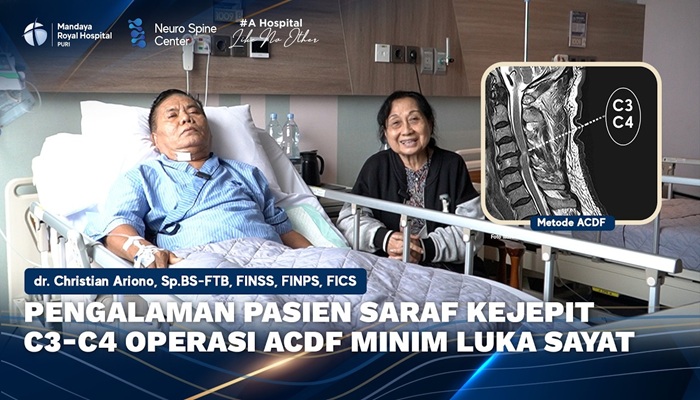
This was the case for Dilmar Tatawi (72), a patient from Manado who was diagnosed with a C3-C4 cervical pinched nerve caused by a bulging spinal disc. After consulting several hospitals without being offered surgery due to his age and the complexity of the case, Dilmar eventually sought treatment at Mandaya Royal Hospital Puri, where he underwent Anterior Cervical Discectomy and Fusion (ACDF) performed by dr. Christian Ariono, Sp.BS-FTB, FINSS, FINPS, FICS, a neurosurgeon. Remarkably, just two days after surgery, his condition showed significant improvement.
“Yesterday, which was two days after the surgery, he was already able to move his legs. His urinary problem has also improved. Before the surgery, whenever he felt the urge to urinate, he couldn’t hold it and would wet himself. Now it’s almost back to normal. His left hand has become much stronger,” said Rubi Tatawi, the patient’s wife, who accompanied him throughout his treatment.

Contents
Patient’s Journey: Living with a Cervical Pinched Nerve
Dilmar’s symptoms first appeared in early May when he woke up one morning with sudden weakness in both legs. His condition gradually worsened, making it increasingly difficult to walk. An MRI scan revealed narrowing in both his cervical spine and pelvis. However, after consulting a neurosurgeon in Manado, surgery on his neck was not recommended due to his age of 72.
He then underwent various non-surgical treatments, including two spinal injections. Initially, his condition improved enough for him to stand and walk with the help of a cane. Unfortunately, the improvement lasted only one to two months. After the second injection, his symptoms worsened significantly. Both his arms and legs became weaker, he constantly felt like he was about to fall, and eventually required a walker with assistance from another person.
Over the following months, Dilmar sought treatment at four different hospitals. While several doctors recommended pelvic surgery, none were willing to perform cervical spine surgery because of the complexity of the case.
Eventually, through a recommendation from a fellow physician in Manado, the family contacted dr. Christian Ariono at Mandaya Royal Hospital Puri via a video consultation. After reviewing the MRI results, dr. Christian advised the family to come to Jakarta immediately because the primary source of the problem was located in the cervical spine.
Condition Improved After ACDF Surgery
Dilmar subsequently underwent Anterior Cervical Discectomy and Fusion (ACDF) to relieve the pressure on the nerves in his neck.
Before surgery, he experienced weakness in both his arms and legs, difficulty walking, and urinary incontinence that significantly affected his daily life.
Just two days after surgery, noticeable improvements began to appear. According to his wife, he gradually regained his ability to walk, his left hand became stronger, and the urinary problems that had previously troubled him had significantly improved.
What Is ACDF?
Anterior Cervical Discectomy and Fusion (ACDF) is a surgical procedure used to treat disorders of the cervical spine through a small incision made at the front of the neck. The goal of the procedure is to relieve pressure on the spinal nerves or spinal cord, thereby reducing symptoms caused by cervical nerve compression.
Doctors may recommend ACDF when conservative treatments—such as medication, physical therapy, or spinal injections—fail to provide adequate symptom relief.
The procedure may be recommended for patients experiencing:
- Pain radiating from the neck to the shoulders, arms, or hands.
- Tingling or numbness in the hands and fingers.
- Weakness in the arms or hands.
- Balance problems and difficulty walking.
- Severe or persistent neck pain.
In some cases, compression of the cervical spinal cord can also cause leg weakness, bladder or bowel dysfunction, and difficulty performing everyday activities. When symptoms become severe or progressively worsen, ACDF may be recommended as the most appropriate treatment.
Warning Signs of a Cervical Pinched Nerve That Require Medical Attention
You should seek medical evaluation immediately if you develop new symptoms or if your existing symptoms worsen, especially when accompanied by one or more of the following:
- Difficulty controlling urination or bowel movements, frequent urination, difficulty urinating, or urinary incontinence.
- Numbness or altered sensation around the buttocks, groin, or genital area, including newly developed sexual dysfunction.
- Poor balance or increasing difficulty walking.
- Worsening pain, weakness, heaviness, or tingling in the arms or legs.
- Weakness or stiffness in the hands causing frequent dropping of objects or difficulty writing, buttoning clothes, or using zippers.
- Neck pain accompanied by a severe headache.
These symptoms may indicate significant compression of the spinal nerves or spinal cord. Prompt diagnosis and treatment provide the best chance of preventing permanent nerve damage.
Consult dr. Christian Ariono for Cervical Pinched Nerve Treatment at Mandaya Royal Hospital Puri

dr. Christian Ariono, Sp.BS-FTB, FINSS, FINPS, FICS is a Neurosurgeon at Mandaya Royal Hospital Puri who specializes in treating disorders of the brain, spine, and peripheral nerves, including pinched nerves, using minimally invasive surgical techniques.
He earned his medical degree from the Faculty of Medicine, Universitas Padjadjaran, where he also completed his Neurosurgery residency.
To continuously enhance his expertise in neurosurgery, dr. Christian actively participates in numerous national and international scientific meetings and advanced surgical training programs. These include the Aesculap Academy & Padjadjaran University Skull Base Cadaver Dissection Resident Course & Cerebrovascular Microanastomosis Course, the Trigeminal Neuralgia International Awareness Day Symposium, and the Annual Scientific Meeting of the Indonesian Society of Neurological Surgeons, organized in collaboration with the World Federation of Neurosurgical Societies (WFNS). These experiences further strengthen his expertise in delivering precise, evidence-based modern neurosurgical care.
Patients wishing to consult dr. Christian Ariono, Sp.BS-FTB, FINSS, FINPS, FICS may visit him at Mandaya Royal Hospital Puri according to the following schedule:
- Monday: 8:00 AM – 4:00 PM
- Tuesday: 8:00 AM – 12:00 PM
- Wednesday: 8:00 AM – 4:00 PM
- Thursday: 8:00 AM – 4:00 PM
- Friday: 8:00 AM – 4:00 PM
- Saturday: 8:00 AM – 4:00 PM
To make your visit easier, you can contact Mandaya Royal Hospital Puri via WhatsApp Chat, Book Appointment, or the Care Dokter mobile application, available on Google Play and the App Store, to book appointments, monitor queue numbers, and access additional information.
The information provided on this page is intended for educational purposes and general reference only. It does not represent the full scope of medical services offered by each physician. For appropriate diagnosis and treatment tailored to your condition, please consult the relevant specialist directly.
If you have any questions, suggestions, or require further information, please contact our call center at 0811-1900-2000.

References
- Cleveland Clinic. Cervical Radiculopathy (Pinched Nerve). (https://my.clevelandclinic.org/health/diseases/22639-cervical-radiculopathy-pinched-nerve). Last reviewed February 10, 2024. Accessed July 23, 2026.
- Cleveland Clinic. ACDF (Anterior Cervical Discectomy & Fusion) Surgery. (https://my.clevelandclinic.org/health/procedures/acdf-surgery). Last reviewed August 14, 2024. Accessed July 23, 2026.
- NHS Inform. Cervical Radiculopathy. (https://www.nhsinform.scot/illnesses-and-conditions/muscle-bone-and-joints/neck-and-back-problems-and-conditions/cervical-radiculopathy). Last reviewed December 19, 2024. Accessed July 23, 2026.