


A brainstem tumor is one of the most complex types of brain tumors because it develops in the part of the brain responsible for controlling vital body functions, including breathing, heartbeat, and balance. As a result, surgery in this area requires exceptional precision as well as the support of advanced medical technology.

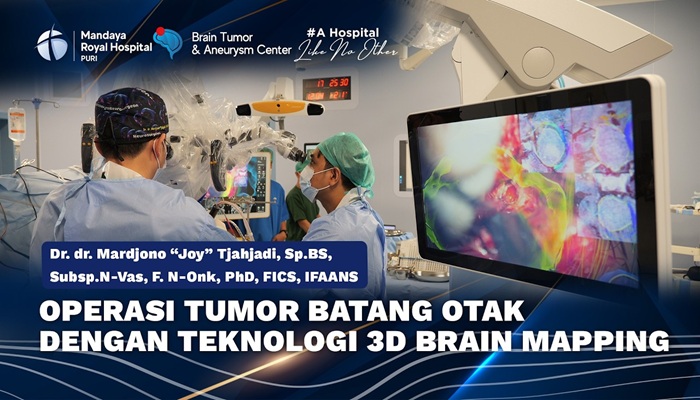
Recently, a successful brainstem tumor surgery was performed by Dr. dr. Mardjono Joy Tjahjadi, Sp.BS, Subsp. N-Vas, F. N-Onk, PhD, FICS, IFAANS (Dr. Joy), a neurosurgeon at Mandaya Royal Hospital Puri. During the procedure, Dr. Joy utilized 3D Neuronavigation technology to guide the surgery with a higher level of precision.

Contents
Understanding Brainstem Tumors and Their Symptoms
A brainstem tumor is an abnormal growth of cells in the brainstem, the part of the brain composed of the midbrain, pons, and medulla. The brainstem connects the brain to the spinal cord and controls many essential body functions, including breathing, heart rate, swallowing, and movement.
Most brainstem tumors are gliomas, which originate from glial cells that support nerve cells. In children, the most common types are diffuse midline glioma and low-grade glioma. These tumors often grow along the nerve pathways within the brainstem, making them difficult to separate from the surrounding healthy tissue.
Because the brainstem controls numerous vital functions, tumors in this area can cause multiple symptoms simultaneously. Symptoms may develop gradually over several weeks or months, although in some cases they can appear more rapidly, depending on the tumor type and its growth rate.
Common symptoms of a brainstem tumor include:
- Problems with balance or body coordination
- Difficulty moving the eyes or changes in eye movement
- Speech difficulties or trouble swallowing
- Weakness on one side of the body
- Facial movement changes or hearing problems
- Headaches accompanied by nausea or vomiting, especially in the morning
- Changes in behavior, learning ability, or school performance (in children)
Brainstem Tumor Surgery Using 3D Neuronavigation by Dr. Joy at Mandaya Royal Hospital Puri
3D Neuronavigation is an advanced technology that enables neurosurgeons to perform brain and spine surgery with greater accuracy. The system serves as a real-time surgical guidance platform, allowing surgeons to plan the safest and most precise surgical pathway while minimizing the risk of damage to surrounding brain tissue, nerves, and blood vessels.
With the assistance of neuronavigation, neurosurgical procedures can be performed more safely and effectively, particularly in cases involving complex brain structures. This technology is widely used in various brain and spine procedures, including:
- Brain tumor surgery
- Surgery for brain hemorrhage
- Surgery for arteriovenous malformations (AVMs) or vascular abnormalities of the brain
- Electrode implantation or deep brain stimulation procedures for patients with Parkinson’s disease and other tremor disorders
- Spine surgery, including accurate screw placement
- Selected orthopedic surgical procedures
Advantages of Brain Tumor Surgery with 3D Neuronavigation
3D Neuronavigation offers numerous advantages in brain tumor surgery, particularly for tumors located in complex and highly sensitive areas of the brain. By utilizing preoperative MRI and CT scan images, the system helps neurosurgeons determine the safest and most efficient surgical route to reach the tumor.
The guidance provided by this technology allows surgeons to identify the exact location of the lesion with exceptional accuracy, enabling more precise tumor removal. In addition to minimizing the risk of injury to healthy brain tissue, 3D Neuronavigation also enhances surgical safety, even during procedures requiring millimeter-level precision.
Some of the key advantages of brain tumor surgery using 3D Neuronavigation include:
- More accurate identification of brain tumors or lesions
- Greater precision during tumor removal
- Smaller surgical incisions
- Reduced intraoperative bleeding
- Shorter operating time
- Faster postoperative wound healing
- Shorter hospital stay, allowing patients to resume their daily activities sooner
Dr. Joy Explains the Patient’s Condition and the Brainstem Tumor Procedure
According to Dr. Joy, the patient presented with a 2 cm brainstem tumor that had already caused severe neurological symptoms, making surgery an urgent necessity.
“With a tumor of this size, the patient had already developed paralysis, impaired eye movement, shortness of breath, difficulty swallowing, as well as numbness and tingling throughout the body. The patient was suffering significantly. Therefore, there was no choice but to remove the brain tumor.”
For this procedure, Dr. Joy employed a highly complex surgical technique known as the supra-infratentorial presigmoid approach. This technique involves making an incision around the ear and carefully thinning portions of the skull base to create an optimal pathway to the tumor, allowing for effective tumor removal.
During the surgery, Dr. Joy also used the KINEVO 900 S surgical microscope, which provides highly detailed visualization of the surgical field. This technology is integrated with the 3D Neuronavigation system, enabling more accurate navigation and improving surgical precision throughout the tumor removal process.
The procedure was further supported by Intraoperative Neuromonitoring (IONM) technology, which continuously monitored the function of critical brain nerves to help preserve them during surgery. The operation was successfully completed, and approximately 90% of the tumor was removed.
Dr. Joy’s Practice Schedule at Mandaya Royal Hospital Puri

Dr. dr. Mardjono Joy Tjahjadi, Sp.BS, Subsp. N-Vas, F. N-Onk, PhD, FICS, IFAANS is available for consultation at Mandaya Royal Hospital Puri on the following schedule:
- Monday: By appointment
- Tuesday: 2:00 PM – 5:00 PM (WIB)
- Wednesday: By appointment
- Thursday: 8:00 AM – 12:00 PM (WIB)
- Friday: 2:00 PM – 5:00 PM (WIB)
- Saturday: 8:00 AM – 12:00 PM (WIB)
To make your visit to Mandaya Royal Hospital Puri more convenient, you can use the WhatsApp Chat feature, Book Appointment, or the Care Dokter application, available for download on Google Play and the App Store. These platforms allow you to book appointments, check queue numbers, and access other useful information.
The information provided on this page is intended for educational purposes and general information only. It does not represent the full range of medical services that each physician may provide. To ensure the most appropriate treatment for your specific health condition, we recommend consulting the respective doctor directly.
If you have any questions, suggestions, or require further information, please contact our call center at 0811-1900-2000.

References
- Mayo Clinic. Brainstem Tumor: Symptoms and Causes. https://www.mayoclinic.org/diseases-conditions/brainstem-tumor/symptoms-causes/syc-205950
- 61. Last revised June 11, 2025. Accessed June 29, 2026.
- Memorial Health Group. What Is Neuronavigation? https://www.memorial.com.tr/en/technologies/what-is-neuronavigation. Accessed June 29, 2026.