



Pancreatic cancer is a malignant disease that develops in the pancreas, an organ that plays an essential role in digestion and blood sugar regulation. Unfortunately, this type of cancer is often difficult to detect in its early stages because the symptoms are usually vague and non-specific. As a result, many patients are only diagnosed when the disease has already progressed to an advanced stage.
With advancements in medical technology, a non-surgical treatment option called High-Intensity Focused Ultrasound (HIFU) is now available. This non-invasive procedure uses high-intensity ultrasound waves to precisely target and destroy tumor tissue without the need for incisions.
The ultrasound energy is focused directly on the tumor, producing heat that damages cancer cells. Through this process, tumor tissue can be destroyed while minimizing damage to surrounding healthy tissues.
At Mandaya Royal Puri Hospital, HIFU has become one of the modern treatment options that can be considered for patients with pancreatic cancer, including those with advanced-stage disease. This approach is considered minimally invasive and generally carries a lower risk of complications compared to major surgery.

Contents
When can HIFU be considered for pancreatic cancer?
HIFU therapy may be considered in several situations, including:
- Locally advanced pancreatic cancer, where the cancer has spread to tissues around the pancreas but has not metastasized to distant organs
- Inoperable tumors, for example when the tumor is located near major blood vessels or when the patient is not suitable for major surgery
- Patients with limited treatment options, particularly in advanced stages of the disease
- Patients experiencing severe pain caused by tumor growth, as HIFU may significantly help relieve pain
- Patients who require tumor size control, as the therapy may gradually shrink the tumor mass
Several studies also suggest that HIFU may provide additional benefits in supporting survival outcomes in certain groups of patients.
How HIFU works in treating pancreatic cancer
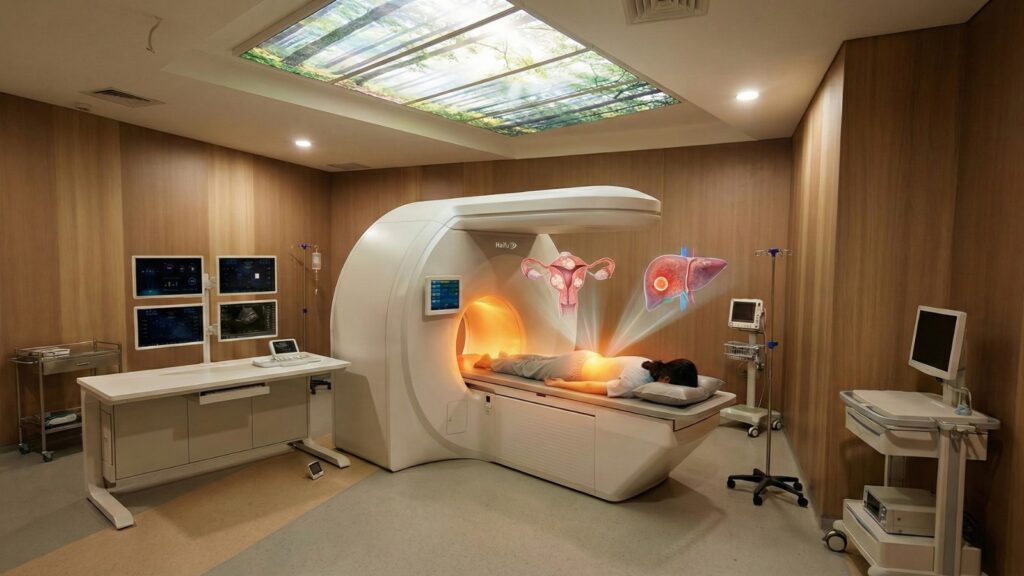
HIFU works based on the principle of thermal ablation without surgery. The process can be explained in simple steps:
1. Precise tumor targeting
Ultrasound waves are directed precisely to the tumor in the pancreas with the assistance of imaging guidance such as ultrasound, ensuring accurate targeting.
2. High temperature at the focal point
When the ultrasound energy is concentrated at a specific point, the temperature in that area can rise to over 80°C.
3. Destruction of tumor tissue
The high temperature causes cancer cells to undergo cell death (necrosis). Over time, the damaged tumor tissue gradually shrinks, leading to a reduction in tumor size.
Advantages of HIFU for pancreatic cancer
HIFU therapy offers several advantages compared to more invasive treatment methods, including:
- No surgery or incisions required
- Lower procedural risk and generally well tolerated by patients
- Helps significantly reduce pain
- Potential to shrink tumor size, which may support other treatments if needed
- Helps improve patients’ quality of life by better controlling pain symptoms
- May provide potential survival benefits for patients with limited treatment options
Clinical research is still ongoing to compare standard palliative therapy with combinations of standard therapy and HIFU for advanced pancreatic cancer, aiming to better understand the full benefits of this treatment approach.
Clinical study results on HIFU therapy for pancreatic cancer
Several studies, including one titled “Clinical Effectiveness and Potential Survival Benefit of US-Guided High-Intensity Focused Ultrasound Therapy in Patients with Advanced-Stage Pancreatic Cancer,” have shown promising results for the use of HIFU in advanced pancreatic cancer.
-
Pain reduction in most patients
In a study involving 50 patients with advanced pancreatic cancer, approximately 84% of patients experienced significant reduction in abdominal pain after undergoing HIFU therapy. This effect persisted during the follow-up period in patients both with and without metastasis.
-
Gradual reduction in tumor size
The study also reported that the average tumor volume decreased by about 37.8% within the first 6 weeks, and reached approximately 57.9% after 6 months. These findings indicate that HIFU may not only relieve symptoms but also help control tumor growth.
-
Potential survival benefits
The study recorded a median overall survival of around 16.2 months after diagnosis, with a median progression-free survival of approximately 16.9 months. These findings suggest a potential survival benefit for patients with advanced pancreatic cancer who undergo HIFU therapy.
HIFU specialist for pancreatic cancer

HIFU treatment at Mandaya Royal Puri Hospital is performed by dr. Sugianto Santoso, Sp.Rad, (K)RI, a radiologist with a subspecialty in interventional radiology who has extensive experience in minimally invasive procedures.
In clinical practice, he utilizes imaging technologies such as ultrasound, CT scan, MRI, and fluoroscopy to ensure procedures are performed accurately and safely. In addition to HIFU, he is also experienced in performing other interventional procedures such as TACE (Transarterial Chemoembolization), Radiofrequency Ablation (RFA), and Microwave Ablation to destroy tumor tissue without major surgery.
dr. Sugianto completed his medical degree at Maranatha Christian University in Bandung and his Radiology Specialist training at the University of Indonesia.
dr. Sugianto Santoso, Sp.Rad, (K)RI is available for consultation at Mandaya Royal Puri Hospital on:
- Tuesday: 16:00 – 20:00 WIB
- Thursday: 16:00 – 20:00 WIB
To make your visit easier, you can use the WhatsApp Chat, Book Appointment feature, or the Care Dokter application, available on Google Play and App Store, to schedule appointments, check queue numbers, and access other service information.