


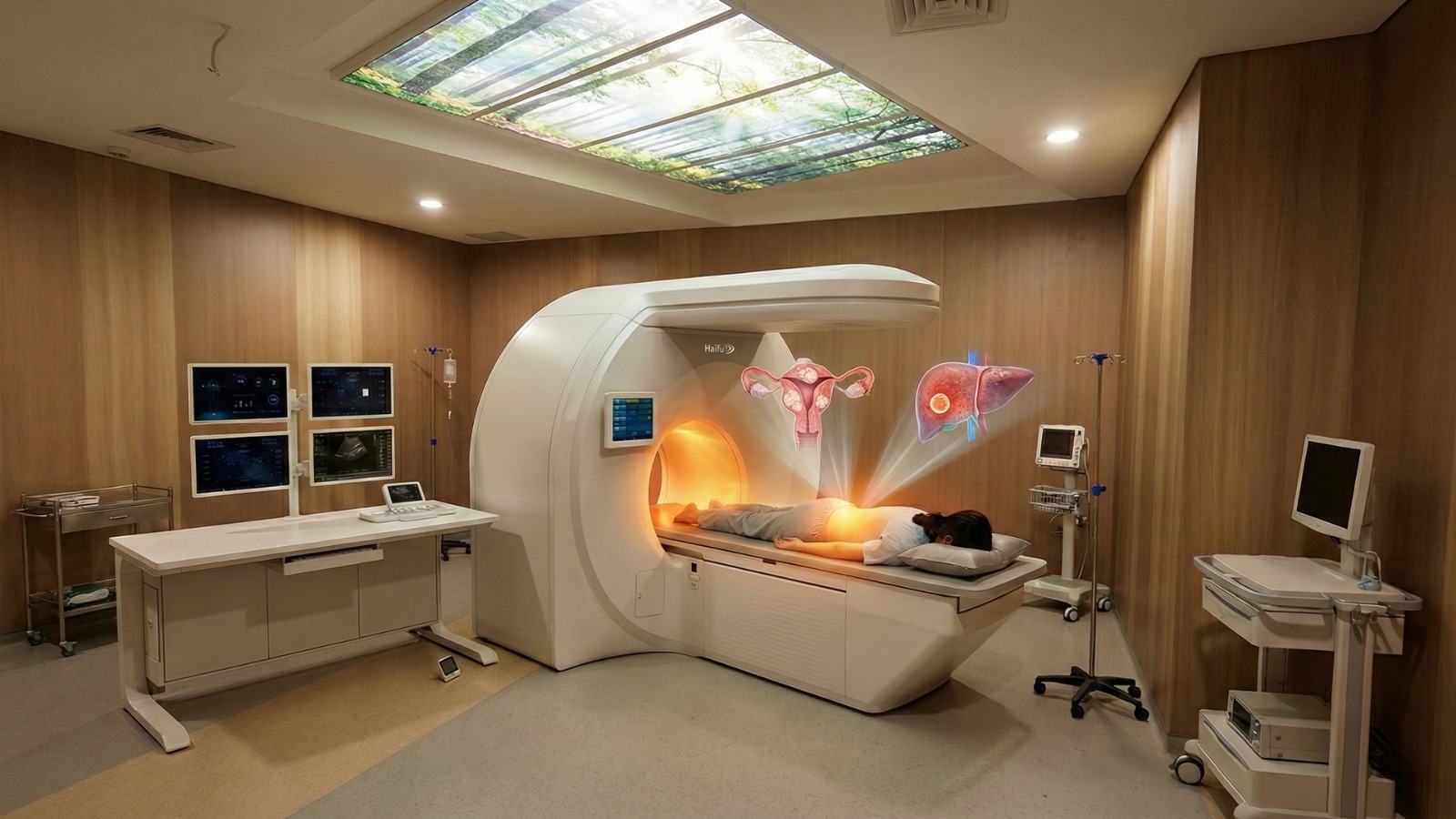
Liver cancer is a type of cancer that develops in the liver, a vital organ responsible for filtering toxins, supporting digestion, and regulating the body’s metabolism. One of the most common types of liver cancer is hepatocellular carcinoma (HCC), which typically develops in patients with chronic liver disease such as cirrhosis. Because early symptoms are often non-specific, many cases of liver cancer are only diagnosed at an advanced stage, making treatment more complex.
One of the latest innovations in liver cancer treatment, including for patients with cirrhosis, is High-Intensity Focused Ultrasound (HIFU). HIFU is a minimally invasive, incision-free procedure that uses high-intensity ultrasound waves to precisely target and destroy tumor tissue. The ultrasound energy is focused directly on the tumor, generating heat that damages cancer cells and gradually shrinks the tumor without the need for open surgery.
HIFU technology is now available at RS Mandaya Royal Puri as a modern treatment option for liver cancer with cirrhosis. This therapy offers a lower-risk, more comfortable alternative for patients and has the potential to improve survival outcomes.

Contents
Which Liver Cancer Patients Are Suitable for HIFU?
HIFU therapy can be considered for selected liver cancer patients, particularly those with HCC. Even patients with advanced cirrhosis and fluid accumulation in the abdomen (ascites) may be evaluated for HIFU, depending on a thorough medical assessment.
The following are general criteria for patients who may benefit from HIFU:
1. Patients with Hepatocellular Carcinoma (HCC)
HIFU is most commonly used for primary liver cancer (HCC). This therapy is promising because it can destroy tumor tissue without open surgery.
2. Patients with Advanced Cirrhosis and Ascites
Patients with advanced cirrhosis, including those with ascites or fluid accumulation around the lungs (pleural effusion), may still be candidates for HIFU. However, the final decision depends on the patient’s overall condition and comprehensive evaluation results.
3. Tumors Clearly Visible on Ultrasound
HIFU works best when the tumor can be clearly visualized through ultrasound imaging. When the tumor’s location and boundaries are well-defined, the procedure can be performed more safely and precisely.
4. Tumors in Challenging Locations
Some tumors are located in difficult areas, such as the upper part of the liver (near the diaphragm), close to the ribs, or near important organs like the stomach, intestines, gallbladder, heart, major blood vessels, or bile ducts.
Despite these challenges, with proper preparation and specialized techniques, HIFU can still be performed and may effectively destroy the tumor with minimal risk of complications.
How Does HIFU Work for Liver Cancer with Cirrhosis?
Here is a simplified explanation of how HIFU works:
1. Energy Delivered from Outside the Body (No Incision)
The HIFU device is placed on the skin surface and sends ultrasound waves directly to the tumor without open surgery.
2. Ultrasound Waves Precisely Focused on the Tumor
The system uses ultrasound waves with specific frequencies (approximately 0.8–3.5 MHz), which are concentrated precisely on the cancerous tissue.
3. Tumor Tissue Temperature Increased Above 60°C
When the energy is focused on a single point, the temperature rises significantly, creating a strong thermal effect.
4. Cancer Cells Destroyed by Heat (Thermal Ablation)
The heat causes proteins inside cancer cells to coagulate and become damaged, leading to cell death and tumor destruction (ablation).
5. Surrounding Healthy Tissue Remains Protected
Because the heat is concentrated only on the tumor area, damage to healthy liver tissue is minimized. This is especially important in patients with cirrhosis, where liver function is already compromised.
Clinical Study Results on HIFU for Liver Cancer with Cirrhosis
Based on a study titled Extracorporeal High Intensity Focused Ultrasound Ablation in the Treatment of Patients with Large Hepatocellular Carcinoma, HIFU therapy showed promising results in patients with large HCC tumors and cirrhosis.
1. No Major Complications Reported
In the study, 55 patients with large liver tumors (average diameter approximately 8.14 cm) and cirrhosis underwent HIFU therapy. No major complications were reported during or after the procedure, indicating that HIFU is relatively safe even in patients with impaired liver function.
2. Complete Tumor Ablation Rate of 69.2%
Among 26 patients who were further evaluated, about 69.2% achieved complete tumor ablation. This means that most of the cancerous tissue was successfully destroyed using HIFU.
3. Favorable Survival Rates
The study reported survival rates of 61.5% at 12 months and 35.3% at 18 months after therapy. These findings suggest that HIFU may help extend survival in patients with liver cancer and cirrhosis.
4. Better Outcomes with Combined HIFU and TACE
Another study by the same research team compared HIFU combined with Transarterial Chemoembolization (TACE) to chemoembolization alone in 50 patients with advanced liver cancer. Patients who received combination therapy showed significantly better survival rates compared to those who underwent chemoembolization alone.
These findings indicate that HIFU, either as a standalone therapy or in combination with other treatments, may be a valuable option for patients with liver cancer and cirrhosis.
HIFU Specialist for Liver Cancer Treatment

HIFU procedures at RS Mandaya Royal Puri are performed by dr. Sugianto Santoso, Sp.Rad (K)RI, a radiologist with a subspecialty in interventional radiology and extensive experience in minimally invasive diagnostic and therapeutic procedures, including liver cancer treatment.
He utilizes advanced imaging technologies such as ultrasound, CT scans, MRI, and fluoroscopy to ensure that each procedure is accurate, targeted, and safe. In addition to HIFU, he is experienced in Transarterial Chemoembolization (TACE), Radiofrequency (RF) Ablation, and Microwave Ablation—procedures designed to destroy tumors without major surgery, thereby reducing complications and accelerating recovery time.
Dr. Sugianto completed his medical degree at Universitas Kristen Maranatha in Bandung and his radiology specialty training at Universitas Indonesia. With a strong academic background and extensive clinical experience, he is committed to providing the latest minimally invasive therapies for liver cancer patients.
Dr. Sugianto Santoso, Sp.Rad, (K)RI is available at RS Mandaya Royal Puri on:
- Tuesday: 4:00 PM – 8:00 PM (WIB)
- Thursday: 4:00 PM – 8:00 PM (WIB)
To make your visit easier, you can use the WhatsApp Chat feature, Book Appointment service, or download the Care Dokter app from Google Play and the App Store to check queue numbers and access complete information.