


Liver cancer treatment continues to evolve alongside advances in medical technology. Today, patients have access to a wider range of modern therapies designed to target cancer more precisely, effectively, and with minimally invasive techniques. Two liver cancer treatment methods that are increasingly used are Transarterial Chemoembolization (TACE) and Transarterial Radioembolization (TARE). These procedures have become important alternatives to surgery or conventional therapies, especially in selected cases.
To gain a deeper understanding of these modern liver cancer treatment options, the explanation is delivered directly by dr. Sugianto Santoso, Sp.Rad (K)RI, a radiology specialist with a subspecialty in interventional radiology at Mandaya Royal Hospital Puri. As an experienced physician who routinely performs both TACE and TARE, dr. Sugianto provides a comprehensive overview of the role of these procedures in liver cancer management using the latest medical technology.

Contents
Understanding TACE and TARE According to dr. Sugianto at Mandaya Royal Hospital Puri
Liver cancer treatment is no longer limited to surgery or systemic chemotherapy alone. With advancements in interventional radiology, more targeted and minimally invasive therapies are now available and can be tailored to each patient’s condition. Two of these methods are TACE and TARE, both of which are available and performed at Mandaya Royal Hospital Puri by experienced specialists.
1. TACE (Transarterial Chemoembolization) for Liver Cancer
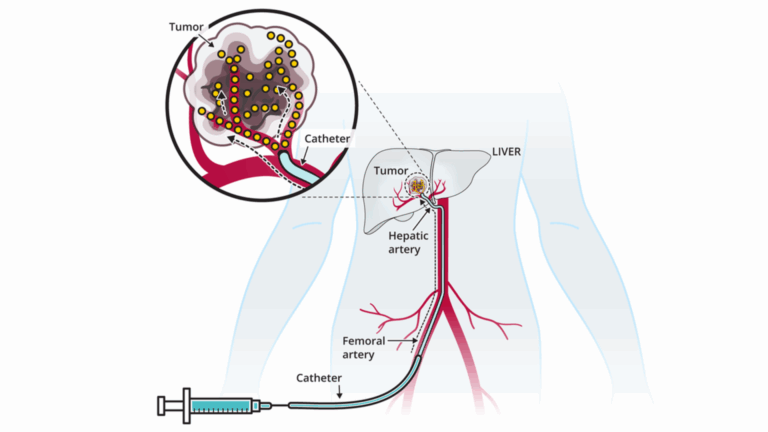
TACE is one of the most commonly used interventional radiology procedures for treating liver cancer. This technique is performed through catheterization, in which a small tube is inserted through an artery in the thigh and guided to the blood vessels that supply the liver tumor.
As explained by dr. Sugianto, “One of the liver cancer treatments that can be performed is TACE, which is a catheter-based procedure where a tube is inserted from the thigh to the liver and chemotherapy drugs are delivered directly to the cancer cells.”
In addition to delivering chemotherapy directly to the tumor, the blood vessels supplying the cancer are also blocked, helping to significantly suppress tumor growth. One of the main advantages of TACE compared to systemic chemotherapy is its localized effect on the tumor, with minimal impact on healthy tissues.
dr. Sugianto emphasized, “With TACE, the treatment is delivered directly to the tumor. We administer the medication to the tumor’s blood vessels and then block them, so the tumor no longer receives nutrients.”
TACE is commonly used for primary liver cancer such as hepatocellular carcinoma (HCC), particularly at certain stages based on the BCLC classification. In clinical practice, TACE may also be applied in other situations, including tumor size reduction, combination therapy with immunotherapy or targeted therapy, and in cases of liver metastases from other cancers.
2. TARE (Transarterial Radioembolization): Radiation Therapy from Within the Blood Vessels
In addition to TACE, a more advanced method known as TARE is also available. This procedure is likewise performed through the arterial blood vessels, but the key difference lies in the therapeutic agent used. While TACE delivers chemotherapy drugs, TARE utilizes radioactive material that works locally within the tumor tissue.
dr. Sugianto explained,
“TARE is also transarterial, but the ‘C’ is replaced with radiation. We use a nuclear substance called Y90.”
Through this method, radioactive particles are delivered directly to the tumor area or specific segments of the liver, allowing for controlled and extensive destruction of cancer tissue. TARE can be used to treat a single liver segment, multiple segments, or even an entire liver lobe, depending on the patient’s condition.
One of the main advantages of TARE is its flexibility in managing tumors that are difficult to operate on or unsuitable for ablation procedures.
“The advantage of TARE is that it can destroy one liver segment, two segments, or even an entire liver lobe, depending on which blood vessels are targeted.”
Currently, TARE is also being used for smaller tumors located in hard-to-reach areas, as well as in conditions that previously had limitations when treated with conventional methods.
Consultation and Determining the Right Liver Cancer Treatment
dr. Sugianto emphasized that choosing between TACE, TARE, or other treatment methods must be based on a thorough evaluation, including imaging results and the patient’s overall clinical condition. Not all liver cancer cases are suitable for the same treatment approach.
“Patients can come directly to interventional radiology or consult with me first. Then we will decide whether TACE is beneficial or if another treatment option would be more appropriate.”
With advanced technology and a multidisciplinary approach, Mandaya Royal Hospital Puri provides comprehensive, personalized liver cancer treatment options focused on achieving the best possible outcomes for patients.
Profile and Expertise of dr. Sugianto in Liver Cancer Treatment

dr. Sugianto Santoso is a radiology specialist with a subspecialty in interventional radiology, experienced in performing a wide range of minimally invasive procedures guided by modern imaging technology. He completed his general medical education at Maranatha Christian University, Bandung, and continued his radiology specialist training at the University of Indonesia.
As an interventional radiologist, dr. Sugianto manages various complex medical conditions without the need for open surgery, including liver cancer and other advanced diseases. His areas of expertise include:
- Radiofrequency Ablation (RFA) for thyroid nodules
- Microwave Ablation (MWA) for tumor and liver cancer therapy
- Transarterial Chemoembolization (TACE) for liver cancer treatment
- Cryoablation for nodules and tumors
- Digital Subtraction Angiography (DSA) for the diagnosis and treatment of brain aneurysms
- Brain aneurysm management using coiling, flow diverter, and stent techniques
Supported by state-of-the-art medical technology and expertise in minimally invasive procedures, dr. Sugianto Santoso, Sp.Rad (K)RI, offers safer, more precise, and effective liver cancer treatment options at Mandaya Royal Hospital Puri, including TACE-based therapy.
Doctor Schedule
dr. Sugianto Santoso, Sp.Rad (K)RI is available at Mandaya Royal Hospital Puri on:
- Tuesday: 4:00 PM – 8:00 PM WIB
- Thursday: 4:00 PM – 8:00 PM WIB
For a more convenient visit, use the WhatsApp Chat, Book Appointment feature, or the Care Dokter app, available on Google Play and the App Store, to schedule appointments, check queue numbers, and access complete information.
Source: dr. Sugianto Santoso, Sp.Rad (K)RI