


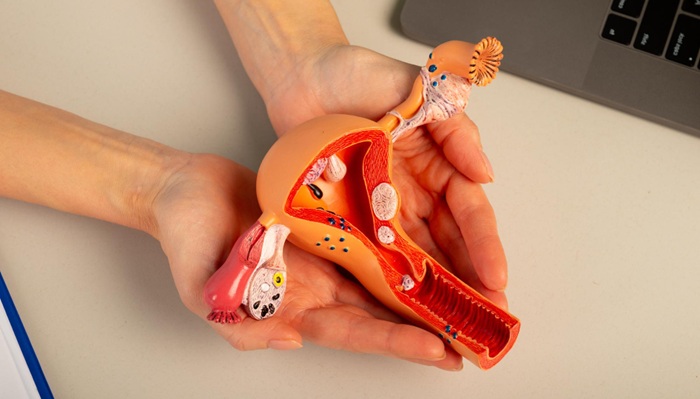
Uterine fibroids and ovarian cysts are two conditions that commonly affect the female reproductive system and are often mistaken for the same disease. In fact, the differences between uterine fibroids and ovarian cysts can be seen from various aspects, including their location of growth, tissue shape and texture, underlying causes, and the symptoms they produce. By recognizing these differences early, women can be more aware of their uterine health and determine the appropriate steps for examination and treatment.
As a hospital providing comprehensive women’s health services, Mandaya Royal Puri Hospital offers a modern solution for treating uterine fibroids without surgery through High Intensity Focused Ultrasound (HIFU) technology. This non-invasive technology allows fibroids to be treated with high precision, minimal pain, and faster recovery time, enabling patients to return to daily activities more comfortably.

Contents
Differences Between Uterine Fibroids and Ovarian Cysts
Below are the key differences between uterine fibroids and ovarian cysts that are important to understand:
1. Location
The most fundamental difference between fibroids and ovarian cysts lies in where they develop.
- Uterine fibroids grow within or on the wall of the uterus. They are firm, rubbery masses that originate from the uterine muscle tissue.
- In contrast, ovarian cysts typically develop on the surface of or inside the ovaries and are generally filled with fluid.
Because their growth locations differ, the effects on the body are also different. Fibroids can press on the bladder, intestines, or uterus, leading to a feeling of pressure and heavy menstrual bleeding. Meanwhile, ovarian cysts may affect ovulation, cause pain on one side of the lower abdomen, or even rupture and result in sudden, severe pain.
2. Texture and Characteristics
Another important physical difference between uterine fibroids and ovarian cysts can be observed in their texture and appearance on imaging examinations.
- Fibroids have a dense, solid, and firm structure.
- On the other hand, ovarian cysts are soft and fluid-filled, resembling a water-filled balloon.
Imaging tests such as ultrasound and MRI are very helpful in distinguishing these two conditions. Fibroids appear as solid masses, while cysts appear as hollow, dark structures. These imaging results assist doctors in determining the next steps, whether observation alone is sufficient or further treatment is required.
3. Causes
The causes of uterine fibroids and ovarian cysts also differ.
- Uterine fibroids are believed to be associated with genetic factors and hormonal influences, particularly estrogen. This condition commonly occurs during the reproductive years and tends to shrink after menopause.
- Ovarian cysts, meanwhile, often form as a natural part of the ovulation cycle. Some cysts may be triggered by conditions such as polycystic ovary syndrome (PCOS) or endometriosis, while others result from hormonal imbalances or infections.
Both conditions are quite common in women under the age of 50, and in some cases, fibroids and cysts can occur simultaneously.
4. Symptoms
One factor that often causes confusion in distinguishing between uterine fibroids and ovarian cysts is the similarity of symptoms in the early stages. However, when examined more closely, the characteristics of the symptoms are actually different. Therefore, recognizing symptom differences is essential to ensure accurate diagnosis and appropriate treatment.
Fibroids generally cause symptoms that develop gradually, whereas ovarian cysts often trigger sharp pain that appears suddenly, especially if the cyst ruptures.
Common symptoms of uterine fibroids include:
- Heavy and prolonged menstrual bleeding
- A feeling of fullness or pressure in the pelvic area
- Frequent urination
- Pain during sexual intercourse
- Constipation
- An enlarged and firm abdomen
Common symptoms of ovarian cysts include:
- Sudden sharp pain on one side of the lower abdomen
- Bloating or intermittent pressure sensation
- Lower back or thigh pain
- Breast tenderness or sensitivity
- Spotting outside of the menstrual cycle
- Severe pain accompanied by dizziness or nausea (which may indicate a ruptured cyst)
Understanding the differences in symptoms between uterine fibroids and ovarian cysts can help women recognize their condition more quickly and seek appropriate medical care.
HIFU Technology at Mandaya Puri Hospital: A Non-Surgical Solution for Uterine Fibroids

Mandaya Royal Puri Hospital offers HIFU technology as a non-surgical treatment option for uterine fibroids. HIFU is a non-invasive procedure that uses high-energy ultrasound waves to directly target fibroid tissue without incisions or surgery. This technology is designed to work selectively, ensuring that the surrounding healthy uterine tissue remains protected.
During the HIFU procedure, ultrasound waves are precisely focused to generate heat that causes coagulation of fibroid cells. Over time, the fibroid tissue gradually shrinks. The entire procedure is performed under medical imaging guidance, allowing the size and position of the fibroid to be clearly visualized and treated accurately.
Advantages of HIFU Technology for Uterine Fibroids
Some of the benefits of HIFU therapy for uterine fibroids include:
- No incisions or surgery – No open surgery is required, leaving no scars or stitches
- Shorter recovery time – Most patients can return to normal activities within 1–2 days after the procedure
- Minimal pain – Performed with mild anesthesia and generally causes only mild discomfort
- High precision – Ultrasound energy is directed specifically at fibroid tissue without damaging surrounding uterine tissue
- Low risk of complications – The risk of infection, bleeding, or post-procedure adhesions is minimal due to its non-invasive nature
- Preserves uterine function – Suitable for women who are planning pregnancy or wish to retain their uterus
Experienced Doctors for Uterine Fibroid Treatment at Mandaya Royal Puri Hospital
In addition to advanced HIFU technology, Mandaya Royal Puri Hospital is supported by a team of competent and experienced specialists in obstetrics, gynecology, and gynecologic oncology. Below are several uterine fibroid specialists you can consult:
1. dr. Gracia Merryane R.G. Rauw, Sp.OG
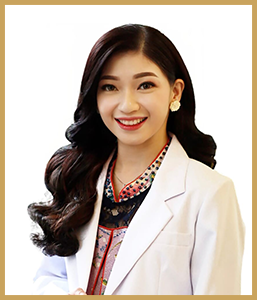
dr. Gracia Merryane R.G. Rauw, Sp.OG is an Obstetrics and Gynecology specialist focusing on women’s reproductive health, pregnancy care, and the management of various gynecological disorders, including uterine fibroids. She completed her medical and specialist education at the Faculty of Medicine, Sam Ratulangi University.
Her services include women’s health examinations, pregnancy planning, family planning and lactation consultations, ovulation induction, normal and cesarean deliveries, as well as gynecological procedures such as laparoscopy, hysterectomy, sterilization, Pap smear, SIS, and LEEP.
Schedule at Mandaya Royal Puri Hospital:
- Monday: 8:00 AM – 11:00 AM & 1:00 PM – 6:00 PM
- Tuesday: 8:00 AM – 11:00 AM & 1:00 PM – 6:00 PM
- Wednesday: 8:00 AM – 11:00 AM & 1:00 PM – 6:00 PM
- Thursday: 8:00 AM – 11:00 AM & 1:00 PM – 6:00 PM
- Friday: 8:00 AM – 11:00 AM & 1:00 PM – 6:00 PM
- Saturday: 8:00 AM – 11:00 AM & 1:00 PM – 6:00 PM
2. dr. Doddy F.P. Gultom, Sp.OG (K), M.Kes
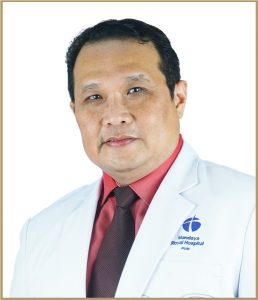
dr. Doddy F.P. Gultom, Sp.OG (K), M.Kes is a consultant Obstetrics and Gynecology specialist with extensive experience in reproductive health and gynecology. He graduated from the Faculty of Medicine, Trisakti University, completed his specialist training at Hasanuddin University, and earned his consultant degree from the University of Indonesia.
His medical services include pre-pregnancy care, prenatal diagnosis, fetal imaging, contraception selection, management of pregnancy complications, benign gynecological disorders, and minimally invasive procedures.
Schedule at Mandaya Royal Puri Hospital:
- Tuesday: 5:00 PM – 8:00 PM
- Thursday: 1:00 PM – 4:00 PM
- Saturday: 8:00 AM – 12:00 PM
3. dr. Ong Tjandra, M.Kes, Sp.OG, Gynecologic Oncology Subspecialist

dr. Ong Tjandra is a gynecologic oncology subspecialist with extensive experience in treating various gynecological cancers, such as cervical, ovarian, and vaginal cancer, as well as other gynecological conditions. He is also skilled in performing fibroid and cyst surgeries using laparoscopic techniques and hysterectomy.
With a comprehensive approach, dr. Ong is well known for managing complex gynecological cases holistically.
Schedule at Mandaya Royal Puri Hospital:
- Monday: 10:00 AM – 5:00 PM
- Thursday: 4:00 PM – 8:00 PM
4. Dr. dr. Unedo Hence Markus Sihombing, Sp.OG, Gynecologic Oncology Subspecialist

Dr. dr. Unedo Hence Markus Sihombing, Sp.OG, Subsp. Onk is an Obstetrics and Gynecology specialist with a subspecialty in gynecologic oncology. He completed his education at Sriwijaya University and Sebelas Maret University, and obtained his Consultant and Doctoral degrees from the University of Indonesia.
He manages various gynecologic cancer cases, including cervical, uterine, ovarian, vulvar, and vaginal cancers, as well as benign conditions such as polyps and uterine tumors. His meticulous and empathetic approach is a key strength in supporting patients throughout their treatment journey.
Schedule at Mandaya Royal Puri Hospital:
- Tuesday: 4:00 PM – 8:00 PM
- Thursday: 4:00 PM – 8:00 PM
- Saturday: 1:00 PM – 4:00 PM
To make your visit more convenient, use the WhatsApp Chat feature, Book Appointment service, or the Care Dokter application available for download on Google Play and the App Store to manage appointments, view queue numbers, and access complete information.