


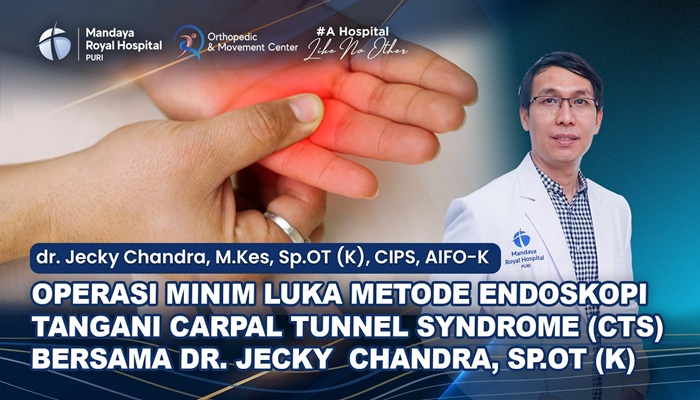
Carpal tunnel syndrome (CTS) is one of the most common hand conditions, caused by pressure or compression on the median nerve in the wrist. This nerve passes through a narrow passageway called the carpal tunnel, located on the palm side of the wrist. When the median nerve becomes compressed, it can interfere with the nerve’s ability to transmit sensations and control hand movements.
This condition can cause various symptoms, including numbness, tingling, and weakness in the fingers and hand. Several factors may increase the risk of CTS, including wrist anatomy, certain health conditions, and repetitive hand movements performed over an extended period.

To help treat this condition, Mandaya Royal Puri Hospital offers endoscopic treatment for CTS. The procedure is performed by dr. Jecky Chandra, M.Kes, Sp.OT (K), CIPS, AIFO-K, an orthopedic specialist with expertise in treating conditions affecting the fingers, hands, elbows, and shoulders. This technique allows CTS to be treated using a minimally invasive approach.

Contents
Understanding Endoscopic CTS Treatment: What Are Its Benefits?
Carpal tunnel release is a surgical procedure performed to treat carpal tunnel syndrome (CTS), a condition in which the median nerve in the wrist becomes compressed, causing pain, numbness, and weakness in the hand.
The median nerve and the tendons responsible for bending the fingers pass through a narrow passageway in the wrist called the carpal tunnel. The roof of this tunnel is formed by a thick ligament known as the carpal ligament. When swelling or increased pressure occurs inside the tunnel, the median nerve can become compressed, resulting in CTS symptoms.
During a carpal tunnel release procedure, the surgeon cuts through part of the carpal ligament to create more space inside the carpal tunnel. This helps relieve pressure on the median nerve and reduce the symptoms experienced by the patient.
One technique that can be used is Endoscopic Carpal Tunnel Release (ECTR). Unlike conventional open surgery, this endoscopic technique uses a thin, flexible tube equipped with a small camera called an endoscope. The instrument is inserted through a small incision in the wrist, allowing the surgeon to visualize the carpal tunnel during the procedure. The surgeon then uses specialized instruments inserted through another small incision to cut the ligament compressing the median nerve.
What Are the Benefits of Endoscopic CTS Treatment?
Advances in endoscopic technology have provided an alternative minimally invasive approach to treating CTS. Some of the benefits of Endoscopic Carpal Tunnel Release include:
- Smaller incision: The procedure uses a small camera and specialized instruments through minimal incisions, helping reduce tissue trauma and surgical scarring.
- Faster recovery: Because the surrounding tissue experiences less disruption, patients generally recover faster compared to conventional open surgery.
- Less postoperative pain: Reduced tissue trauma may help minimize pain following the procedure.
- Quicker return to daily activities: Patients may be able to return to work and resume their usual activities sooner.
- Good success rate: This technique can provide significant symptom relief for many patients with CTS.
Nevertheless, the choice of surgical technique should be tailored to the patient’s condition, the severity of CTS, and the results of medical examinations.
Recognizing CTS Symptoms and Knowing When to See a Doctor
CTS symptoms generally develop gradually and may become more severe over time. Some symptoms to watch for include:
- Tingling and numbness: Usually affects the thumb, index finger, middle finger, and part of the ring finger, but generally does not involve the little finger. The sensation may feel like an electric shock and often occurs when holding a phone, driving, or reading a book.
- Tingling at night: Symptoms may occur during sleep and cause patients to wake up. Some people try to relieve the discomfort by shaking their hands.
- Pain that travels up the arm: Tingling or numbness may sometimes extend from the wrist toward the arm.
- Hand weakness: People with CTS may experience reduced hand strength, particularly when using the thumb to pinch or grip objects. As a result, objects may slip from their hands or be dropped.
In the early stages, CTS symptoms may only occur occasionally. However, over time, numbness may become more frequent or even persistent if pressure on the median nerve continues.
When Should You See a Doctor?
Consult a doctor promptly if CTS symptoms begin to interfere with your daily activities or sleep patterns. Do not ignore persistent tingling and numbness, as untreated pressure on the median nerve can lead to permanent nerve and muscle damage. Early treatment is important to help prevent the condition from becoming more severe.
Does Carpal Tunnel Syndrome Always Require Surgery?
Not all cases of CTS require surgery. In the early stages, doctors generally recommend nonsurgical treatments first to reduce pressure on the median nerve and relieve symptoms. Some available treatment options include:
- Anti-inflammatory medications: Used to help reduce inflammation and relieve pain, depending on the doctor’s recommendation.
- Hand therapy and exercises: Include stretching and specific movements to help manage discomfort in the hand and wrist.
- Activity modifications: Adjusting sitting posture, computer use, and work habits involving repetitive hand movements.
- Wrist splints: Support devices that help keep the wrist in a straight position, particularly during sleep.
- Corticosteroid injections: Medication injected into the carpal tunnel to help reduce inflammation and pressure on the median nerve.
However, if these treatments do not provide sufficient improvement, doctors may recommend further examinations, such as nerve conduction studies (NCS) and electromyography (EMG). These tests evaluate median nerve function and determine the extent of nerve impairment.
Carpal tunnel release surgery is generally considered when pressure on the median nerve becomes severe or symptoms do not improve with nonsurgical treatment. If the condition has caused the muscles in the hand and wrist to shrink, surgery is usually recommended sooner to help prevent further nerve and muscle damage.
Therefore, the decision to undergo CTS surgery should be based on the severity of the condition, nerve examination results, and the patient’s response to previous treatments.
Consult dr. Jecky Chandra for Carpal Tunnel Syndrome Treatment at Mandaya Royal Puri Hospital

dr. Jecky Chandra, M.Kes, Sp.OT (K), CIPS, AIFO-K is an orthopedic specialist with experience in treating various musculoskeletal conditions involving bones, joints, muscles, and other supporting tissues. One of his areas of expertise is treating conditions affecting the hands and fingers, including injury-related pain, tendon disorders, and other conditions requiring specialized evaluation and treatment.
For certain hand surgeries, dr. Jecky may also use the WALANT (Wide Awake Local Anesthesia No Tourniquet) technique. This approach uses local anesthesia without a tourniquet or blood-flow restriction device, allowing patients to remain awake during the procedure. This enables the doctor to assess hand and finger function and movement directly during certain procedures, depending on the patient’s medical needs.
Hand conditions can be treated through nonsurgical therapies or surgical procedures, depending on their underlying causes, severity, and the patient’s individual condition. Therefore, an evaluation by an orthopedic specialist with expertise in hand and microsurgery is important to determine the most appropriate treatment approach.
dr. Jecky Chandra, M.Kes, Sp.OT (K), CIPS, AIFO-K is available for consultations at Mandaya Royal Puri Hospital on the following schedule:
- Monday: 08:00 AM – 12:00 PM
- Tuesday: 08:00 AM – 12:00 PM
- Wednesday: 01:00 PM – 05:00 PM
- Thursday: 01:00 PM – 05:00 PM
- Friday: 08:00 AM – 12:00 PM
- Saturday: 05:00 PM – 08:00 PM.
Facilities for Out-of-Town and International Patients at Mandaya Royal Puri Hospital


Mandaya Royal Puri Hospital provides various supporting facilities to ensure greater comfort for patients traveling from other cities or abroad:
- VIP Transportation: A pickup service from Soekarno-Hatta International Airport, train stations, or seaports to the hospital using comfortable vehicles, accompanied by the Patient Experience Officer (PEO) team.
- Medical Ambulance Pickup: A specialized pickup service for patients with specific medical conditions from their arrival point (airport, train station, or seaport), equipped with medical equipment and accompanied by professional healthcare personnel.
- Accommodation (Sleep Hub and Apartments): Comfortable accommodation facilities for accompanying family members, located directly on the 8th floor of the Mandaya Royal Puri building, along with nearby apartment options.
- International Patient Relations: Dedicated assistance for international patients, including medical coordination, interpretation services, and administrative support. For information and assistance from International Patient Relations, please contact 021 5092 8888 or email [email protected].
To make your visit to Mandaya Royal Hospital Puri easier, use the WhatsApp chat feature, Book Appointment service, or the Care Dokter application, available for download on Google Play and the App Store. These services allow you to manage appointments, check queue numbers, and access other important information.
The information provided on this page is intended for educational purposes and general reference only. It does not represent the full range of medical services that may be performed by each doctor. To ensure that you receive treatment appropriate for your health condition, we recommend consulting the relevant doctor directly.
For questions, suggestions, or further information, please contact our call center at 0811-1900-2000.

References:
- Mayo Clinic. Carpal Tunnel Syndrome – Symptoms and Causes. (https://www.mayoclinic.org/diseases-conditions/carpal-tunnel-syndrome/symptoms-causes/syc-20355603). Accessed on November 27, 2026.
- MedlinePlus. Carpal Tunnel Release. (https://medlineplus.gov/ency/article/002976.htm). Accessed on November 27, 2026.
- Johns Hopkins Medicine. Carpal Tunnel Release. (https://www.hopkinsmedicine.org/health/treatment-tests-and-therapies/carpal-tunnel-release). Accessed on November 27, 2026.
- JIS Orthopedics. Benefits of Endoscopic Carpal Tunnel Release. (https://jisortho.com/benefits-endoscopic-carpal-tunnel-release). Accessed on November 27, 2026.