


The Achilles tendon is a strong band of tissue that connects the calf muscles to the heel bone. It plays an important role in supporting movements such as walking, running, and jumping. However, excessive stress or stretching, particularly during sports activities, can cause the Achilles tendon to partially or completely tear. This condition is known as an Achilles tendon rupture and can occur suddenly, for example, during explosive movements in sports, falls, trips, or sudden twisting of the ankle.
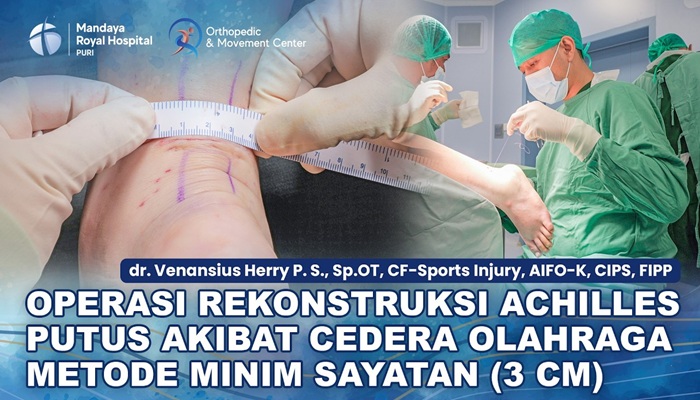
Treatment for an Achilles tendon rupture depends on the severity of the injury and the patient’s individual needs to help restore tendon function. One treatment option is minimally invasive surgery, which uses a smaller incision compared with conventional open surgery. At Mandaya Royal Puri Hospital, dr. Venansius Herry Perdana Suryanta, Sp.OT, CF-Sports Injury, AIFO-K, CIPS, FIPP, an orthopedic specialist with a fellowship in sports injuries, recently performed minimally invasive Achilles tendon repair surgery on a 37-year-old male patient whose tendon ruptured during sports activity. Notably, the procedure was performed through an incision measuring only 3 cm.

Contents
Diagnosis of Achilles Tendon Rupture in a 37-Year-Old Patient After Playing Football
A 37-year-old male patient sustained an injury while playing football. During the game, he felt a sudden “pop” in his calf, followed by difficulty and eventually an inability to walk. After undergoing an examination, the patient was diagnosed with an Achilles tendon rupture.
One examination that can help identify an Achilles tendon rupture involves applying pressure to the calf muscle while observing the movement of the ankle. Under normal conditions, squeezing the calf causes the ankle to move. However, when the Achilles tendon is ruptured, squeezing the calf does not produce the expected ankle movement.
Minimally Invasive Achilles Tendon Repair Surgery
To repair the ruptured Achilles tendon, the patient underwent minimally invasive surgery performed by dr. Venansius Herry Perdana Suryanta. The technique uses a horizontal incision of approximately 3 cm, which is considerably smaller than conventional surgery, which generally requires a vertical incision of around 10 cm.
Through the small incision, the doctor inserted specialized instruments to help pull and position the surgical sutures, allowing the torn ends of the tendon to be brought together and secured. After the tendon was repaired, its function was assessed by applying pressure to the calf muscle. The ankle was able to move again, indicating that the tendon function had been restored.
Following the procedure, the patient’s leg was immobilized to help maintain the tendon in the appropriate position during the healing process. The patient will then undergo gradual physiotherapy to help restore the strength, flexibility, and function of the injured leg so that he can return to his previous activities.
Recognize the Symptoms of a Ruptured Achilles Tendon and When to See a Doctor
An Achilles tendon rupture can happen suddenly and may cause several noticeable symptoms. However, the severity of symptoms can vary from person to person. Common symptoms include:
- A sudden sensation as if the calf has been kicked or struck.
- Sharp pain and swelling around the heel.
- Difficulty pointing the foot downward or pushing off with the injured foot while walking.
- Difficulty standing on the toes of the injured foot.
- Hearing a “pop” or snapping sound when the injury occurs.
When Should You See a Doctor?
Seek medical attention immediately if you hear a “pop” around the heel or calf, especially if you subsequently have difficulty walking or moving the foot. Early evaluation is important to determine whether an Achilles tendon rupture has occurred and to establish the most appropriate treatment based on the severity of the injury.
Read also: 8 Types of Sports Injuries to Watch Out For and Their Treatments
Causes of Achilles Tendon Rupture to Be Aware Of
An Achilles tendon rupture can occur when the quality or strength of the tendon has decreased and it is subsequently exposed to a load beyond its capacity. Certain sports movements and other factors can increase the risk of tendon injury. These include:
- Sudden and explosive sports movements, such as forceful jumping, rapid changes in direction (pivoting), or sudden running acceleration. These movements can place excessive stress on the Achilles tendon and cause it to tear.
- Falls or trips, particularly when the position of the foot places sudden stress on the Achilles tendon.
- Tendinopathy, a condition involving changes in tendon quality associated with repeated cycles of use, damage, and repair. A weakened tendon may be more susceptible to rupture when exposed to a high load.
- Certain medical conditions, including some rheumatological conditions that may affect tendon strength and quality.
- Certain medications, such as long-term steroid use or certain types of antibiotics, which may increase the risk of tendon weakness and rupture.
Read also: Sports Injury Treatment: From Rest to Surgery
Profile and Practice Schedule of dr. Venan at Mandaya Royal Puri Hospital

dr. Venansius Herry Perdana Suryanta, Sp.OT, CF-Sports Injury, AIFO-K, CIPS, FIPP is an orthopedic and traumatology specialist who treats various musculoskeletal conditions, including sports injuries, trauma, and disorders affecting the bones and joints. He completed his medical and Orthopedic and Traumatology Specialist education at the Faculty of Medicine, Universitas Padjadjaran.
To further develop his expertise in orthopedics, dr. Venansius participated in the Overseas Orthopaedic Training Program at Semmelweis University in Budapest, Hungary. He has also continued to expand his clinical skills through various training programs, including Advanced Trauma Life Support (ATLS), Advanced Cardiac Life Support (ACLS), AO Trauma Course, as well as workshops and scientific meetings covering osteoarthritis, ligament injuries, and spinal surgery. With his clinical experience and continued professional development, dr. Venansius provides treatment for a range of orthopedic conditions, including sports-related injuries.
dr. Venan’s Practice Schedule at Mandaya Royal Hospital Puri
dr. Venansius Herry Perdana Suryanta, Sp.OT, CF-Sports Injury, AIFO-K, CIPS, FIPP is available for consultation at Mandaya Royal Puri Hospital on:
- Tuesday: 10:00 AM–12:00 PM
- Wednesday: 4:00 PM–8:00 PM
- Friday: 4:00 PM–8:00 PM
- Saturday: 4:00 PM–8:00 PM.
To make your visit to Mandaya Royal Hospital Puri easier, you can use the WhatsApp Chat, Book Appointment, or Care Dokter application, which can be downloaded from Google Play and the App Store to check queue numbers and access other information.
The information provided on this page is intended for educational purposes and general information only and does not represent the full range of medical services that may be performed by each doctor. To determine the most appropriate treatment for your medical condition, consultation with the relevant doctor is recommended.
If you have any questions, suggestions, or require further information, please contact our call center at 0811-1900-2000.

References:
- Cleveland Clinic. Achilles Tendon Rupture. (https://my.clevelandclinic.org/health/diseases/21703-achilles-tendon-rupture). Accessed September 1, 2026.
- Mayo Clinic. Achilles Tendon Rupture – Symptoms and Causes. (https://www.mayoclinic.org/diseases-conditions/achilles-tendon-rupture/symptoms-causes/syc-20353234). Accessed September 1, 2026.
- NHS Fife. Achilles Tendon Rupture. (https://www.nhsfife.org/services/all-services/patient-advice/achilles-tendon-rupture/). Accessed September 1, 2026.