


Atrial fibrillation (AFib) is a type of arrhythmia, or abnormal heart rhythm. With this condition, the heartbeat becomes irregular and often beats too quickly. Atrial fibrillation can cause blood clots to form in the heart, increasing the risk of stroke, heart failure, and other heart-related complications.
One treatment option for atrial fibrillation is cardiac ablation. This minimally invasive procedure uses a catheter inserted through a blood vessel and guided to the heart to identify and treat areas responsible for abnormal electrical signals. Cardiac ablation may be considered for patients whose heart rhythm problems are not adequately controlled with medication.
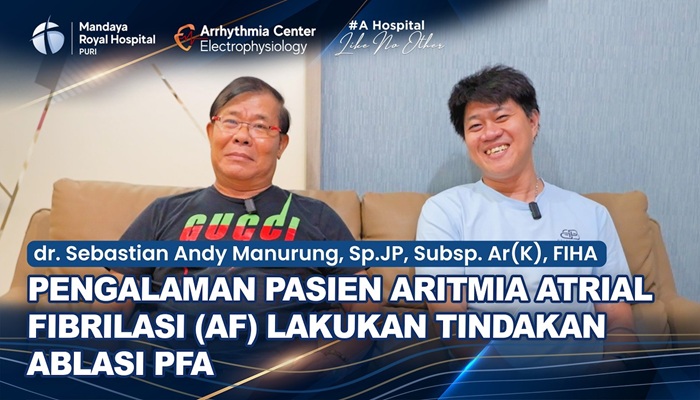
Recently, Siaw Muk Chon, a patient from West Kalimantan, underwent cardiac ablation to treat his atrial fibrillation. The procedure was performed using Pulsed Field Ablation (PFA) by dr. Sebastian Andy Manurung, Sp.JP, Subsp. Ar(K), FIHA, at Mandaya Royal Puri Hospital.
“For me, I would give it ten thumbs up. The service was good, and the way the doctor spoke was reassuring. He didn’t make us panic or feel afraid. He was very friendly,” said the patient’s son.
“Now the shaking is gone. The results are good,” the patient added.

Contents
His Heartbeat Became Rapid After Previously Being Too Slow
Siaw Muk Chon, a patient from West Kalimantan, had a long history of heart rhythm problems. Previously, he had experienced a condition in which his heart rate became too slow, requiring the implantation of a pacemaker. After this condition was treated, another problem emerged: his heartbeat would suddenly become very fast, sometimes reaching more than 100 beats per minute.
The rapid heartbeat did not occur continuously. The episodes could come and go, but they still caused concern for Siaw Muk Chon and his family. He therefore underwent regular check-ups and consultations, including visits to a hospital in Penang every few months.
Based on previous evaluations, Siaw Muk Chon had been advised several times to undergo cardiac ablation. However, his family took some time to consider the procedure and sought another medical opinion in Indonesia. After consulting with dr. Sebastian at Mandaya Royal Puri Hospital, cardiac ablation was once again recommended as a treatment option for his atrial fibrillation.
Undergoing Cardiac Ablation with PFA
After discussing and considering his treatment options, Siaw Muk Chon ultimately underwent cardiac ablation at Mandaya Royal Puri Hospital. The procedure was performed by dr. Sebastian using PFA.
The procedure involved inserting a small multipoint catheter through a blood vessel in the thigh and guiding it toward the heart. This type of catheter can target multiple areas of the heart at the same time. Before the procedure, the patient received general anesthesia, so he did not feel the ablation procedure, which lasted approximately four hours.
In patients with atrial fibrillation, cardiac ablation aims to treat areas of the heart that trigger or contribute to abnormal heart rhythms. With PFA technology, doctors use high-energy electrical pulses delivered over a short period to target specific heart tissue and help eliminate the source of abnormal electrical activity.
PFA works through a mechanism called electroporation, in which electrical energy creates tiny pores in the cell membrane. When sufficient energy is applied, the damage to the targeted cells can become irreversible. This mechanism is used in cardiac ablation to treat tissue responsible for abnormal heart rhythms.
How Is PFA Different from Conventional Cardiac Ablation?
PFA differs from some more conventional cardiac ablation techniques, such as radiofrequency ablation and cryoablation. While these methods use heat or cold energy to treat targeted tissue, PFA uses electrical energy.
Some of the potential advantages of PFA compared with thermal ablation include:
- Uses electrical energy instead of heat or cold. PFA uses high-energy electrical pulses delivered over a short period to target heart tissue responsible for abnormal rhythms.
- Helps limit the risk of injury to surrounding organs. Thermal ablation can potentially affect nearby structures, including the esophagus and nerves associated with the diaphragm and stomach.
- May reduce the risk of pulmonary vein narrowing. PFA is designed to target specific heart tissue while limiting exposure to surrounding structures.
- May allow for a more efficient procedure. Compared with some thermal ablation techniques, PFA can generally be performed in a shorter amount of time, potentially reducing the duration of general anesthesia.
During the procedure, the doctor also uses cardiac mapping technology to help identify the location of the abnormal rhythm more precisely. For Siaw Muk Chon and his family, the availability of comprehensive facilities and medical equipment was also one of the factors considered when choosing where to undergo the procedure.
After Ablation, His Heartbeat Became More Stable
After undergoing the ablation procedure, Siaw Muk Chon experienced significant improvement. The palpitations and sudden episodes of rapid heartbeat that he had experienced previously were no longer felt as before.
His recovery also progressed well. The procedure was performed through a small access point in the thigh and did not require a large incision. Following the procedure, the patient underwent the necessary care and observation to monitor his condition and check for any signs of recurrent abnormal heart rhythms.
Siaw Muk Chon’s experience highlights that atrial fibrillation may require more definitive treatment when symptoms continue to recur. PFA cardiac ablation is one treatment option that may be considered based on each patient’s condition and evaluation by a cardiologist.
Recognize the Symptoms of Atrial Fibrillation
The main symptoms of atrial fibrillation are related to changes in heart rhythm and heart rate. Symptoms may occur for several seconds or minutes before disappearing and returning later. If you experience these symptoms, especially if they occur repeatedly or interfere with your daily activities, you should consult a doctor for an evaluation and to determine the underlying cause.
Symptoms of atrial fibrillation may include:
- An irregular heartbeat, causing the pulse to feel uneven or unstable.
- Heart palpitations, which may feel like the heart is pounding, racing, fluttering, or skipping a beat.
- A heart rate faster than 100 beats per minute.
- Feeling unusually tired, including during activities that would normally be manageable.
- Reduced ability to exercise or perform physical activities.
- Chest pain or pressure.
- Shortness of breath.
- Dizziness, lightheadedness, or feeling like you may faint.
However, not everyone with atrial fibrillation experiences symptoms. In some people, the condition may be discovered incidentally during a routine health check-up or while undergoing tests for another medical condition.
Symptoms may also vary depending on the type of atrial fibrillation. With paroxysmal atrial fibrillation, episodes may start and stop on their own. With persistent atrial fibrillation, the abnormal rhythm generally does not stop on its own and may require treatment to restore a normal heart rhythm. Over time, atrial fibrillation can also become permanent, meaning the abnormal rhythm continues continuously.
Consult dr. Sebastian for Heart Rhythm Disorders (Arrhythmia) at Mandaya Royal Puri Hospital

Mandaya’s Atrial Fibrillation Heart Center is supported by dr. Sebastian Andy Manurung, Sp.JP, Subsp. Ar(K), FIHA, a cardiologist and vascular specialist with a subspecialty in arrhythmia. He has experience treating various heart rhythm disorders, including atrial fibrillation, using cardiac ablation procedures with PFA technology. Dr. Sebastian also performs 2D and 3D cardiac ablation for other types of arrhythmias.
Dr. Sebastian completed his medical education at the Faculty of Medicine, Universitas Padjadjaran, before continuing his cardiology and vascular medicine specialist training at FKUI/Harapan Kita National Cardiovascular Center. He also obtained an arrhythmia consultant qualification from the Indonesian College of Cardiology and Vascular Medicine.
In addition to PFA ablation, dr. Sebastian is experienced in performing cardiac ablation using 3D mapping technology and implanting pacemakers. One of his achievements was performing the implantation of Micra, one of the world’s smallest pacemakers, in a patient at Mandaya Royal Puri Hospital.
Mandaya Royal Puri Hospital also provides Pacemaker Reprogramming services to check and adjust pacemaker settings according to the patient’s condition and needs.
dr. Sebastian Andy Manurung, Sp.JP, Subsp. Ar(K), FIHA is available at Mandaya Royal Puri Hospital on:
- Tuesday: 4:00 PM–8:00 PM WIB
- Thursday: 4:00 PM–8:00 PM WIB
- Saturday: 1:00 PM–5:00 PM WIB
To make your visit to Mandaya Royal Hospital Puri easier, you can use the WhatsApp Chat, Book Appointment, or the Care Dokter app, available for download on Google Play and the App Store. The app allows you to check queue numbers and access other information related to your visit.
This information is provided for educational purposes and as a general overview. It does not represent the full range of medical services that may be performed by each doctor. To determine the most appropriate treatment for your condition, consultation with the relevant doctor is recommended.
If you have any questions, suggestions, or need further information, please contact our call center at 0811-1900-2000.

References
- Mayo Clinic. Atrial Fibrillation – Symptoms and Causes. (https://www.mayoclinic.org/diseases-conditions/atrial-fibrillation/symptoms-causes/syc-20350624). Accessed August 21, 2026.
- Cleveland Clinic. Catheter Ablation. (https://my.clevelandclinic.org/health/treatments/16851-catheter-ablation). Accessed August 21, 2026.
- Johns Hopkins Medicine. Pulsed Field Ablation. (https://www.hopkinsmedicine.org/health/treatment-tests-and-therapies/pulsed-field-ablation). Accessed August 21, 2026.
- NHS. Atrial Fibrillation. (https://www.nhs.uk/conditions/atrial-fibrillation/). Accessed August 21, 2026.