


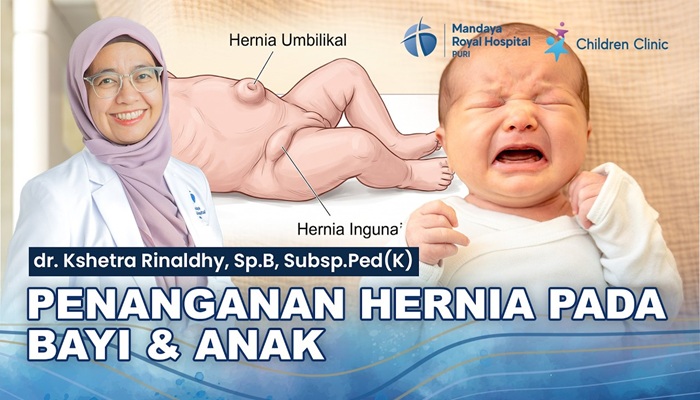
Hernias are among the most common conditions affecting infants and young children. Many parents assume that a lump in the groin or around the belly button is harmless. However, such a lump may be a sign of a hernia that requires evaluation and treatment by a pediatric surgeon.
In children, hernias are usually congenital, meaning they are present from birth. Although they often begin as a lump that comes and goes, hernias should not be ignored because, in some cases, part of the intestine can become trapped, creating a surgical emergency that requires prompt treatment.

dr. Kshetra Rinaldhy, Sp.B, Subsp.Ped(K), a pediatric surgery consultant at Mandaya Royal Hospital Puri, provides a comprehensive explanation of hernias in infants and children, including their causes, types, symptoms, diagnosis, and available treatment options.

Contents
Understanding Pediatric Hernias with dr. Kshetra Rinaldhy, Sp.B, Subsp.Ped(K)
According to dr. Kshetra, a hernia occurs when there is a weakness or opening in the abdominal wall, allowing tissue inside the abdomen—such as the intestine or fatty tissue—to protrude through the opening and form a visible lump.
“A hernia is a medical condition in which there is a weakness or opening in the abdominal wall. Usually, part of the intestine or fatty tissue protrudes through this opening and is enclosed within a hernia sac,” explained dr. Kshetra.
In children, hernias are generally congenital conditions. The opening in the abdominal wall is already present at birth because the tissue that should have closed before or shortly after birth fails to close completely.
Although the opening exists from birth, the lump often becomes noticeable only when pressure inside the abdomen increases, such as when a child cries forcefully, coughs, strains, or engages in vigorous physical activity. The increased pressure pushes the intestine through the opening, causing the lump to appear.
Types of Hernias in Children
Not all hernias occur in the same location. According to dr. Kshetra, several types of hernias can affect infants and children.
1. Inguinal Hernia
An inguinal hernia is the most common type of hernia in children. It appears as a lump in the groin area or, in boys, within the scrotum.
This type of hernia carries a higher risk of intestinal entrapment (incarceration or strangulation), which is why surgical repair is generally recommended.
2. Umbilical Hernia
An umbilical hernia develops at the belly button. In Indonesia, this condition is commonly referred to as “bodong.”
In many children, especially when the hernia opening is small, an umbilical hernia may close on its own as the child grows and therefore does not always require immediate surgery.
3. Other Abdominal Wall Hernias
Hernias may also develop in less common areas of the abdominal wall, meaning the lump does not always appear in the groin or around the belly button.
4. Internal Hernia
In an internal hernia, part of the intestine protrudes through an opening within the abdominal cavity rather than outside the body. As a result, no visible lump is present, and additional medical evaluation is required to establish the diagnosis.
5. Diaphragmatic Hernia
A diaphragmatic hernia is typically diagnosed in newborn babies. In this condition, there is an opening in the diaphragm, the muscle that separates the chest cavity from the abdominal cavity.
As a result, the intestine or other abdominal organs can move into the chest cavity, potentially interfering with lung development and the baby’s breathing.
What Are the Symptoms of a Hernia in Children?
The symptoms of a hernia depend on its severity. In the early stages, the only sign is usually a lump that appears intermittently.
Common symptoms to watch for include:
- A lump in the groin, scrotum, or around the belly button.
- The lump becomes more noticeable when the child cries, coughs, strains, or is physically active.
- The lump disappears when the child is relaxed or asleep.
- In some cases, the lump can be gently pushed back into the abdomen.
However, a hernia can become a medical emergency if the protruding intestine becomes trapped in the hernia opening.
“If the lump appears and becomes trapped, the blood vessels can also become compressed along with the intestine. This condition is called strangulation and is usually accompanied by severe pain. The child may cry intensely or become extremely irritable and difficult to comfort,” said dr. Kshetra.
If this happens, the child should be taken to the hospital immediately because the trapped intestine may lose its blood supply and become damaged.
How Is a Hernia Diagnosed in Children?
Diagnosing a hernia involves more than simply identifying a lump. A pediatric surgeon will perform a thorough physical examination to determine the exact cause of the swelling.
This is important because a lump in the groin or scrotum is not always caused by a hernia. Other conditions that can resemble a hernia include:
- Hydrocele, a collection of fluid around the testicle.
- Enlarged lymph nodes in the groin.
- Undescended testicle (cryptorchidism).
A proper evaluation by a pediatric surgeon is therefore essential to establish the correct diagnosis and determine the most appropriate treatment.
How Is a Hernia Treated in Children?
Treatment depends on the type of hernia the child has.
-
Umbilical Hernia
For an umbilical hernia, surgery is not always the first option.
If the diameter of the hernia ring is less than approximately 1–1.5 cm, doctors usually recommend observation because the opening may close naturally as the child grows.
In most cases, the child is monitored until around 2–3 years of age before deciding whether surgery is necessary.
-
Inguinal Hernia
Unlike an umbilical hernia, an inguinal hernia is not recommended for observation.
Because the risk of intestinal strangulation is significantly higher, surgical repair is generally advised to prevent potentially serious complications.
Preparing for Hernia Surgery
Before surgery, several important preparations are required, including:
- Parents should be ready to accompany and care for their child throughout the surgical and recovery process.
- The child should be in good health and free from fever, cough, or other infections.
- The child must fast before surgery according to the doctor’s instructions.
How Is Hernia Surgery Performed in Children?
According to dr. Kshetra, herniotomy is one of the most commonly performed procedures in pediatric surgery.
“The surgeon closes the hernia opening by placing sutures around the hernia ring. The procedure can be performed through conventional surgery using a small incision or through keyhole surgery (laparoscopy).”
There are two main surgical approaches:
- Conventional (open) surgery, which uses a small incision near the hernia.
- Laparoscopic (keyhole) surgery, which uses several tiny incisions and a camera, resulting in smaller wounds and potentially faster recovery.
Most children stay in the hospital for one night after surgery. In selected cases, the procedure can even be performed as one-day care, allowing the child to return home on the same day once their condition is stable.
Consult dr. Kshetra Rinaldhy, Sp.B, Subsp.Ped(K) at Mandaya Royal Hospital Puri

If you notice a lump in your child’s groin, scrotum, or around the belly button, do not delay seeking medical attention. Early evaluation can help determine whether the lump is a hernia or another condition, as well as whether it can be safely monitored or requires surgical treatment.
dr. Kshetra Rinaldhy, Sp.B, Subsp.Ped(K) is a pediatric surgery consultant at Mandaya Royal Hospital Puri with extensive experience in treating a wide range of pediatric hernias, including umbilical hernias, inguinal hernias, and more complex cases. He performs both conventional and laparoscopic (minimally invasive) hernia repair procedures. With timely and appropriate treatment, the risk of complications can be minimized, allowing children to recover and return to their normal activities comfortably.
You can meet dr. Kshetra Rinaldhy, Sp.B, Subsp.Ped(K) at Mandaya Royal Hospital Puri during the following clinic hours:
- Tuesday: 5:00 PM – 7:00 PM (WIB)
- Saturday: 10:00 AM – 12:00 PM (WIB)
To make your visit more convenient, you can use the WhatsApp Chat feature, Book Appointment, or the Care Dokter mobile application, available on Google Play and the App Store. The app allows you to schedule appointments, check queue numbers, and access additional hospital services and information.
The information provided on this page is intended for educational and general informational purposes only. It does not represent the full range of medical services that may be provided by each physician. To receive appropriate diagnosis and treatment based on your individual health condition, we recommend consulting directly with the relevant specialist.
If you have any questions, suggestions, or would like more information, please contact our call center at 0811-1900-2000.