


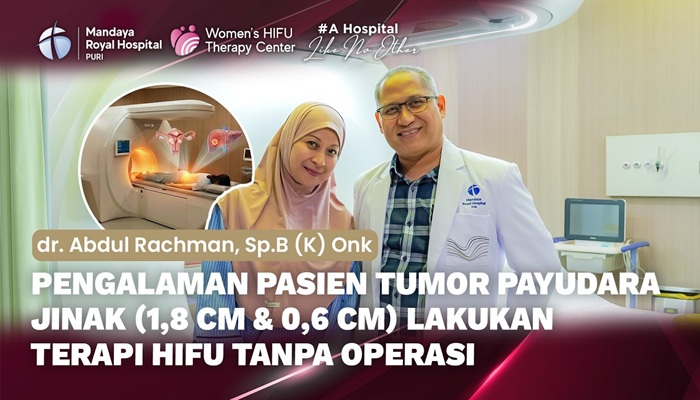
A breast tumor is a lump that develops due to the abnormal growth of breast tissue. In general, breast tumors are classified into two types: benign tumors and malignant tumors (breast cancer). Unlike malignant tumors, which can spread to other tissues, benign breast tumors are non-cancerous and typically do not invade surrounding tissue. Therefore, doctors do not always recommend removing benign tumors immediately. However, in some cases, these tumors may continue to grow, compress nearby tissues, cause discomfort, or create anxiety for the patient, making treatment necessary.
One patient who experienced this condition is Olivia Novita, a 50-year-old woman from Lubang Buaya, East Jakarta. Olivia first discovered lumps in both of her breasts during a self-examination. After consulting dr. Abdul Rachman, Sp.B (K) Onk, a surgical oncologist at Mandaya Royal Hospital Puri, she was diagnosed with benign breast tumors. Although the tumors were non-cancerous, her doctor recommended treatment. Olivia, however, postponed the procedure because she was afraid of undergoing surgery with general anesthesia. Eventually, she found a treatment option that gave her greater confidence—High-Intensity Focused Ultrasound (HIFU) at Mandaya Royal Hospital Puri.
“The procedure started at around 2:00 p.m. It didn’t take long—one position took about 40 minutes, while the other only took around 10 minutes. I only had local anesthesia, and even the injection didn’t hurt. The anesthesia wasn’t painful, and neither was the procedure itself. On a scale of 1 to 10, I’d say the pain was only about a 2. I had to lie face down because the treatment was performed from underneath. By around 4:00 p.m., it was finished. After three hours of observation, I was allowed to go home the same day. I felt completely fine afterward. Since it was only local anesthesia, I was comfortable. My family was even surprised that I was already back home. It was a very comfortable experience,” said Olivia.

Contents
She Delayed Treatment Because She Was Afraid of Surgery
Olivia first noticed lumps in both of her breasts during a routine self-check. She then visited a doctor to determine whether the condition was serious.
After consulting dr. Abdul at Mandaya Royal Hospital Puri, Olivia learned that the lumps were benign breast tumors. At that time, she had two main tumors measuring approximately 1.8 cm and 0.6 cm, along with several smaller lumps. Although she did not experience any pain, her doctor still recommended treatment.
However, Olivia was not ready to undergo surgery. She admitted that the thought of receiving general anesthesia made her anxious. For nearly a year, she chose to attend follow-up appointments every three to four months to monitor the growth of her tumors.
Eventually, dr. Abdul introduced her to an alternative treatment that did not require open surgery—HIFU. After learning that the procedure involved no incision and only required local anesthesia, Olivia felt confident enough to proceed with treatment at Mandaya Royal Hospital Puri.
What Is HIFU and How Does It Work?
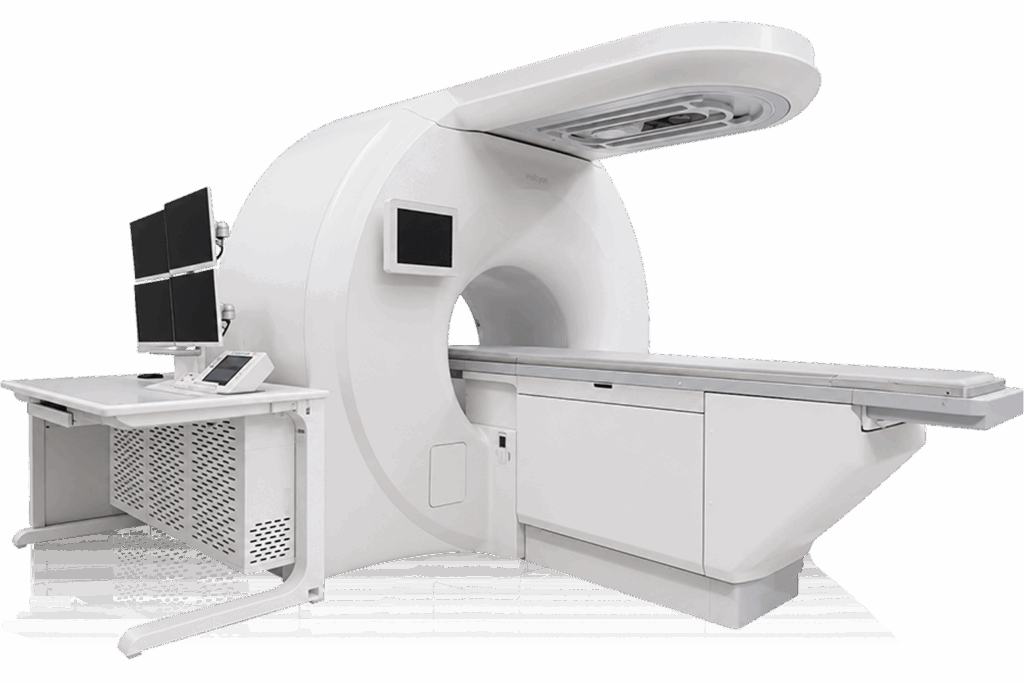
High-Intensity Focused Ultrasound (HIFU) is a medical procedure that uses high-intensity ultrasound waves to treat various medical conditions, including tumors. HIFU is considered a minimally invasive procedure because it does not require surgical incisions.
Unlike conventional ultrasound examinations, which are used to produce images of internal organs, HIFU delivers focused ultrasound energy to destroy targeted tissue without damaging the surrounding healthy tissue.
HIFU works by:
- Using high-intensity ultrasound waves that are precisely focused on the targeted tissue.
- Delivering thermal energy rather than producing diagnostic images.
- Raising the temperature of the targeted tissue until it is destroyed (ablated).
- Allowing the ultrasound waves to pass safely through the skin and surrounding tissues without harming them before reaching the treatment area.
- Operating similarly to a magnifying glass focusing sunlight onto a single point, where heat is concentrated only on the intended target.
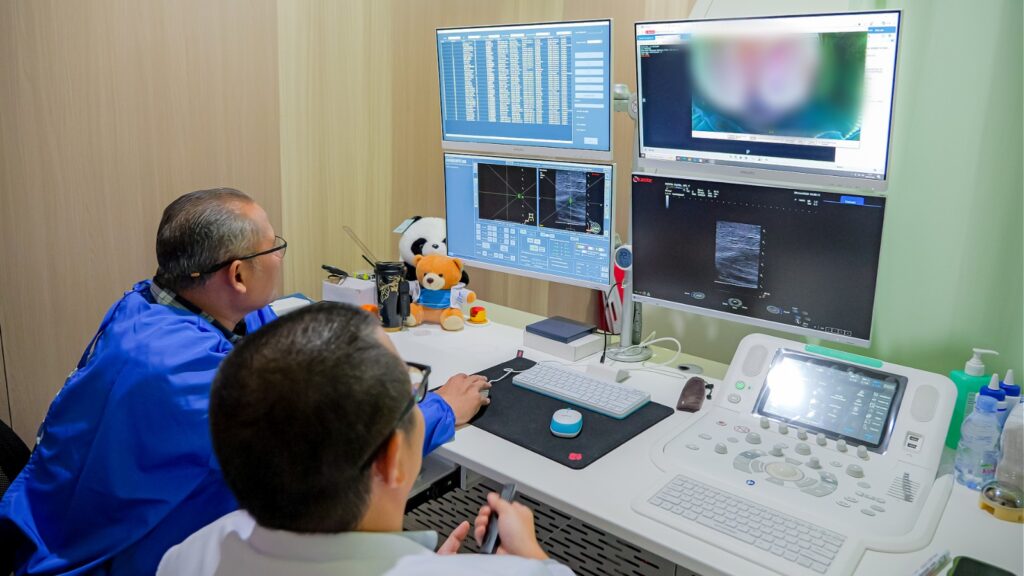
To ensure accuracy, physicians typically use imaging guidance during the procedure, including:
- Magnetic Resonance Imaging (MRI), or
- Ultrasound (US).
These imaging technologies help physicians identify the treatment target, guide the procedure, and monitor the treatment in real time for greater precision.
After HIFU, the Patient Was Able to Go Home the Same Day
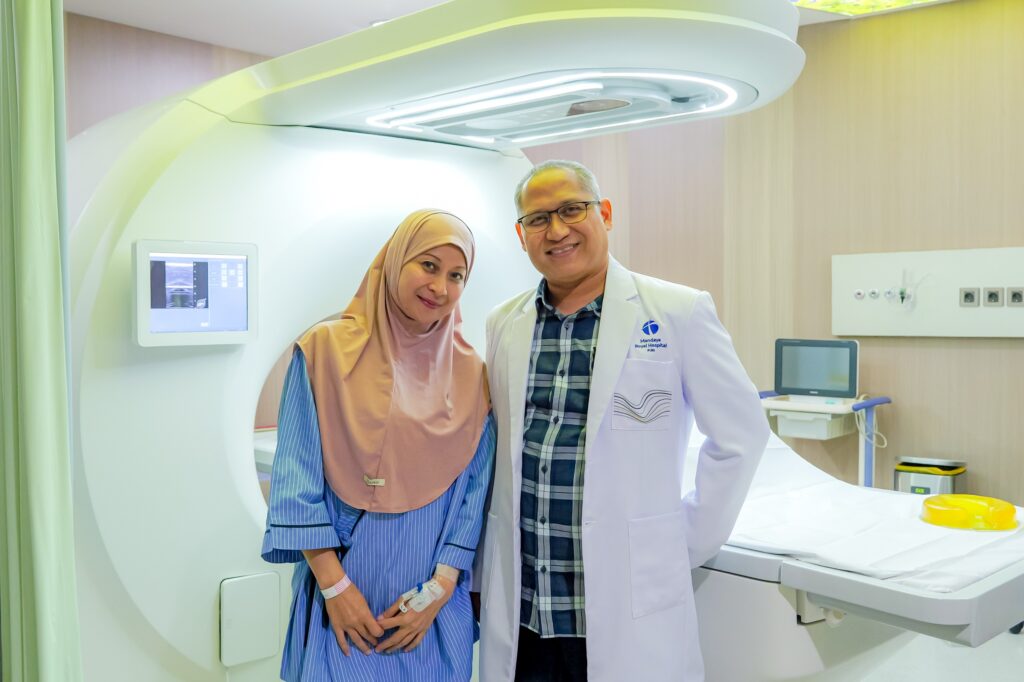
Olivia underwent HIFU treatment at Mandaya Royal Hospital Puri in the morning. Before the procedure, she completed a series of pre-treatment evaluations, including laboratory tests and lung and heart examinations to ensure she was fit for treatment. She was then prepared for the HIFU procedure later that afternoon.
Throughout the procedure, Olivia received only local anesthesia. She described both the anesthesia injection and the HIFU treatment as comfortable. According to her, the pain level was only 2 out of 10.
After the procedure, Olivia remained under observation for approximately three hours before being discharged on the same day. She experienced no significant discomfort afterward and was pleasantly surprised by how quickly she recovered.
Approximately 13 days after undergoing HIFU, Olivia returned to Mandaya Royal Hospital Puri for a follow-up appointment. The evaluation showed that her recovery was progressing well. According to her doctor, the treated tumor tissue would continue to shrink and gradually be absorbed by the body over the following months. She was scheduled for another follow-up visit three months later to monitor her progress.
Profile and Practice Schedule of dr. Abdul at Mandaya Royal Hospital Puri
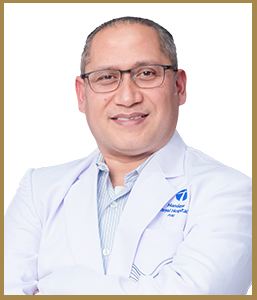
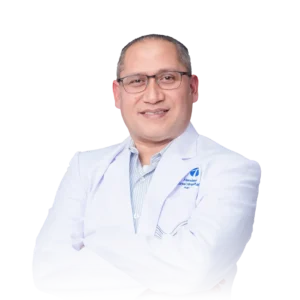
dr. Abdul Rachman, Sp.B (K) Onk is a consultant surgical oncologist at Mandaya Royal Hospital Puri who specializes in treating tumors and cancer through both surgical and minimally invasive approaches. He earned his medical degree from Trisakti University, followed by his General Surgery and Surgical Oncology specialist training at the University of Indonesia. To further enhance his expertise, he has participated in numerous advanced training programs, including the Workshop on Minimally Invasive Surgery, RFA, and VABB at Dharmais National Cancer Hospital, the Workshop on Oncoplasty and Microsurgery in Cancer Management, the Workshop on Evidence-Based Medicine, and Laparoscopic Breast Cancer Reconstruction with Implants at National Cheng Kung University Hospital.
At Mandaya Royal Hospital Puri, dr. Abdul provides a wide range of surgical oncology services, including total thyroidectomy, partial thyroidectomy, lumpectomy (breast lump removal), and breast cancer surgery. In addition to surgical procedures, he also offers minimally invasive treatment options such as High-Intensity Focused Ultrasound (HIFU) for selected patients, allowing treatment plans to be tailored to each patient’s condition and medical indications.
dr. Abdul Rachman, Sp.B, Subsp. Onk (K) is available for consultation at Mandaya Royal Hospital Puri on:
- Tuesday: 4:00 PM – 6:00 PM
- Thursday: 4:00 PM – 6:00 PM
- Saturday: 9:00 AM – 12:00 PM
To make your visit to Mandaya Royal Hospital Puri more convenient, you can use the WhatsApp Chat, Book Appointment, or Care Dokter mobile application, available on Google Play and the App Store, to book appointments, check queue numbers, and access additional information.
The information provided on this page is intended for educational purposes and as a general overview. It does not represent the full range of medical services offered by each physician. To receive treatment tailored to your specific health condition, we recommend consulting directly with the relevant doctor.
If you have any questions, suggestions, or require further information, please contact our call center at 0811-1900-2000.

References
- National Breast Cancer Foundation. Breast Tumors. (https://www.nationalbreastcancer.org/breast-tumors/). Last revised March 2, 2026. Accessed July 16, 2026.
- Cleveland Clinic. High-Intensity Focused Ultrasound (HIFU): Purpose & Procedure. (https://my.clevelandclinic.org/health/treatments/16541-hifu-high-intensity-focused-ultrasound). Last revised August 31, 2022. Accessed July 16, 2026.