


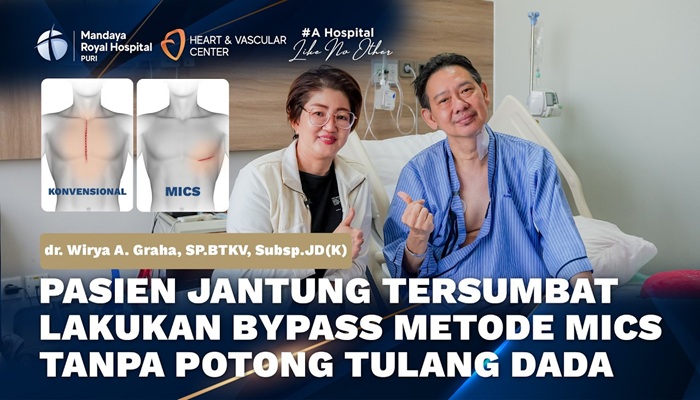
A heart attack is a medical emergency that occurs when blood flow to the heart muscle is blocked. When multiple coronary arteries are affected or the blockages are severe, coronary stent placement may not always be the most appropriate treatment option. In such cases, heart bypass surgery may be required to restore blood flow to the heart and reduce the risk of another heart attack.
Fortunately, heart bypass surgery no longer always requires opening the breastbone. Thanks to advances in cardiac surgery, Minimally Invasive Cardiac Surgery (MICS) allows bypass procedures to be performed through a small incision on the side of the chest without cutting the sternum, helping patients recover more quickly.

This was the experience of Eko Wisanto, a 60-year-old patient from Bandung, who underwent MICS heart bypass surgery performed by dr. Wirya A. Graha, Sp.BTKV, Subsp. JD(K) at Mandaya Royal Hospital Puri after suffering a heart attack caused by severe blockages in multiple coronary arteries.
“Three days after the surgery, I was amazed by his recovery. We were truly grateful because, as his caregiver at home—not just as his wife—the aftercare would become our responsibility,” said the patient’s wife.
“The progress has been great because I’ve been closely monitored. Yesterday I already started rehabilitation and walking back and forth without any shortness of breath. My oxygen saturation was monitored, and it stayed at 99,” said the patient.

Contents
What Is MICS?
Minimally Invasive Cardiac Surgery (MICS) is a heart surgery technique performed without dividing the breastbone, unlike conventional open-heart surgery. Instead, cardiac surgeons use specialized instruments through a small incision on the side of the chest or between the ribs, eliminating the need for a large incision in the center of the chest. The incision typically measures only 5–8 cm.
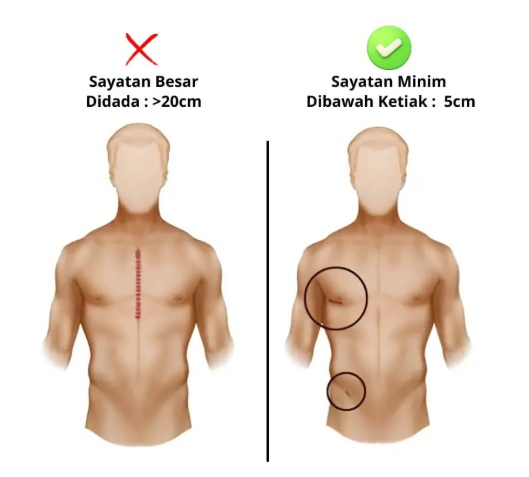
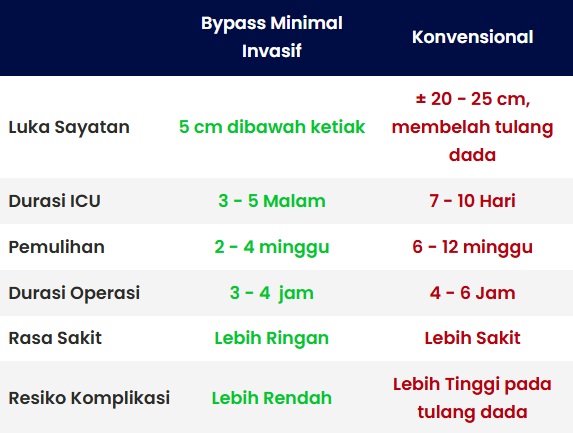
Because the incision is much smaller, MICS generally results in less postoperative pain, reduced blood loss, and less damage to surrounding tissues. The risk of infection is also lower compared to conventional surgery. In addition, patients usually experience a faster recovery, a shorter hospital stay, and an earlier return to daily activities with an improved quality of life.
Stent Placement Was Not Optimal, Patient Was Advised to Undergo Heart Bypass Surgery
Approximately three to four weeks before undergoing surgery, Eko experienced a mild heart attack and received immediate treatment at a hospital in Bandung. He was admitted to the High Care Unit (HCU) for four days.
The medical team performed a cardiac catheterization with the intention of placing coronary stents. However, the examination revealed extensive plaque buildup, making stent placement less effective than expected.
The catheterization showed severe narrowing of approximately 80–90% in three to four coronary arteries. Because of the high risk of another heart attack, the patient was advised to undergo heart bypass surgery as soon as possible.
His cardiologist in Bandung also explained that bypass surgery could now be performed using the MICS technique, but the procedure was not yet available there, so he was referred to Jakarta.
The patient’s family then explored various treatment options, including hospitals in Penang, Kuala Lumpur, and China. After careful consideration, they chose Mandaya Royal Hospital Puri, where MICS heart bypass surgery is performed by dr. Wirya.
In addition to being more affordable than seeking treatment overseas, the family preferred MICS because the patient has diabetes. They believed the smaller incision would promote better wound healing than conventional bypass surgery, which requires opening the breastbone.
Throughout the treatment process, the family also appreciated the hospital’s communication. The medical team regularly provided updates through WhatsApp groups from the beginning of surgery until recovery in the ward, allowing family members to stay informed about the patient’s condition.
MICS Heart Bypass Surgery Without Opening the Breastbone
According to dr. Wirya, this patient’s bypass surgery was performed differently from the conventional technique.
“In conventional bypass surgery, the breastbone is divided, the chest is opened, the heart is exposed, and the heart is temporarily stopped while a heart-lung machine is used during the operation,” explained dr. Wirya.
At Mandaya Royal Hospital Puri, MICS has become the standard approach for suitable bypass surgery candidates. The procedure is performed through a 7–8 cm incision on the left side of the chest without cutting the breastbone. Surgeons access the heart by working through the chest muscles while leaving the sternum intact.
Another major advantage is that the bypass is performed while the heart continues beating, eliminating the need to stop the heart during surgery.
In Eko’s case, the surgical team successfully created four bypass grafts—three on the left side of the heart and one on the right—to restore blood flow beyond the blocked coronary arteries.
Because the breastbone was not divided, recovery was significantly faster. Three days after surgery, the patient was already walking and performing light activities. By the fifth postoperative day, he was discharged and continued recovering at home.
Benefits of MICS Heart Bypass Surgery
- No need to divide the breastbone (sternum)
- Small incision hidden beneath the breast, measuring approximately 3–5 cm
- Reduced injury to surrounding tissues and blood vessels
- Minimal blood loss
- Less postoperative pain
- Lower risk of complications, particularly in patients with chronic conditions such as diabetes and in older adults
- Faster recovery, with many patients able to return to daily activities within approximately one week
dr. Wirya’s Profile and Consultation Schedule at Mandaya Royal Hospital Puri

dr. Wirya A. Graha, Sp.BTKV, Subsp. JD(K) is a thoracic, cardiac, and vascular surgeon with a subspecialty in adult cardiac surgery. He has extensive experience performing a wide range of heart and vascular procedures. After completing his specialist training at the Faculty of Medicine, Universitas Indonesia, he continued to advance his expertise in modern cardiac surgery techniques, including minimally invasive heart surgery.
One of dr. Wirya’s areas of expertise is Minimally Invasive Cardiac Surgery (MICS), which enables heart surgery to be performed through a small incision without opening the breastbone. This approach minimizes surgical trauma and may result in less postoperative pain, a lower risk of complications, and faster recovery compared with conventional open-heart surgery.
To further enhance his expertise, dr. Wirya regularly participates in international scientific meetings and training programs, including:
- 2017: 25th Annual Meeting of the Asian Society for Cardiovascular and Thoracic Surgery, Seoul, South Korea
- 2018: 28th Annual Meeting of the Association of Thoracic and Cardiovascular Surgeons of Asia
- 2019: 1st Joint Biennial South East Asian Regional Congress on Cardiovascular and Thoracic Surgery in conjunction with the 20th MATCVS Annual Scientific Meeting, Malacca, Malaysia
- 2021: 25th European Vascular Course and 5th European Cardiovascular Course
Consultation Schedule at Mandaya Royal Hospital Puri
- Tuesday: 4:30 PM – 8:00 PM
- Thursday: 4:30 PM – 8:00 PM
- Saturday: 10:00 AM – 1:00 PM
To make your visit to Mandaya Royal Hospital Puri more convenient, you can use the hospital’s WhatsApp Chat, Book Appointment feature, or the Care Dokter mobile application, available on Google Play and the App Store. These services allow you to book appointments, check queue numbers, and access other important information.
The information provided on this page is intended for educational purposes and general reference only. It does not represent the full scope of medical services that may be performed by each physician. To receive the most appropriate treatment based on your individual condition, please consult directly with the relevant doctor.
If you have any questions or require further information, please contact our call center at 0811-1900-2000.

References
- Mayo Clinic. Heart Attack. (https://www.mayoclinic.org/diseases-conditions/heart-attack/symptoms-causes/syc-20373106). Last revised October 19, 2024. Accessed July 8, 2026.
- Bangkok Hospital. Minimally Invasive Cardiac Surgery (MICS). (https://www.bangkokhospital.com/id/bangkok-heart/content/minimally-invasive-cardiac-surgery-mics). Accessed July 8, 2026.