


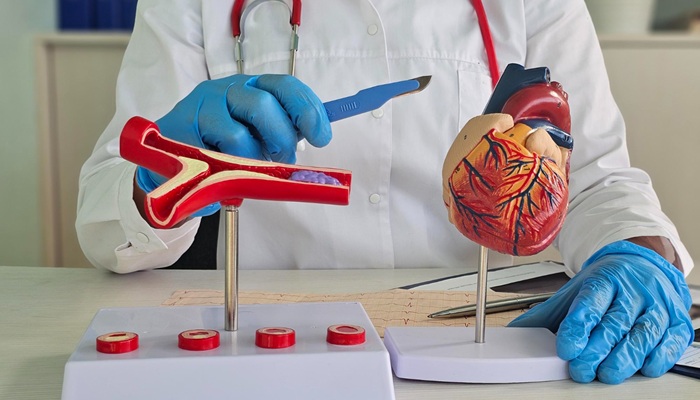
Recovery is one of the main considerations for many people about to undergo heart surgery. The good news is that advances in cardiac surgery technology now allow heart surgery to be performed using the Minimally Invasive Cardiac Surgery (MICS) method, a technique using small incisions without splitting the breastbone. Compared to conventional heart surgery, this method generally offers a faster recovery process.

According to dr. Wirya A. Graha, Sp.BTKV, Subsp. JD(K), a thoracic, cardiac, and vascular surgery specialist with a subspecialty in adult cardiac surgery at Mandaya Royal Hospital Puri, patients who undergo MICS heart surgery can even be discharged from the hospital within about 4-5 days, depending on each patient’s condition.

Contents
How long is recovery after MICS heart surgery?
One of the advantages of MICS is a recovery process that is generally faster compared to conventional heart surgery. This is because the procedure is performed through a small incision without splitting the breastbone, minimizing tissue damage and bleeding during surgery.
According to dr. Wirya, patients who undergo MICS heart surgery can generally be discharged from the hospital within about 4-5 days, depending on each patient’s condition.
He explained that with minimally invasive surgery, there is less tissue damage and less bleeding, so patients can go home 4-5 days after the operation.
dr. Wirya added that patients who undergo surgery early in the week even have a chance to return home by the weekend if their recovery progresses as expected.
He noted that if surgery is performed on a Monday, the patient might be able to go home by Friday or Saturday. In his view, this represents a new era and a new approach—people who were previously hesitant to undergo heart surgery may feel reassured upon learning that the healing process is now much faster.
After being discharged, patients are not advised to remain on bed rest. Instead, light physical activity becomes an important part of the rehabilitation process. Patients are encouraged to start walking for about 15-30 minutes regularly as advised by their doctor, since movement and activity can help speed up recovery.
The ability to return to normal activities also improves gradually. Based on dr. Wirya’s experience, many patients are able to return to work and daily life within about 1 month after surgery. Some patients are even able to engage in fairly high-intensity exercise after the recovery period.
He shared that when patients ask when they can resume sports, his answer is often that they can play tennis again after one month and run 10 km after two months. Typically, patients are able to return to work within about one month, resuming normal life, fairly strenuous exercise, and regular work activities.
However, recovery time varies between patients. Factors such as age, overall health condition, comorbidities, and adherence to rehabilitation programs and routine check-ups will affect the speed of recovery after MICS heart surgery.
Getting to know MICS heart surgery better
MICS is a group of heart surgery procedures performed through small incisions in the chest, without needing to split the breastbone (sternum) as in conventional open-heart surgery.
This method is also known as small-incision heart surgery. Through the MICS technique, surgeons can treat certain heart conditions with minimal trauma to the chest wall.
MICS has the same goal as conventional open-heart surgery: repairing or addressing heart problems. However, in suitable patients, this method offers several advantages, such as milder post-operative pain, smaller scars, shorter hospital stays, and faster recovery.
In MICS heart surgery, surgeons access the heart through a small incision between the ribs, eliminating the need to split the breastbone. During the procedure, doctors use specialized surgical instruments and high-resolution camera assistance to clearly view the surgical area and perform actions with precision.
Heart conditions that can be treated with MICS
MICS can be an option for treating several heart conditions that require surgery. This method is recommended for patients with certain conditions deemed suitable for minimally invasive surgical procedures.
Some heart conditions that can be treated with the MICS method include:
- Heart valve disease, such as disorders of the mitral or aortic valve, causing the valve to narrow (stenosis) or leak (regurgitation).
- Coronary artery disease, namely narrowing or blockage of the coronary blood vessels requiring Coronary Artery Bypass Graft (CABG) surgery.
MICS is generally considered when catheter-based procedures are not feasible or when minimally invasive surgery is expected to provide better long-term outcomes.
However, not all patients are candidates for this procedure. The decision to perform MICS heart surgery will be determined by the doctor based on the disease condition, the heart’s anatomical structure, the patient’s overall health condition, and the level of surgical complexity required.
Besides faster recovery, what other advantages does MICS heart surgery offer?
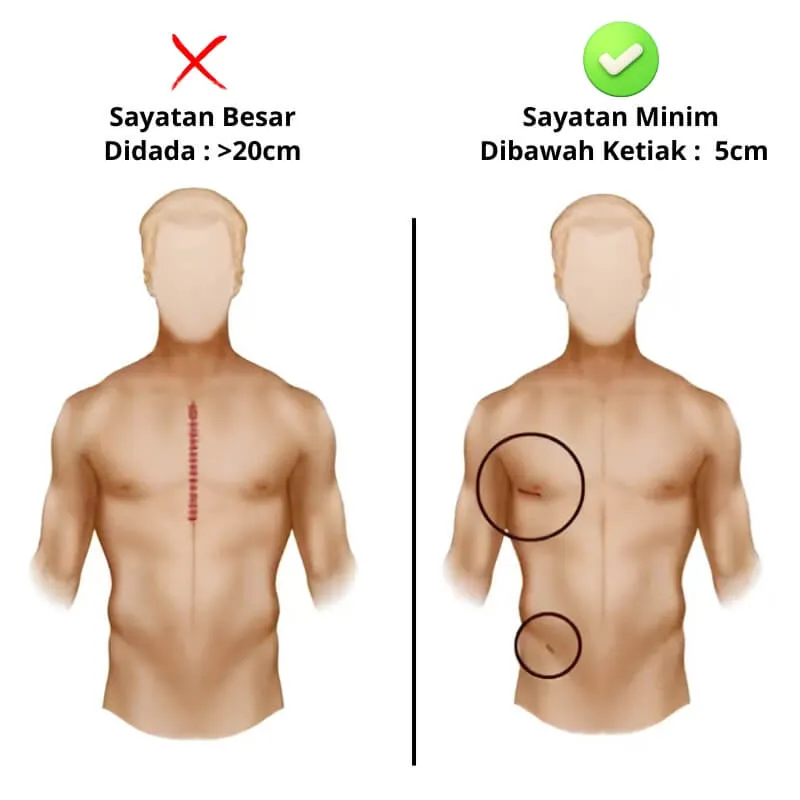
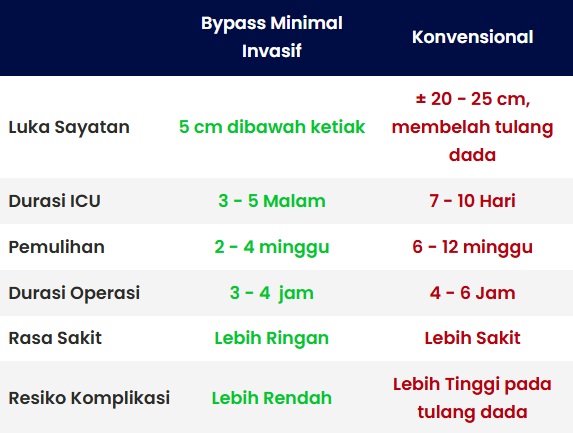
MICS heart surgery offers various advantages compared to conventional open-heart surgery. Because it is performed through a small incision without splitting the breastbone, this procedure can reduce trauma to the body while speeding up the recovery process. Here are some advantages of MICS heart surgery:
- No need to split the breastbone (sternum) as in conventional open-heart surgery
- Uses a small incision of about 3-5 cm, generally made below the breast so the scar is more concealed
- Minimal damage to tissue and blood vessels, resulting in a procedure that causes less trauma to the body
- Less bleeding during surgery, which can also reduce the need for blood transfusions
- Post-operative pain tends to be milder due to the smaller incision and the absence of breastbone splitting
- Lower risk of complications, especially in patients with comorbidities such as diabetes or in elderly patients
dr. Wirya’s expertise and practice schedule at Mandaya Royal Hospital Puri

dr. Wirya A. Graha, Sp.BTKV, Subsp. JD(K) is a thoracic, cardiac, and vascular surgery specialist with a subspecialty in adult cardiac surgery, experienced in handling various heart and blood vessel diseases requiring surgical intervention. He completed his specialist education in Thoracic and Cardiovascular Surgery at the Faculty of Medicine, University of Indonesia, and continues to develop his expertise in modern cardiac surgery.
One of dr. Wirya’s key areas of expertise is MICS, a heart surgery technique using small incisions without splitting the breastbone. This approach allows patients to gain various benefits, such as milder post-operative pain, lower risk of complications, smaller scars, and a recovery period that tends to be shorter compared to conventional heart surgery.
In addition to MICS, dr. Wirya also has experience performing various other cardiac surgical procedures, including heart bypass surgery, heart valve repair and replacement surgery, and aortic blood vessel surgery. As a member of the Indonesian Medical Association (IDI), he is committed to providing cardiac surgical care that prioritizes safety, quality, and the needs of each patient.
To stay up to date with the latest developments in cardiac surgery technology and techniques, dr. Wirya regularly attends various international training programs and scientific conferences, including:
- 2017: 25th Annual Meeting of the Asian Society for Cardiovascular and Thoracic Surgery, Seoul, South Korea
- 2018: 28th Annual Meeting of the Association of Thoracic and Cardiovascular Surgeons of Asia
- 2019: 1st Joint Biennial South East Asian Regional Congress on Cardiovascular and Thoracic Surgery, held jointly with the 20th MATCVS Annual Scientific Meeting, Malacca
- 2021: 25th European Vascular Course and 5th European Cardiovascular Course
For those who wish to consult about minimally invasive heart surgery, heart bypass, or heart valve disorders, dr. Wirya A. Graha, Sp.BTKV, Subsp. JD(K) practices at Mandaya Royal Hospital Puri with the following schedule:
- Tuesday: 4:30 PM–8:00 PM (WIB)
- Thursday: 4:30 PM–8:00 PM (WIB)
- Saturday: 10:00 AM–1:00 PM (WIB)
To make your visit to Mandaya Royal Hospital Puri easier, use the WhatsApp Chat feature, Book Appointment, or the Care Dokter app, available for download on Google Play and the App Store, to make visits easier, check queue numbers, and get other complete information.
*The information provided on this page is intended for educational purposes and general overview, and does not reflect the full range of medical services that each doctor can provide. To ensure treatment appropriate to your health condition, it is recommended that you consult directly with the relevant doctor.
If you have any questions, suggestions, or need further information, please contact our call center at 0811-1900-2000.

References:
- Mount Elizabeth Hospitals. Minimally Invasive Cardiac Surgery. (https://www.mountelizabeth.com.sg/tests-treatments/minimally-invasive-cardiac-surgery). Accessed June 30, 2026.
- Bangkok Heart Hospital. Minimally Invasive Cardiac Surgery (MICS). (https://www.bangkokhospital.com/en/bangkok-heart/content/minimally-invasive-cardiac-surgery-mics). Last revised April 2, 2026. Accessed June 30, 2026.