


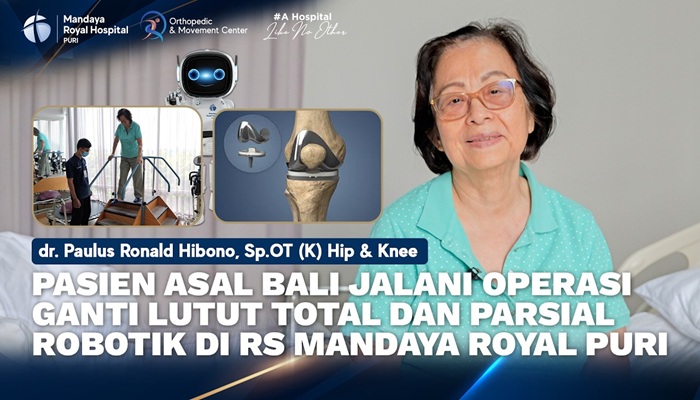
Knee pain is often considered a normal part of aging. Many elderly individuals choose to endure the pain, limit their activities, and gradually lose their independence in daily life. In reality, when osteoarthritis becomes more severe or a torn meniscus begins interfering with movement, the pain is no longer just “ordinary soreness.” Simple activities such as climbing stairs, walking, or even sleeping can become exhausting struggles.
This was the experience of Mrs. Irmayanti, an 80-year-old patient from Bali. Despite her age, she refused to surrender to the pain. After suffering from severe osteoarthritis and worsening meniscus tears, Mrs. Irmayanti eventually underwent simultaneous total and partial knee replacement surgery at Mandaya Royal Hospital Puri with dr. Paulus Ronald Hibono, Sp.OT (K), an orthopedic consultant specializing in hip and knee conditions.
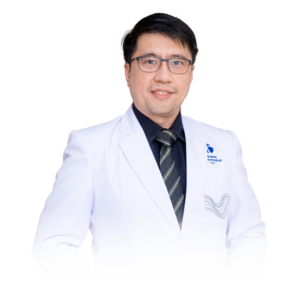
“So, one knee underwent total knee replacement, and the other underwent partial replacement. Both procedures were performed simultaneously, and the results were excellent. I am truly satisfied. The surgery was performed by dr. Paulus, who I believe is very expert in robotic surgery. I am satisfied, the results are great, and I am very grateful to dr. Paulus for all the treatment and the excellent communication,” said Mrs. Irmayanti several days after surgery.

Contents
Worsening Knee Pain That Began Interfering with Daily Activities
Initially, Mrs. Irmayanti’s condition was still classified as grade 3 osteoarthritis. However, it rapidly progressed to grade 4, a severe stage of joint degeneration that generally requires knee replacement surgery.
At the same time, her other knee suffered from a meniscus tear that caused even more intense pain. What initially felt manageable gradually became increasingly severe and began affecting her overall quality of life.
She started having difficulty climbing stairs and had to move one step at a time while relying heavily on her stronger leg. Without realizing it, constantly putting more weight on one side of the body can eventually affect posture and lead to lower back and spinal problems.
Even at night, the pain became more intense. Sleeping was uncomfortable because the pain felt like sharp cutting sensations. This condition made Mrs. Irmayanti realize that surgery could no longer be postponed.
The decision to undergo surgery was ultimately made not only because of the pain, but also because of her desire to remain active and independent while she was still physically fit. Support from her family also became a major motivation to proceed with the procedure sooner rather than later, before age and recovery challenges became more difficult.
Choosing Mandaya Royal Hospital Puri for Robotic Knee Surgery
Before deciding to undergo surgery, Mrs. Irmayanti and her family searched extensively for information about hospitals and knee surgery technology. From recommendations by relatives, stories from family members who had previous surgeries, as well as information she found on social media and educational health videos, the name Mandaya Royal Hospital Puri repeatedly appeared as one of the most recommended options.
She was particularly interested in the modern technology available at the hospital, including robotic-assisted knee surgery, which is considered capable of providing more precise results.
Additionally, positive experiences shared by relatives and family members who had undergone procedures at Mandaya Royal Hospital Puri further strengthened her confidence to travel from Bali to Jakarta in order to receive the best possible treatment.
The surgery was performed by dr. Paulus Ronald Hibono, Sp.OT (K), an orthopedic consultant hip & knee specialist experienced in robotic-assisted knee replacement surgery.
During the procedure, one knee underwent total knee replacement, while the other underwent partial knee replacement in a single simultaneous operation.
Able to Stand and Walk After Surgery
Fear before surgery is certainly understandable, especially at an advanced age. However, knowing that knee replacement surgery has a high success rate helped Mrs. Irmayanti feel calmer throughout the process.
After surgery, her condition showed good progress. She was already able to stand and walk using a walker and even participated in walking exercises with physiotherapists.
According to her, walking actually felt more comfortable compared to before surgery. Although there was still some soreness and pain when transitioning from sitting to standing, her recovery process has progressed well and has given her renewed hope of returning to daily activities more comfortably.
Mrs. Irmayanti’s experience serves as a reminder that severe knee pain is not something that simply has to be accepted as part of aging. When osteoarthritis and meniscus tears begin limiting mobility and reducing quality of life, appropriate treatment can help patients move more comfortably and confidently again.
When Should Knee Replacement Surgery Be Considered for Osteoarthritis?
Not all osteoarthritis patients need immediate knee replacement surgery. In the early to moderate stages, treatment usually begins with conservative therapies such as pain medications, physical therapy, lifestyle modifications, and knee gel injections to help reduce pain and improve joint movement.
However, over time, there are situations where joint damage becomes more severe and these therapies no longer provide optimal results. When pain begins interfering with daily activities and quality of life continues to decline, knee replacement surgery may become a treatment option worth considering.
Some signs or indications that someone may already require knee replacement surgery due to osteoarthritis include:
- Severe knee pain that limits daily activities such as walking, climbing stairs, or standing for long periods
- Moderate to severe knee pain even while resting, during both daytime and nighttime
- Persistent knee inflammation and swelling that do not improve despite rest or medication
- Changes in leg alignment, causing the legs to bend inward or outward due to joint damage
- Pain medications such as NSAIDs no longer effectively relieve pain or instead cause side effects that are difficult to tolerate
Many patients delay surgery because of fear or because they feel they can still tolerate the pain. In fact, when joint damage becomes increasingly severe, it may affect posture, walking ability, and the health of other joints and bones due to the body constantly relying on the stronger side.
Therefore, earlier consultation with an orthopedic specialist can help determine the right timing for surgery before the condition worsens and recovery becomes more difficult.
Robotic Knee Surgery with dr. Paulus at Mandaya Royal Hospital Puri
Knee replacement surgery continues to advance with the support of robotic technology that helps procedures become more precise. At Mandaya Royal Hospital Puri, knee replacement procedures are performed using the CORI robotic system, a modern technology designed to help surgeons carry out highly accurate joint replacement procedures tailored to each patient’s anatomy.
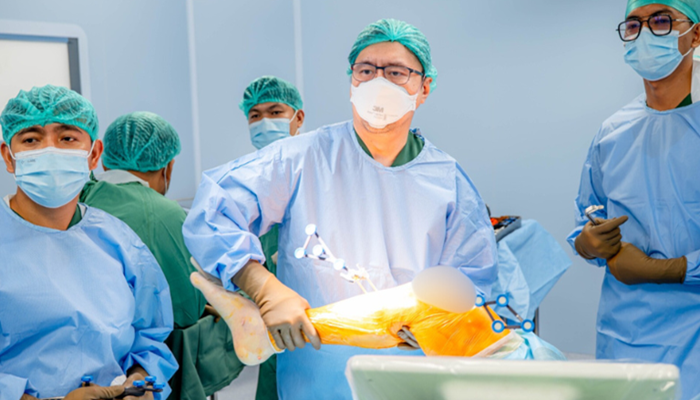
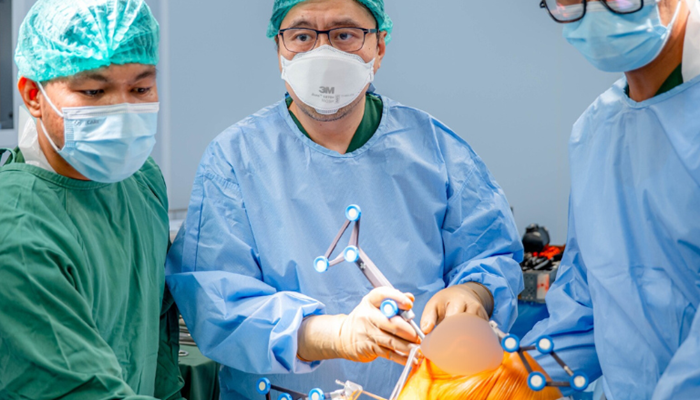
The CORI robotic system helps doctors map the patient’s knee condition in detail during surgery. With assistance from this system, the procedure can be performed more precisely, which is expected to provide more optimal outcomes for patients.
Some advantages of robotic-assisted knee surgery using CORI include:
- More precise surgical planning: The CORI system helps surgeons map the patient’s knee structure in real time, allowing procedures to be tailored to each patient’s condition.
- Helps preserve healthy tissue around the knee: Robotic technology enables more targeted procedures, helping maintain healthy tissue and bone.
- More accurate implant positioning: Proper implant placement is essential for comfort and knee function after surgery. CORI technology helps improve implant placement accuracy.
- Helps improve joint balance and movement: With more detailed adjustments during surgery, patients are expected to achieve more natural knee movement afterward.
- More comfortable recovery process: Because procedures are performed more precisely, some patients may experience smoother recovery and return to activities sooner.
- Built-in safety system to help minimize errors: The CORI robot is equipped with safety features where the burr tool can automatically stop if its movement does not match the planned surgical mapping. This feature helps surgeons keep the procedure within the intended surgical area, increasing safety during surgery.
One of the orthopedic surgeons performing robotic knee surgery at Mandaya Royal Hospital Puri is dr. Paulus Ronald Hibono, Sp.OT (K), an orthopedic consultant specializing in hip and knee conditions with extensive experience in treating various joint and bone disorders.
He completed his medical education at the Faculty of Medicine, Atma Jaya Catholic University Jakarta, followed by orthopedic and traumatology specialist training at Airlangga University. dr. Paulus also completed the Orthopedic and Traumatology Residency Training Program at Jose Reyes Memorial Medical Center in Manila, Philippines, and is a Consultant and Fellow of the Indonesian Hip and Knee Society.
In his daily practice, dr. Paulus treats various orthopedic conditions including osteoarthritis, knee cysts, total knee replacement, unicompartmental knee arthroplasty, arthroscopy procedures for meniscus tears, ACL surgery, and fracture surgery. Supported by modern robotic technology at Mandaya Royal Hospital Puri, patients can receive more precise and personalized knee treatments according to their individual conditions.
dr. Paulus Ronald Hibono, Sp.OT (K) is available at Mandaya Royal Hospital Puri on:
- Monday: 08:00 AM – 01:00 PM WIB
- Tuesday: 05:00 PM – 08:00 PM WIB
- Wednesday: 02:00 PM – 05:00 PM WIB
- Thursday: 02:00 PM – 05:00 PM WIB
- Friday: 02:00 PM – 08:00 PM WIB
- Saturday: 08:00 AM – 02:00 PM WIB
To make your visit easier, you can use the WhatsApp Chat feature, Book Appointment service, or the Care Dokter application available on Google Play and the App Store to manage appointments, view queue numbers, and access additional information.
The information available on this page is intended for educational and general informational purposes only and may not reflect the full scope of medical services provided by each doctor. To ensure appropriate treatment according to your condition, direct consultation with the relevant doctor is recommended.
If you have questions, suggestions, or require further information, please contact the call center at 0811-1900-2000.