


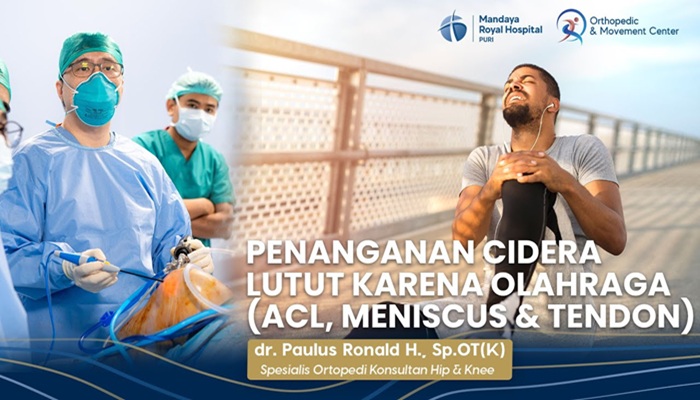
Knee injuries are among the most common issues encountered during sports activities, affecting both professional athletes and physically active individuals. These injuries can result from improper movements, direct impact, or excessive strain on the joint, and if not treated properly, they may lead to more severe damage. Therefore, understanding proper management and first aid is essential from the very beginning.
dr. Paulus Ronald Hibono, Sp.OT (K) Hip & Knee, an orthopedic consultant specializing in hip and knee at RS Mandaya Royal Puri, explains how to recognize sports-related knee injuries and the initial steps that can help prevent the condition from worsening.

Contents
Common Causes of Knee Injuries During Sports
According to dr. Paulus, knee injuries most commonly occur during sports such as football or basketball, particularly when there is a sudden twisting motion, collision, or direct tackle to the knee. These situations can lead to damage in various important structures within the knee.
He explains that the knee has several key ligaments that maintain joint stability, including the MCL (Medial Collateral Ligament) on the inner side, LCL (Lateral Collateral Ligament) on the outer side, as well as the ACL (Anterior Cruciate Ligament) and PCL (Posterior Cruciate Ligament) located in the center of the knee. In addition, the patellar tendon and quadriceps tendon at the front of the knee play a crucial role in leg movement.
According to dr. Paulus, injuries may affect a single ligament, but it is also common for multiple structures to be involved, depending on the mechanism of injury.
First Aid for Knee Injuries on the Field
According to dr. Paulus, proper initial treatment on the field is crucial to prevent the injury from worsening. He emphasizes avoiding excessive manipulation of the injured knee. Massaging or forcing the knee to move despite pain can actually increase inflammation and worsen tissue damage.
The initial steps recommended by dr. Paulus include:
- Resting the knee and stopping all activities
- Using support or braces to protect the knee
- Applying ice compresses to reduce swelling and pain
- Avoiding excessive pressure or weight on the knee
According to dr. Paulus, these steps are intended to relieve initial symptoms but are not sufficient to determine the exact type of injury.
The Importance of Further Examination for Diagnosis
Furthermore, dr. Paulus explains that additional examinations are necessary to accurately identify the injured structures. X-rays generally only show bone conditions, such as whether a fracture is present.
However, many important structures in the knee—such as ligaments, meniscus, and other soft tissues—cannot be visualized through X-rays. Therefore, further imaging such as MRI (Magnetic Resonance Imaging) is required to provide a more detailed view of the soft tissues within the knee.
With MRI, doctors can determine the exact location and severity of the injury, allowing for more precise and effective treatment.
Advances in Knee Injury Treatment: From Open Surgery to Arthroscopy
In the past, knee injuries were commonly treated with open surgery, where the doctor had to make a large incision to directly view and repair the damaged tissues.
However, with advancements in medical technology, arthroscopy has now become the standard approach for modern knee injury treatment.
Arthroscopy is a minimally invasive surgical procedure that uses a small camera inserted into the knee joint through tiny incisions. This camera allows doctors to clearly visualize the inside of the knee on a monitor and perform precise repairs.
The advantages of arthroscopy compared to open surgery include:
- Smaller incisions
- Lower risk of complications
- Less postoperative pain
- Faster recovery time
With this method, according to dr. Paulus, patients can return to their activities more quickly and achieve better treatment outcomes.
Profile of dr. Paulus and Practice Schedule

dr. Paulus Ronald Hibono, Sp.OT (K) Hip & Knee, is an orthopedic specialist with a subspecialty in hip and knee, known for his extensive experience in performing knee replacement surgery using the CORI Robotic System.
In addition to his expertise, dr. Paulus was selected as the only delegate from Indonesia to participate in the CORI Robotic Summit, an international forum discussing the latest advancements in robotic orthopedic surgery.
In his practice, dr. Paulus manages various orthopedic conditions, including:
- Anterior Cruciate Ligament injury (ACL injury)
- Knee cysts
- Osteoarthritis
- Meniscus tears treated with Arthroscopy
- Fractures
To make your visit more convenient, you can use the WhatsApp Chat feature, Book Appointment service, or the Care Dokter app (available on Google Play and the App Store) to manage appointments, check queue numbers, and access additional information.
The information provided on this page is intended for educational purposes and general reference only, and may not represent all medical services offered by each doctor. For appropriate treatment based on your condition, it is recommended to consult directly with the doctor.
If you have any questions, suggestions, or need further information, please contact our call center at 0811-1900-2000.