



Persistent shoulder pain that does not improve—especially when lifting the arm overhead—is often mistaken for ordinary muscle soreness. In fact, this complaint may be caused by shoulder impingement syndrome, a condition in which shoulder muscles or tendons become pinched between bones, leading to pain, limited range of motion, and disruption of daily activities. This condition is commonly experienced by individuals of productive age who are active in sports involving overhead movements, such as badminton, padel, or other activities that require repeated arm lifting over a long period of time.
To properly treat shoulder impingement syndrome, Dr. Troydimas Panjaitan, Sp.OT (K), an orthopedic specialist and shoulder and elbow consultant at Mandaya Royal Puri Hospital, performs shoulder arthroscopy. This minimally invasive procedure uses a specialized arthroscope inserted through several small incisions to identify the source of impingement, followed by smoothing the bone surface so it no longer presses on the muscles or tendons. With this approach, shoulder pain can be treated more precisely and safely, helping patients return to daily activities more comfortably.

Contents
Understanding Shoulder Arthroscopy for Treating Shoulder Impingement Syndrome
Shoulder impingement syndrome is a condition in which the bones in the shoulder rub against or pinch the rotator cuff—a group of muscles and tendons that play an important role in shoulder movement. This condition occurs when swelling develops in the shoulder area, causing the rotator cuff to enlarge and lose its ability to move freely between the shoulder bones.
There are several types of shoulder impingement, one of which is rotator cuff tendinitis, an inflammation of the rotator cuff tendons that often causes pain, especially when lifting the arm or performing overhead movements.
Shoulder arthroscopy is a minimally invasive surgical procedure used to diagnose and treat various shoulder problems. This procedure can be performed for conditions such as rotator cuff tears and shoulder impingement. Compared to open surgery, shoulder arthroscopy requires only very small incisions—each about the size of a keyhole—thereby minimizing tissue trauma.
Shoulder arthroscopy helps doctors identify the source of shoulder pain and address it directly, particularly in cases that do not improve with non-surgical treatment. Non-operative management usually attempted beforehand includes physiotherapy, medication, injections, and rest.
What Are the Advantages of Shoulder Arthroscopy for Treating Shoulder Pain?
The advantages of shoulder arthroscopy include:
- Can be an alternative to open surgery, depending on the patient’s condition and needs.
- Uses smaller incisions compared to open surgery, resulting in minimal tissue trauma.
- Lower risk of infection.
- Shorter recovery time.
- Postoperative pain and joint stiffness are generally milder compared to conventional shoulder surgery.
Profile of Dr. Troy, Orthopedic Specialist Expert in Treating Shoulder Disorders
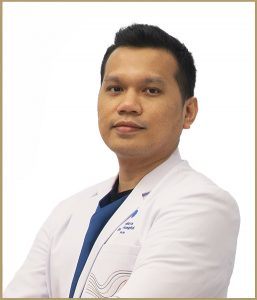
Dr. Troydimas Panjaitan, Sp.OT (K), is an orthopedic specialist and shoulder consultant with extensive experience in managing various shoulder complaints and disorders. Cases commonly handled include sports-related shoulder injuries, shoulder joint degeneration, stiff and painful shoulder (frozen shoulder), shoulder dislocation, shoulder muscle injuries, and shoulder fractures.
After completing his consultant training at the Sports Medicine & Joint Center, Funabashi Orthopaedic Hospital, Chiba, Japan, Dr. Troy has developed strong expertise in treating shoulder and elbow conditions using modern techniques such as arthroscopy (minimally invasive surgery with incisions under 1 cm) and arthroplasty or joint replacement procedures.
Dr. Troy provides a comprehensive (one-stop service) approach, starting from thorough diagnosis and patient education, medical therapy, surgical intervention when needed, and physiotherapy programs to support optimal recovery.
Treatment is tailored to the severity of each patient’s condition. In the early stages, a shoulder specialist typically recommends conservative therapy such as pain medication and physiotherapy. However, if symptoms do not improve, further procedures such as arthroscopy, arthroplasty, rotator cuff repair, or shoulder reconstruction may be considered.
Conditions Commonly Treated by an Orthopedic Shoulder Consultant Include:
- Shoulder fractures
- Shoulder joint injuries
- Shoulder joint degeneration
- Bursitis
- Tendinitis
- Frozen shoulder
- Rotator cuff tears
- Shoulder dislocation
- Shoulder impingement syndrome
- Sports-related shoulder injuries
- Sternoclavicular joint injuries
- Tennis elbow
Patients Usually Consult a Shoulder Specialist When Experiencing Symptoms Such As:
- Shoulder pain
- Shoulder pain during movement that radiates to the elbow
- Weakness in the shoulder muscles
- Numbness or tingling sensations
- Clicking or cracking sounds when moving the shoulder
- Shoulder instability
- Difficulty sleeping due to shoulder pain in various positions
With proper treatment and the support of advanced medical technology, shoulder conditions can be managed optimally, allowing patients to return to daily activities comfortably.
Dr. Troy’s Practice Schedule at Mandaya Royal Puri Hospital
Dr. Troydimas Panjaitan, Sp.OT (K), is available at Mandaya Royal Puri Hospital on:
- Tuesday: 5:00 PM – 8:00 PM WIB
- Friday: 5:00 PM – 8:00 PM WIB
To make your visit easier, use the WhatsApp Chat feature, Book Appointment, or the Care Dokter application available on Google Play and the App Store to schedule visits, view queue numbers, and access complete information.