


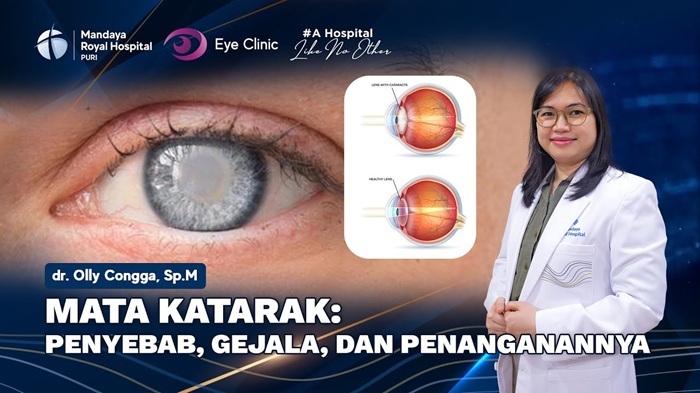
Cataracts are one of the most common vision problems experienced as people age. This condition occurs when the eye’s lens, which is normally clear, becomes cloudy due to the natural aging process. As a result, vision becomes blurred, similar to looking through a dirty window, making daily activities increasingly difficult.
Today, cataract treatment has undergone significant advancements. Mandaya Royal Hospital Puri provides minimally invasive cataract surgery, also known as small-incision cataract surgery, allowing patients to achieve optimal visual outcomes through a fast, safe, and comfortable procedure.

Contents
What Is Cataract and Why Does It Require Surgery?
Cataracts develop due to changes in the protein structure of the eye’s lens, causing it to become cloudy. Common symptoms of cataracts include:
- Blurred or cloudy vision
- Frequent changes of eyeglasses without significant improvement in vision
- Glare or hazy vision, as if looking through fog
- Difficulty seeing clearly, especially in bright light or at night
To date, the only effective treatment for cataracts is surgery, which involves replacing the clouded natural lens with an artificial intraocular lens. Once the cataract is removed, vision can become clear again, and the cataract will not recur.
Innovation in Cataract Surgery with a Minimally Invasive Approach
Along with advancements in medical technology, cataract surgery has become far more sophisticated compared to conventional methods in the past. At Mandaya Royal Hospital Puri, cataract surgery is performed using minimally invasive techniques, providing multiple benefits for patients.
Advantages of Minimally Invasive Cataract Surgery at Mandaya Royal Hospital Puri:
- Short procedure time, approximately ±15 minutes
- Very small incision, less than 3 millimeters
- No stitches required, allowing faster wound healing
- No hospitalization needed, patients can go home on the same day
- Minimal pain, making the procedure more comfortable
- Fast recovery, enabling patients to resume daily activities quickly
- Improved visual outcomes after cataract removal
With this approach, cataract surgery becomes a safe, efficient, and less intimidating procedure.
The Importance of Early Cataract Screening
Cataracts cannot be completely prevented, as they are part of the natural aging process. However, regular eye screening is strongly recommended to detect cataracts at an early stage.
Cataract screening is recommended to:
- Start from the age of 40 years
- Be performed annually
- Detect whether cataracts have begun to develop
- Assess the severity of cataracts
- Determine the appropriate timing for surgery
In addition to eye examinations, doctors will also evaluate the patient’s general health, especially if there are underlying conditions such as diabetes, hypertension, or heart disease. Once the overall health condition is stable, cataract surgery can be performed safely.
A Safe and Well-Planned Cataract Surgery Process
Before surgery, patients receive thorough education regarding their cataract condition and the surgical procedure. During the operation, the cloudy lens is removed and replaced with an artificial lens to restore clear vision.
Supported by modern technology and an experienced medical team, the procedure is carried out safely and smoothly, delivering satisfying results. Many patients experience a significant improvement in their quality of vision after undergoing cataract surgery.
When Should You See an Eye Doctor?
You are advised to consult an eye specialist if you experience the following conditions:
- Vision becoming increasingly blurry over time
- Eyeglasses no longer improving vision
- A history of diabetes, hypertension, or glaucoma
- Glare or visual discomfort
If left untreated, cataracts may lead to complications such as increased intraocular pressure or inflammation, which can pose a risk to long-term eye health.
Profile and Practice Schedule of dr. Olly Congga, Sp.M

dr. Olly Congga, Sp.M is an ophthalmologist who completed both her General Medical Education and Ophthalmology Specialist training at Hasanuddin University. To stay up to date with advancements in eye care, she actively participates in various international trainings, courses, and seminars, including the 32nd Annual Meeting of the Asia-Pacific Association of Cataract and Refractive Surgery (APACRS) in Kyoto (October 2019) and the 34th Asia-Pacific Academy of Ophthalmology (APAO) Congress in Bangkok (March 2019).
In her clinical practice, dr. Olly is experienced in a wide range of ophthalmology procedures, including cataract surgery, LASIK, intraocular lens implantation, eye biometric examinations, and pterygium surgery. This expertise enables comprehensive and personalized eye care tailored to each patient’s needs.
Practice schedule at Mandaya Royal Hospital Puri:
- Monday: 16.00 – 18.00 WIB
- Wednesday: 08.00 – 09.30 WIB
- Thursday: 08.00 – 10.00 WIB
- Saturday: 13.00 – 15.00 WIB
Modern and Comfortable Cataract Treatment at Mandaya Royal Hospital Puri
With advanced technology and a minimally invasive surgical approach, Mandaya Royal Hospital Puri offers a cataract treatment solution that is safe, fast, and comfortable. The short procedure time without the need for hospitalization allows patients to regain better vision without disrupting their daily routines.
If you or your family members are experiencing vision problems due to cataracts, schedule an eye examination early to receive appropriate and timely treatment.
To make your visit easier, you can use the WhatsApp Chat feature, Book Appointment, or the Care Dokter application, available for download on Google Play and the App Store, to check queue numbers and access complete information.
Source: dr. Olly Congga, Sp.M